


Backlinks are still one of Google’s clearest trust signals. The #1 result on Google carries 3.8 times more backlinks than pages sitting in positions two through ten, according to a Backlinko study of 11.8 million search results. Yet most sites never see this benefit — 94% of all published content earns zero external backlinks at all, based on Ahrefs’ analysis of 14 billion pages.
That gap is exactly why a proper link building checklist matters. This guide walks through 20 practical, field-tested tips that cover everything from vetting a site before you pitch it, to negotiating terms, to protecting the links you’ve already earned. Whether you’re just starting out or tightening an existing process, this checklist gives you a clear, repeatable path to build powerful backlinks the right way.
What Is a Link Building Checklist (And Why US Websites Need One)
A link building checklist is simply a structured set of steps you follow every time you try to earn a backlink — so quality control never slips, no matter how many links you’re building at once.
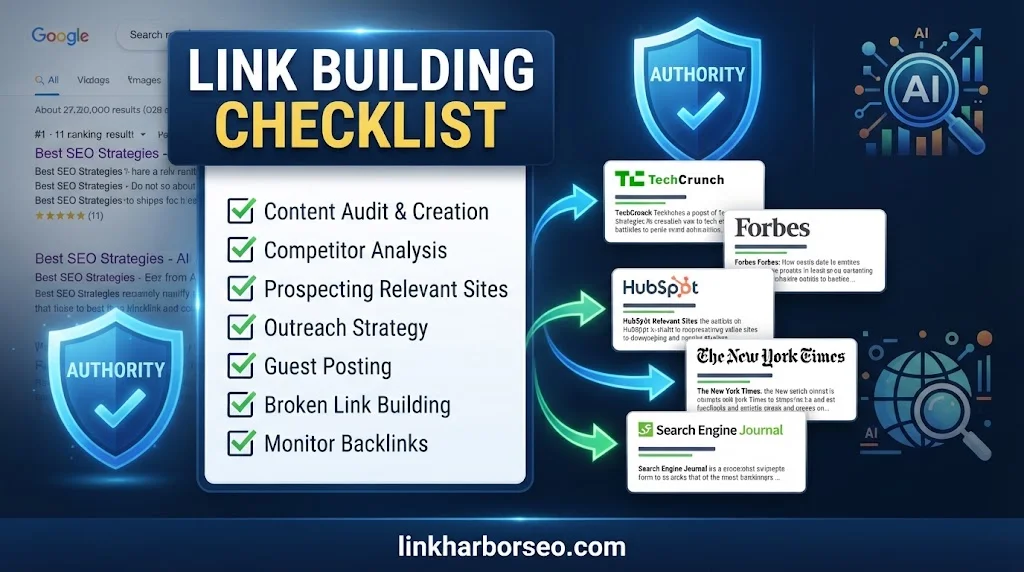
Without one, most teams either chase easy links that carry no real value, or waste hours on sites that were never going to rank well in the first place. A checklist keeps your link building strategy consistent and measurable.
It also matters more today because of how Google actually treats links. The 2024 API leak confirmed what many SEOs suspected — Google tracks link velocity, spam signals, and link diversity as distinct ranking inputs, not just raw link counts. First Page Sage’s ongoing algorithm-weight tracking now puts backlinks at roughly 13% of total ranking weight — smaller than a decade ago, but still one of the largest single factors search engines measure.
There’s a newer wrinkle too: AI Overviews and other generative answers don’t always reward the same signals as classic rankings. Ahrefs’ analysis of 75,000 brands found that branded web mentions correlate with AI Overview visibility at 0.664, roughly three times stronger than backlinks alone (0.218–0.295). In plain terms — links still build the authority that gets you into the top 10, and most AI citations still come from pages that already rank there (76.1%, per Ahrefs), but brand visibility now carries extra weight on top of that.
Pre-Campaign Checklist: Audit, Goals, and Budget Before You Build Links
Before you send a single outreach email, you need a clear picture of where your site stands today. Skipping this step is the fastest way to waste a link building budget on the wrong pages.

Start by pulling your existing backlink profile in a tool like Ahrefs or Semrush. Look at your total referring domains, your anchor text ratio, and how fast new links are arriving (your link velocity). This tells you what’s working and where the gaps sit.
Next, run a link gap analysis — compare your backlink profile against two or three direct competitors to find domains that link to them but not to you. These are usually your easiest wins, since a site that already links out to a competitor is proving it’s open to linking in your niche.
Set goals tied to business outcomes, not vanity numbers. “Increase organic traffic to our pricing page by 15%” is far more useful than “build 50 links.” Once the goal is clear, budget backward from it. Pricing for quality placements generally runs from $150–$200 for a DR20–DR34 site, up to $330–$500+ for DR50 and above — cheaper links almost always come from low-quality or risky sources.
Finally, lock in your foundational links — Google Business Profile, LinkedIn, Crunchbase, and relevant industry directories. These low-risk citations establish your business as a real, verifiable entity before you start chasing editorial backlinks.
The Core Link Building Checklist: 20 Expert Tips to Build Powerful Backlinks
This is the heart of the link building checklist — the actual criteria and tactics to apply to every prospect before you pitch, and every link type worth pursuing.
Site vetting tips (before you ever reach out):
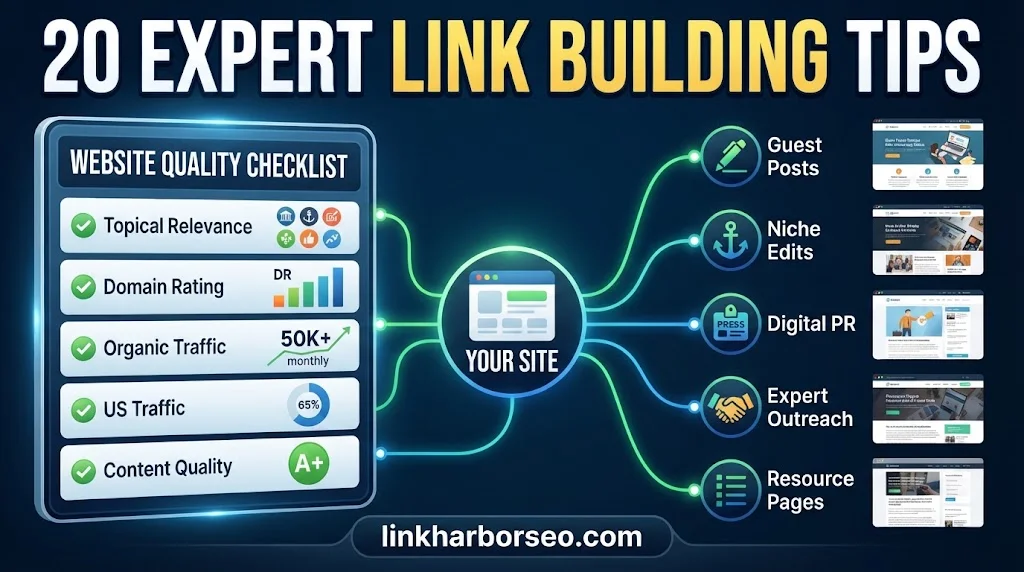
- Check topical relevance — a link only carries real weight if the linking site covers a related subject. A finance blog linking to a food site sends a mismatched, low-value signal.
- Verify Domain Rating or Domain Authority — but never in isolation. Combine it with spam score and referring domain count for a fuller picture of site health.
- Confirm organic traffic is real and growing — a healthy traffic trend, not a spike-and-crash pattern, shows Google already trusts the site.
- Check where that traffic comes from — a “.com” site aimed at US readers should show most of its visitors coming from the US, not overseas.
- Read the actual content — well-written, original articles are a strong sign of a legitimate publication rather than a link farm or PBN (private blog network).
Acquisition tactics worth prioritizing:
- Guest posts remain a scalable way to build relevant authority — you control the anchor text, the content, and exactly where the link points.
- Niche edits (also called link insertions) add your link into an already-ranking page, so it passes authority immediately instead of waiting for a new post to gain traction.
- Digital PR earns coverage from news outlets and industry publications — Google treats these editorial links as some of the hardest to replicate and most trustworthy in existence.
- HARO-style expert outreach (now largely run through Connectively) trades your industry expertise for a mention and link — no payment required, just a useful quote.
- Resource page links are fast to find — search your niche plus “resources” or “useful links” and pitch pages that already exist purely to link out.
Technical and on-page checks:
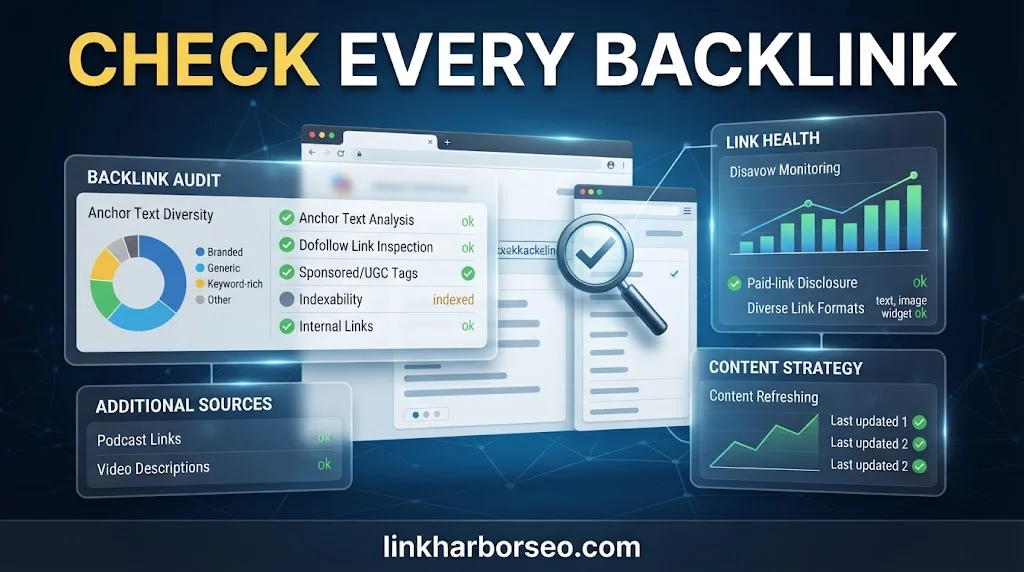
- Balance your anchor text ratio — lean on branded and partial-match anchors, and use exact-match sparingly to avoid tripping spam filters.
- Confirm the link is dofollow — right-click the link, choose “Inspect,” and check for a missing rel attribute.
- Check for “sponsored” or “UGC” tags — either one tells Google the link was paid for or user-generated, which strips most of its SEO value.
- Verify the page is indexable — a noindex tag or a robots.txt block means your link never gets counted at all.
- Look for internal links on the target page — a page with healthy internal linking passes authority more efficiently through the rest of the site.
Must Read: How Targeted Link Building Can Explode Your Domain Authority Fast
Modern tactics competitors often skip:
- Treat podcast guesting and video descriptions as link sources — show notes and YouTube descriptions carry real, often-overlooked backlinks.
- Keep your disavow file current — review it twice a year so old, toxic links don’t quietly drag your profile down.
- Disclose paid placements properly — FTC guidance requires clear disclosure on sponsored content; skipping this risks both legal and reputational damage.
- Diversify your link formats — mix guest posts, images, PDFs, and video embeds, since Semrush’s 2025 study found image links outperform text links at higher authority tiers.
- Refresh your best-performing content regularly — updated statistics and expanded sections give past linkers a reason to link again, and new visitors a reason to cite you.
Must Read: 15 Expert Citation Link Building Tips to Dominate Local Search Rankings
Outreach and Negotiation Checklist: Turning Prospects Into Live Links
Finding a great prospect means nothing if the outreach email never gets a reply — or worse, never reaches the inbox at all.
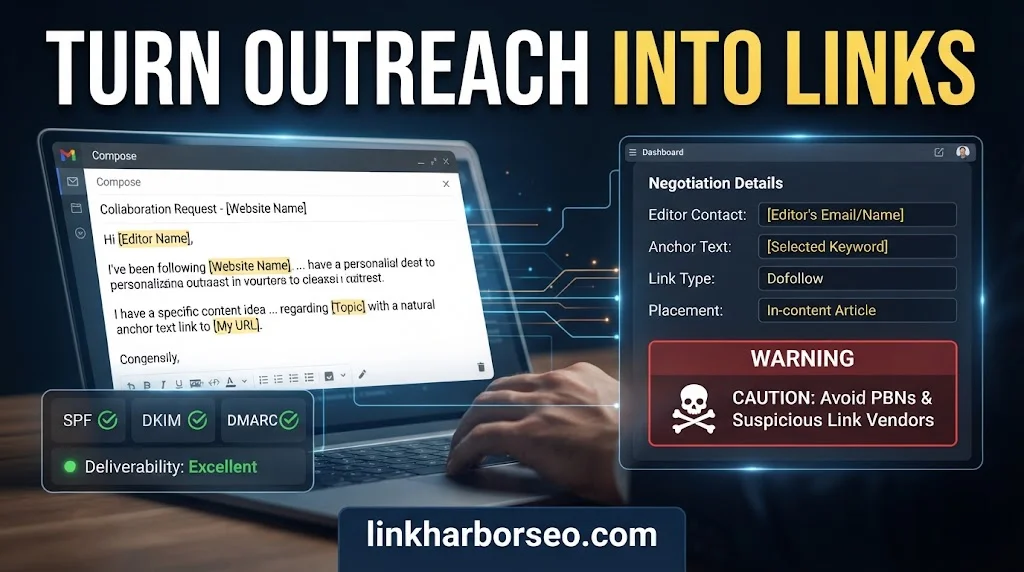
Start with deliverability. Set up SPF, DKIM, and DMARC records on your sending domain, then warm up any new inbox gradually — roughly 5–10 emails a day in week one, scaling to 40–50+ by week four. Skipping this step is the single biggest reason cold outreach lands in spam.
Keep templates short, specific, and personal. Reference something real about the site — a recent article, a shared audience, a specific gap you can fill — rather than a generic compliment. Personalized outreach consistently converts better than mass-blasted templates.
Identify the right contact before you pitch — usually an editor, content manager, or site owner — and don’t be afraid to follow up on LinkedIn or X if email goes unanswered.
When you get a reply, negotiate the details clearly: anchor text, dofollow status, placement location, and how long the link stays live. Also watch for red flags of bad-faith vendors — sites that guarantee rankings, refuse to show sample placements, or push suspiciously cheap bulk-link packages. These almost always trace back to PBNs or link farms that put your site at risk.
Post-Placement Monitoring Checklist: Protecting the Links You’ve Built
Backlinks decay. Pages get deleted, sites get redesigned, and links quietly disappear — one industry report found 66.5% of links published over the past nine years are already dead. Monitoring isn’t optional if you want to protect your investment.
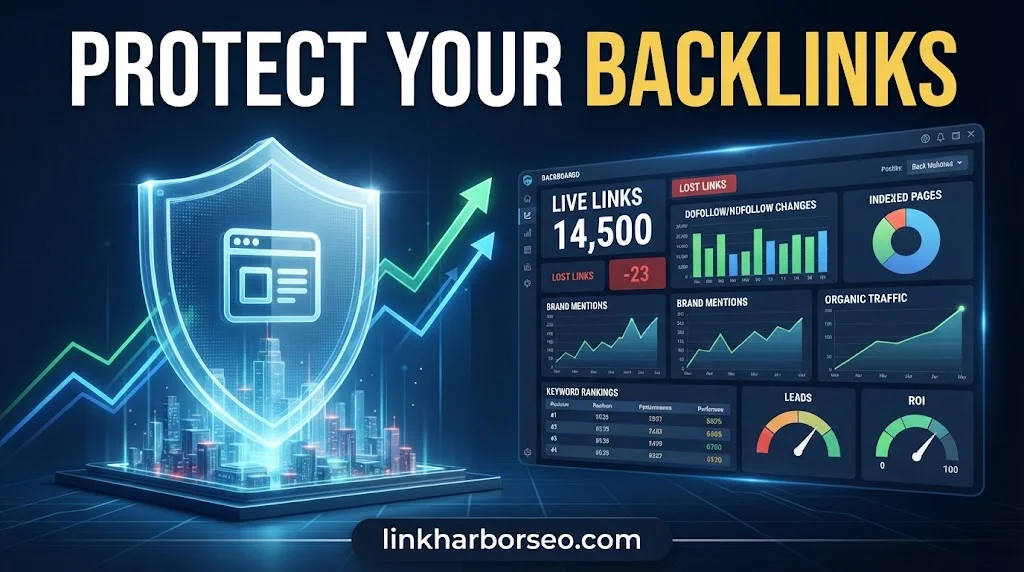
Check your backlink profile weekly using Ahrefs or Semrush alerts. Watch for links that switch from dofollow to nofollow, anchor text that gets edited, or pages that drop out of Google’s index entirely.
Set up Google Alerts for your brand name and key product terms so you catch new, unlinked mentions as soon as they appear — these convert into easy links since the writer already chose to mention you.
If a paid or earned link disappears, don’t just let it go. Reach out to the site owner, ask what happened, and request reinstatement if it was removed in error. Ahrefs’ 2024 disavow study found that removing links caused a 13.3%–18% drop in organic traffic on test pages — and restoring them recovered 99–144% of that traffic. That’s a clear signal of how much a single lost link can cost you.
Finally, tie everything back to ROI. Track organic traffic, keyword rankings, and — most importantly — whether the pages you’ve built links to are actually converting into leads or revenue.
FAQs
Is link building part of SEO?
Yes. Link building is one of the three core pillars of SEO, alongside on-page optimization and technical SEO. It focuses specifically on earning backlinks from other websites to build your site’s authority and trust in Google’s eyes.
What is a SEO checklist?
An SEO checklist is a structured list of tasks — covering technical setup, on-page content, and off-page factors like backlinks — that ensures nothing gets missed during an optimization or link building campaign.
How does link building work?
Link building works by earning or placing links from other websites that point back to yours. Search engines treat each quality link as a vote of trust, and pages with more relevant, authoritative backlinks tend to rank higher over time.
What are the best link building tools?
Ahrefs and Semrush are the industry standards for backlink analysis and competitor research. Pitchbox and BuzzStream help manage outreach at scale, while Google Search Console and Google Alerts are free tools worth using for monitoring and finding unlinked mentions.
Conclusion
Building powerful backlinks isn’t about chasing volume — it’s about following a consistent process every single time. Use this link building checklist to vet sites properly, execute the right mix of tactics, negotiate fair terms, and monitor what you’ve built. Do that consistently, and your backlink profile will keep compounding in value long after each individual link goes live.

3 comments on “Link Building Checklist: 20 Expert Tips to Build Powerful Backlinks”