


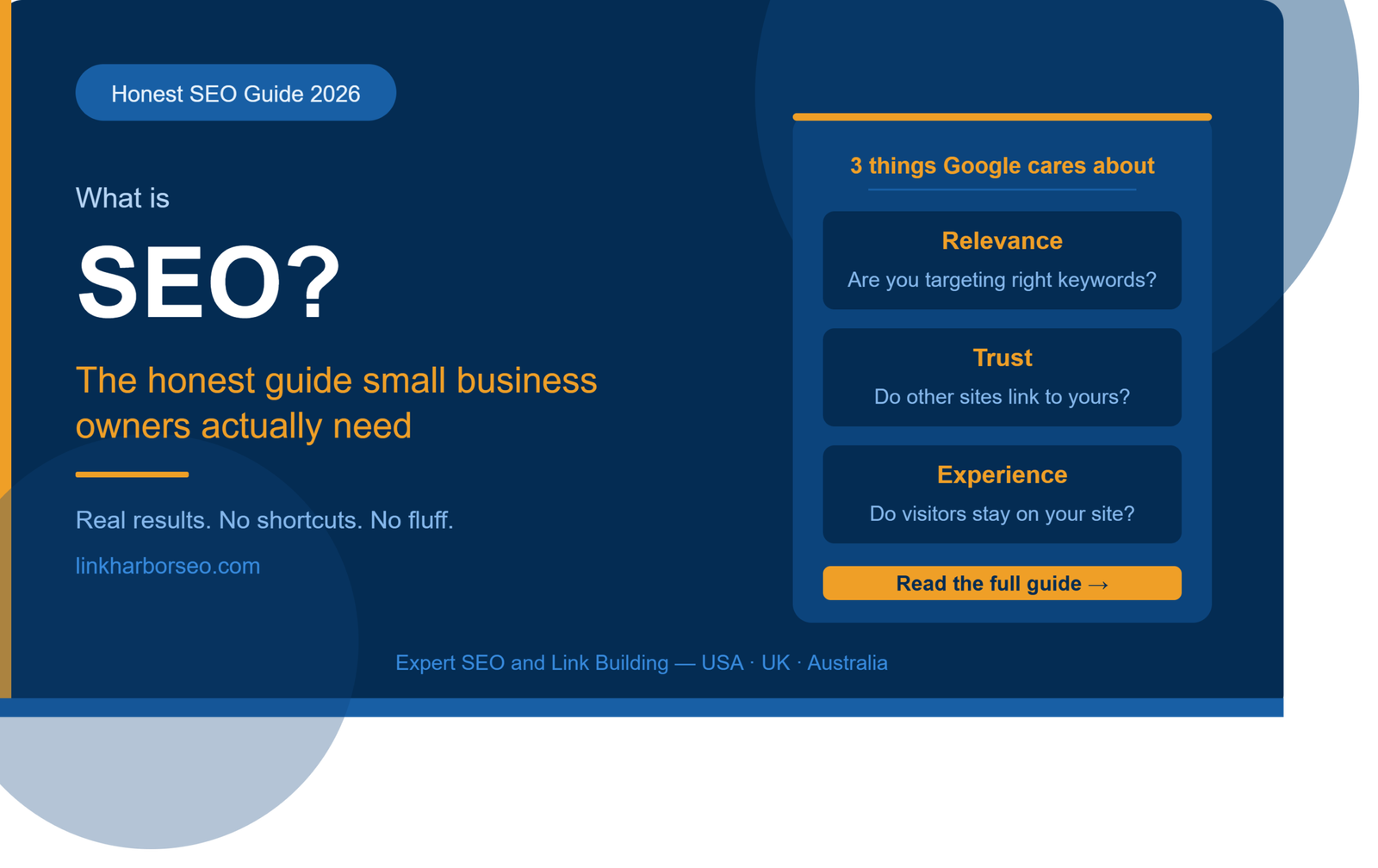
Let me be honest with you from the start. I have read dozens of SEO guides online about seo for small business. Most of them open with something like this — “SEO stands for Search Engine Optimization and it is the process of improving your website’s visibility in search engine results pages.”
Technically correct. Completely useless.
If you are a small business owner trying to figure out why your website is invisible on Google, that definition helps you exactly zero. You do not need a textbook. You need someone to sit down with you and say — here is what is actually happening, here is why it matters, and here is exactly where you should start today.
Let me show you what I mean before we go any further.
A client of mine runs a small accounting firm in Sydney. When we started working together, his website was getting around 40 visitors a month — mostly people who already knew his name and typed it directly into Google. Not a single new customer had ever found him through search in three years of being online.
Four months later, after doing the basics properly, his website was pulling in over 800 visitors a month from people who had never heard of him before. In month five, he signed two new clients who found him entirely through Google. Those two clients alone were worth more than his entire SEO investment for the year.
He did not do anything magical. He just understood what Google actually needed from him — and then did it consistently.
That is what this guide is about.
I have worked with small business owners across the USA, UK, and Australia. A plumber in Melbourne who had been running his business for eleven years but had never gotten a single enquiry from Google. A law firm in Manchester spending thousands on leaflets every month because their website sat on page seven. A dental clinic in Texas with a beautifully designed website that got zero organic traffic.
Every single one of them asked me the same question.
“I have a website. Why is nobody finding me?”
By the end of this guide, you will know exactly why — and more importantly, you will know what to do about it.
What is SEO — For Real This Time
SEO — Search Engine Optimization — is the work you do to help your website appear when people search for what you offer on Google. It involves making your website easy for Google to understand, targeting the right keywords, and earning trust signals that tell Google your site deserves to rank.
Forget the technical definition for now. Here is what SEO actually means in real life.
When someone in your city types “emergency plumber near me” or “best dental clinic in Texas” into Google, Google goes through hundreds of millions of websites in about half a second and decides which ones deserve to show up on page one.
SEO is the work you do to convince Google that your website deserves one of those spots.
That is it. That is the whole thing.
Now here is the part most guides completely skip. Google is not looking at your website alone. It is comparing your website against every other website on the same topic at the same time. So when you do SEO, you are not just improving your site — you are competing against every other business in your niche who also wants to be on page one.
This is why SEO takes time. You are not flipping a switch. You are building a case, week by week, month by month, that your website deserves to rank above your competitors.
The Melbourne plumber I mentioned — when we first audited his website, Google could not even properly read half his pages. The dental clinic in Texas had a gorgeous website but every page title said “Home” and “Services” — Google had no idea what they actually did. The Manchester law firm had great content but zero other websites linking to them, so Google had no reason to trust them.
Three completely different problems. Three completely different fixes. But the same starting point — understanding what Google actually needs from you.
Does SEO Actually Work for Small Businesses?
Yes — SEO works for small businesses, but only when done consistently and with realistic expectations. Businesses that do the basics properly — proper indexing, right keywords, quality content, and steady backlink building — typically see meaningful results within three to six months.
This is the question I get asked most often — and I completely understand the skepticism.
SEO has a reputation problem. Too many agencies have promised page one in 30 days and delivered nothing. Too many business owners have spent real money on SEO and seen zero results. The distrust is completely fair.
So let me show you what actually happens instead of just telling you it works.
The Sydney accounting firm I mentioned at the start — 40 visitors a month when we began, over 800 a month by month six, two new clients signed in month five who found him entirely through Google. Those two clients were worth more than his full year of SEO investment.
But that was not a one-off. The Melbourne plumber went from zero Google enquiries in eleven years to booking three new jobs a week through organic search within seven months. The dental clinic in Texas went from invisible to ranking on page one for six of their target keywords within five months — and their new patient bookings doubled in that period. The Manchester law firm tripled their organic traffic within four months once we started targeting what their customers actually searched for instead of what the firm called their own services.
These were not big budgets. These were not complicated strategies. They were businesses that finally understood what Google needed from them and then did the work consistently.
That is what SEO does for a small business. It puts you in front of people who are already searching for exactly what you offer — at the exact moment they are ready to make a decision.
The Three Things Google Actually Cares About
Most SEO articles give you a list of 50 ranking factors. That is overwhelming and not useful when you are just starting out.
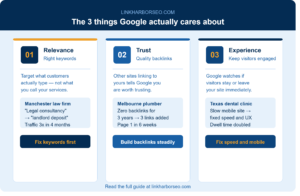
In my experience working with real businesses, Google really focuses on three things. Everything else sits underneath these.
The first thing is relevance.
Google wants to show the most relevant result for every single search. If someone searches for “emergency plumber London” and your website is about plumbing equipment, you are not relevant — even if your website is technically perfect in every other way.
This is exactly why keyword research is the starting point of all SEO work. You need to understand the exact words and phrases your customers type into Google — not the words you use to describe your own business internally, but the words your customers actually use when they have a problem and need help.
The Manchester law firm thought they should rank for “legal consultancy services.” Their actual customers were typing “what to do if my landlord won’t return my deposit” and “employment rights for contractors UK.” Two completely different worlds. Once we built content around those actual searches, their organic traffic tripled within four months.
The second thing is trust.
Google does not automatically trust new websites. Trust is built over time through two things — the quality and usefulness of your content, and the number of other trusted websites that link back to yours.
Think of backlinks like professional references. If ten respected people in your industry vouch for you, a new client is far more likely to trust you than if you simply said “trust me” yourself. Google works the same way.
The Melbourne plumber had been online for three years with zero backlinks. Not a single other website mentioned him. From Google’s perspective, he was a stranger with no references and no reputation. The moment we started building even a small number of quality backlinks from relevant trade websites, Google’s trust in his site started to shift — and his rankings followed.
The third thing is experience.
Google pays close attention to what people do after they visit your website. If someone clicks your link from Google and immediately goes back to search for something else, Google reads that as a signal that your website did not give them what they needed.
But if people stay on your website, read your content, click through to other pages, and spend real time there — Google sees that as a strong positive signal.
The dental clinic in Texas had a beautiful website that loaded slowly and was nearly impossible to navigate on a mobile phone. Over 60 percent of their visitors were coming from mobile devices and leaving within seconds. Google noticed. Once we fixed the speed and the mobile experience, their average time on site doubled — and their rankings started climbing within weeks.
This is why a simple, fast, easy-to-use website with genuinely helpful content will always outrank a technically sophisticated website with nothing useful on it.
What SEO Looks Like in Practice — Month by Month
This is the section most guides leave out entirely. Not the theory — the actual reality of what doing SEO looks like week to week.
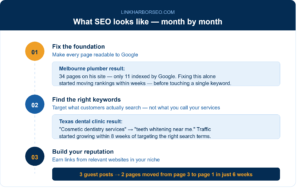
Month One — Make Your Website Readable to Google
Before anything else, your website needs to be in a state where Google can actually find, crawl, and understand it.
Here is a specific thing you can do today. Open Google and type this exactly — site:yourwebsite.com — replacing that with your actual domain. If your pages appear in the results, Google knows you exist. If nothing appears at all, your website is essentially invisible and fixing this is your only job right now.
Next, set up Google Search Console if you have not already. It is completely free. It tells you which of your pages Google has found, which keywords you are already showing up for even if you did not know it, and what technical errors Google is finding on your site.
The plumber in Melbourne had 34 pages on his website. When we ran this check, only 11 of them were indexed by Google. Nearly two thirds of his website simply did not exist as far as Google was concerned. Fixing that alone — before we touched a single keyword — started moving his rankings within weeks.
Month Two — Find the Words Your Customers Actually Use
This is where most small business owners make an expensive mistake.
They optimize their website for the words they use to describe their own services — not the words their customers type into Google when they have a problem.
Here is a simple exercise. Think about the last five customers who contacted you. What problem were they trying to solve? What words did they use to describe it? Those are probably much closer to your target keywords than whatever is written on your homepage right now.
For the dental clinic in Texas, the owner wanted to rank for “cosmetic dentistry services.” But the searches actually bringing people to similar clinics in their area were things like “teeth whitening near me,” “how much does a dental implant cost,” and “emergency dentist open Saturday.” Once we built content around those actual searches, traffic started growing within eight weeks.
Month Three — Start Building Your Reputation Outside Your Website
By month three, your website is properly indexed, targeting the right keywords, and has content that actually helps people. Now you need other websites to start mentioning and linking back to you.
This sounds harder than it is at the beginning. You do not need dozens of backlinks to start seeing results for a small local business. Three to five quality links from relevant websites in your industry or your local area can make a real difference at this stage.
Here is exactly what worked for the Melbourne plumber. We found three trade and home improvement blogs that accepted guest articles. He wrote one article for each of them — practical stuff like “how to check if your hot water system needs replacing” — and each article linked back to his website. Nothing paid. Nothing spammy. Just useful content on relevant websites.
Within six weeks of those three links going live, two of his service pages moved from page three to page one for their target keywords. Three articles. Three links. That was it at that stage.
Guest posting on relevant industry blogs, getting properly listed in respected directories in your field, reaching out to local business associations or news websites — these are all realistic starting points that do not require a big budget.
What SEO Will NOT Do For You
I think this section is more important than most of what I have written above — because wrong expectations destroy more SEO efforts than bad strategy does.
SEO will not save a business with real problems. If your product or service is poor, if your prices are not competitive, or if your customer experience lets people down — ranking on page one will just bring more people to a business that disappoints them.
I worked briefly with a restaurant owner in Brisbane who had decent SEO results — page one for several local searches, good traffic numbers. But the reviews on Google were terrible. Two and a half stars. Every new visitor who found him through search read those reviews and went somewhere else. SEO brought people to the door. The poor experience drove them away. No amount of SEO fixes a business that has not fixed its fundamentals first.
SEO will not produce results overnight. The websites sitting on page one of Google today did not get there last month. They have been earning trust and building authority for months or years. You are competing against that history. There is no shortcut around it.
SEO will not replace every other form of marketing. This is a long-term investment. If you need customers next week, you need paid advertising. If you are building for six months from now, you need SEO. The most successful small businesses I work with do both — paid ads for immediate results while SEO builds in the background for long-term growth.
The One Mistake That Kills Most Small Business SEO
I want to talk about this specifically because I have watched it happen more times than I can count.
The single biggest mistake small business owners make with SEO is quitting too early.
They do the work seriously for two or three months. Results are slow. Nothing dramatic has happened yet. They decide it is not working and stop.
I had a client in Manchester — a small HR consulting firm — who did exactly this. We worked together for two and a half months, built a solid foundation, fixed all their technical issues, published six pieces of genuinely useful content, and got their first four backlinks. Then they decided SEO was too slow and stopped everything.
Eight months later they called me back. Their main competitor — a firm half their size — had quietly kept going and was now sitting on page one for every keyword my client cared about. The competitor was getting enquiries my client should have been getting. It took us another five months of work to close that gap.
SEO compounds. The work you do in month one makes month three easier. The work in month three makes month six significantly more powerful. Stopping at month two is like planting a tree, watering it every day for six weeks, and then pulling it out of the ground the week before it was going to take root.
The businesses I have seen succeed with SEO are never the ones with the biggest budgets. They are always the ones who stayed consistent when the results were slow and the temptation to quit was loudest.
Exactly Where to Start If Your Website is Getting Zero Traffic
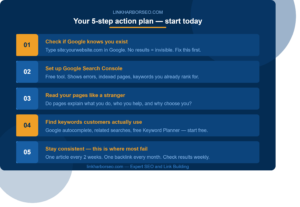
If you are reading this and your website is currently invisible on Google, here is the exact sequence I would follow — the same sequence I follow with every new client.
Step one — Do the site:yourwebsite.com check in Google right now. This tells you immediately whether Google knows you exist.
Step two — Set up Google Search Console. Verify your website, submit your sitemap, and spend thirty minutes reading what it tells you. It will show you errors you did not know existed.
Step three — Read your five most important pages out loud as if you are a customer who has never heard of you. Does each page clearly explain what you do, who you help, where you are based, and why someone should choose you over a competitor? If any of those answers are unclear, that is your first writing job.
Step four — Pick one service or product that matters most to your business right now. Then find the specific search phrases your customers actually use to find that service. Here is the simplest way to do this without any paid tools.
Open Google and start typing your main service into the search bar — but do not press enter. Watch what Google suggests as you type. Those suggestions are real searches real people have made. Write them down.
Then scroll to the bottom of any Google results page and look at the “People also search for” and “Related searches” sections. These give you even more real phrases your potential customers are using.
If you want to go deeper, Google Keyword Planner is completely free with a Google account. Type in your service and your location and it will show you exactly how many people search for different phrases every month — and how competitive each one is. Start with phrases that have decent search volume but lower competition. That is where a new website can actually win.
Once you have two or three of those phrases, make sure your most relevant page talks about them clearly and naturally — not stuffed in awkwardly, but genuinely woven into content that answers what someone searching for that phrase actually wants to know.
Step five — Be patient and be consistent. Publish one genuinely useful piece of content every week or two. Build one or two quality backlinks every month. Check your Search Console data once a week to see what is improving.
That is the whole starting framework. It is not complicated. The businesses that win at SEO are the ones who do these simple things consistently for long enough.
Frequently Asked Questions
What is SEO in simple terms? SEO is the work you do to help your website appear when people search for what you offer on Google. It involves making your website easy for Google to understand, creating content that matches what your customers actually search for, and earning links from other trusted websites that tell Google your site is worth ranking.
How long does SEO take to show results for a small business? For most small businesses targeting low to medium competition keywords, meaningful results start appearing within three to six months of consistent work. More competitive industries or locations can take nine to twelve months. The key is consistency — stopping and restarting resets much of the progress you have built.
How much does SEO cost for a small business? Doing it yourself costs time but very little money — mainly tools like Semrush or Ahrefs which start around 100 dollars a month. Hiring a reliable freelancer typically costs between 300 and 800 dollars a month. A good agency usually starts at 800 to 2000 dollars a month. The right investment depends entirely on how competitive your market is and how fast you want to grow.
Can I do SEO myself as a small business owner? Yes — and for many small businesses in lower competition local markets, doing the basics yourself is completely realistic. The fundamentals are learnable. Where most owners run into difficulty is finding the time to do it consistently while also running their business day to day.
What is the difference between SEO and Google Ads? Google Ads puts you at the top of search results immediately but you pay for every click and the traffic stops the moment you stop paying. SEO takes longer to build but once your rankings are established, the traffic is free and continues even when you are not actively working on it. The smartest small businesses use both — ads for immediate results and SEO for long-term sustainable growth.
Is SEO still worth it for small businesses in 2026? Yes — SEO is still one of the highest return investments a small business can make in 2026. Organic search remains the largest source of website traffic globally. While AI Overviews and new Google features have changed how results look, websites with genuinely helpful, well-structured content are still being cited and ranked prominently. The businesses that invest consistently in quality SEO today are building an asset that pays returns for years.

5 comments on “What is SEO? The Honest Guide Small Business Owners Actually Need”