


Introduction
A client called me in a panic last year. His phone had basically stopped ringing. “My competitor down the street gets calls every day, we do the same work, I don’t get it” – that’s pretty much what he told me.
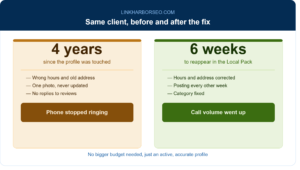
So I pulled up his Google Business Profile. It was made four years earlier and never touched after that. Hours were wrong. He’d moved offices eight months before this call and the old address was still sitting there. The category he picked was close to what he does but not really it.
Then I checked his competitor. Hours correct. Photos that were actually recent. Reviews with real replies under them, not generic “thank you” stuff. Right category too.
Same skill level. Same prices, from what he told me. Same neighborhood even. But one of them showed up when people searched and the other one just… didn’t. As far as Google was concerned it barely existed.
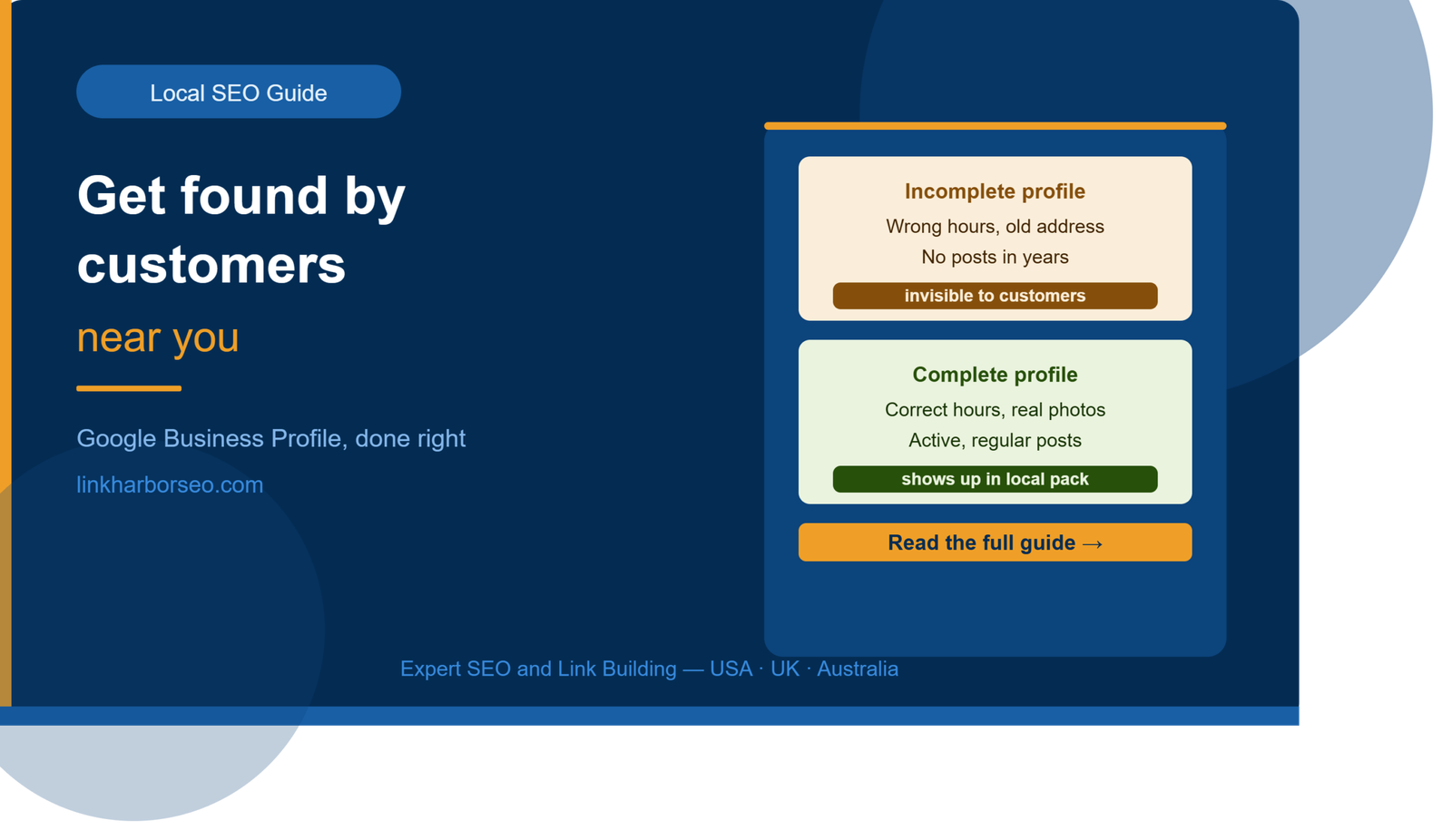
That’s what this whole guide is about. Why that happens, and what you actually do about it if you’ve never touched your Google Business Profile.
What is a Google Business Profile, Actually
Quick basics first, because not everyone knows this part.
A Google Business Profile is your free listing on Google. It’s the thing that shows up on the map when someone searches for your type of business – your hours, photos, reviews, phone number, all of that.
You don’t pay for this. Go to google.com/business, search your business name. If it’s already there you claim it. If not you make a new one. Takes about ten minutes.
Everything else in this guide builds on top of this profile, so if you haven’t set one up yet, do that first.
What Local SEO Actually Means
Local SEO is just the work you do so your business shows up when people search for stuff near them. Like “plumber near me” or “best dentist in Manchester.”
It’s not the same as regular SEO. Regular SEO is competing for people searching nationally, or even worldwide – I went over that side of things here if you want the bigger picture. Local SEO is different because you’re competing for someone standing in your actual city right now, phone in hand.
When someone searches “coffee shop near me” Google doesn’t just give you ten blue links. It shows a map with three businesses pinned on it first. That’s called the Local Pack and it sits right at the top. Getting into those three spots is the whole point of local SEO.
Why the Local Pack Matters So Much
Most small business owners don’t realize how much traffic this one thing brings in.
Local searches trigger that Local Pack the vast majority of the time – well over 90% according to most of the data out there. And when it shows up it eats most of the clicks before anyone even scrolls down to a regular listing.
I remember explaining this to my client and watching it click for him. Someone searching “plumber near me” isn’t planning for next month. Something just broke. They want someone now. A lot of these searches end in a call or a visit that same day.
So if you’re not in those three spots, you’re invisible to the exact person who’s ready to pay you right this second.
Your Google Business Profile is Probably Your Most Important Asset
Most business owners assume their website is their main thing online. For local searches in 2026 that’s just not true anymore.
People now call, get directions, or message you straight from your profile without ever clicking through to your site. Google’s doing the work, not your website.
My client’s site was actually decent. Well built, looked professional. Didn’t matter one bit. His profile told Google he might not even be a real active business anymore. Wrong address, wrong hours, nothing posted in years. This is honestly one of several reasons a website ends up not ranking even when it looks fine on the surface.
The Five Things That Actually Move Your Local Rankings
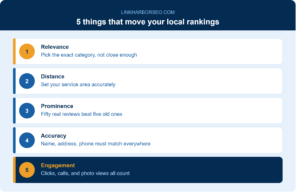
Google is looking at a handful of signals here. Nail these and you show up consistently. Mess them up and you disappear.
First one is relevance – does your profile match what someone’s actually searching for. This starts with your category, and picking “close enough” instead of exact is probably the single most common mistake I see. A contractor who picks “Construction Company” instead of “Kitchen Remodeler” is going to lose out on exactly the searches that would’ve brought him the best leads.
Then there’s distance, which is how close you are to whoever’s searching. Can’t really control this directly but you can at least set your service area properly so Google knows what neighborhoods you cover.
Prominence is your reputation – built through reviews, mentions, how people interact with your listing. Fifty real recent reviews will beat five old ones almost every single time, no contest. It’s a similar idea to how authority backlinks work actually – real signals from real sources beat raw numbers.
Accuracy matters too obviously. Name, address, phone number need to match everywhere. People call this NAP consistency. If your website says one thing and your profile says another, Google notices and just kind of… hesitates.
And engagement. Clicks, calls, people viewing your photos, asking for directions – all of it tells Google real people actually care about your business. A profile nobody touches for years sends the opposite message.
The Mistake That Cost My Client the Most
Let me be specific about what actually went wrong here because I see this exact thing constantly.
When I put his profile next to his competitor’s the gap was obvious immediately. Competitor posting regularly, job photos, seasonal stuff, little updates here and there. My client’s last activity? One photo. Uploaded the day he made the account. Four years before this conversation.
Google reads that silence as a red flag honestly. A business that never posts, never adds photos, never responds to reviews – it looks dead even if the actual business is doing fine.
The fix wasn’t complicated though. We corrected his hours, fixed the address, updated his category, started posting something small every couple weeks. Six weeks later he’s showing up in the Local Pack for searches he’d been totally invisible on before that.
Call volume noticeably went up within two months.
He didn’t need a bigger budget. Didn’t need some clever strategy either. He just needed his profile to actually look like a real, active business – because that’s literally what Google is trying to confirm before it recommends you to anyone.
How to Fix Your Google Business Profile, Step by Step
Here’s roughly the order I walk people through.
Claim and verify your listing first if you haven’t already. An unverified listing is one of the most common reasons a business just never shows up at all.
Pick the most specific category you can find. Don’t go with close enough – check what your actual competitors are using and match your main service exactly. Add secondary categories too for anything else you genuinely offer.
Keep your name, address, and phone number identical everywhere. Website, profile, any directories. Even small stuff like a missing suite number or an old phone line that’s still listed somewhere creates doubt for Google.
Add real photos and keep adding them regularly. Interior, exterior, work in progress shots – whatever’s relevant to what you actually do.
Fill out your services section properly. Most people skip this completely and it’s actually one of the more useful spots to add detail.
Post something every couple of weeks. A job photo, a quick update, an offer – it doesn’t need to be elaborate, it just needs to be consistent.
And reply to your reviews. All of them, good and bad. A short, specific reply tells Google – and future customers – that an actual person is running this thing.
Local SEO and Your Website Work Together
Your profile gets you into the map pack. Your website is where that person actually becomes a customer. They need to work together, not separately.
Make sure your website actually says what city or area you serve, ideally in your titles and somewhere early in your content too.
I saw this go wrong with a small dental clinic I worked with. Profile was genuinely strong – good reviews, correct hours, regular posts, all of it. But the homepage never even mentioned their city by name. No page for either of the two neighborhoods they actually served. So people would click through from the map pack, land on this generic homepage with zero local language, and just leave within seconds.
We added one line near the top naming their city and service area. Built two short pages for those neighborhoods. Within a month, time on site from map pack visitors had roughly doubled. Appointment requests went up too.
There’s also something called schema markup which sounds more technical than it is. It’s basically a small piece of code telling Google your exact business name, hours, address, all that. When it matches your profile exactly, word for word, Google trusts you more as a real consistent business. And that trust is honestly what gets you ranked higher.
How Long Does This Actually Take
I’ll be honest about timing because expectations matter just as much as the actual work.
Simple stuff – fixing your hours, correcting your category – can move the needle within a few weeks. Building real authority through reviews and consistent posting, that’s more like three to six months before you see the full effect.
My client’s six week turnaround was honestly on the faster side, mostly because his old profile had such obvious problems that were easy to fix. If your profile is already decent but just not very active, expect more of a slow steady climb over a few months rather than some sudden jump.
Frequently Asked Questions
Why is my Google Business Profile not showing up in local search? Usually it’s one of a few things – unverified listing, wrong category, info that doesn’t match across the web, barely any recent activity, or just stronger competitors nearby.
How long does local SEO take to show results? Quick fixes like hours or category can help within weeks. Real, lasting rankings through reviews and consistent activity usually take three to six months.
Do I need a website if I already have a Google Business Profile? Yes, you do. Your profile gets the initial discovery but your website is usually where someone decides to actually reach out.
How important are reviews for local SEO? Pretty important honestly – one of the strongest signals there is. They affect your visibility and they affect whether someone actually picks you. Replying to all of them, even the bad ones, helps more than people think.
What is NAP consistency and why does it matter? NAP just means Name, Address, Phone number. Keeping it exactly the same across your website, your profile, and any directories you’re listed in. Mismatches make Google less confident about your business, which can hurt your visibility.

2 comments on “Local SEO Guide: How to Get Your Business Found Near You”