


I get the same message every week from someone new to SEO.
“I want to start guest posting but I don’t even know where to begin. There are so many guest posting sites, I don’t know which ones are real and which ones are spam. I don’t know what domain authority means. I don’t know how to pitch. I am completely lost.”
If that sounds like you, this article is for you.
I am not going to give you a list of 50 ranking factors or a wall of theory. I am going to walk you through the exact guest posting framework I use with clients.
A few weeks ago, a family member of mine — sharp, hardworking, but brand new to SEO — asked me to teach him this exact skill. He had never opened Semrush before. He did not know what domain authority meant. He could not tell a legitimate guest posting site from a spam farm if his life depended on it.
I sat him down and walked him through the same five-step process you are about to read. Within three weeks, he was finding legitimate guest posting sites on his own, checking their authority correctly, and writing pitches that got real replies from real editors. This guide is that exact process, written down step by step.
By the end of this article, you will know how to find guest posting sites, judge whether a site is worth pitching, write an outreach email that actually gets opened, and land your first backlink — even if you are starting from absolute zero today.
“If you are still new to SEO overall, start with this guide first — then come back here once you understand the basics.”
What is Guest Posting and Why a Framework Matters
Guest posting means writing an article for someone else’s website and getting a link back to your own site in return. That is the simple definition. The complicated part is doing it well.
Most beginners fail at guest posting not because the concept is hard, but because they have no system. They search randomly, pitch randomly, and get rejected randomly. A simple guest posting framework fixes this — it turns guest posting from guesswork into a repeatable process, the same five steps, every single time, regardless of your niche.
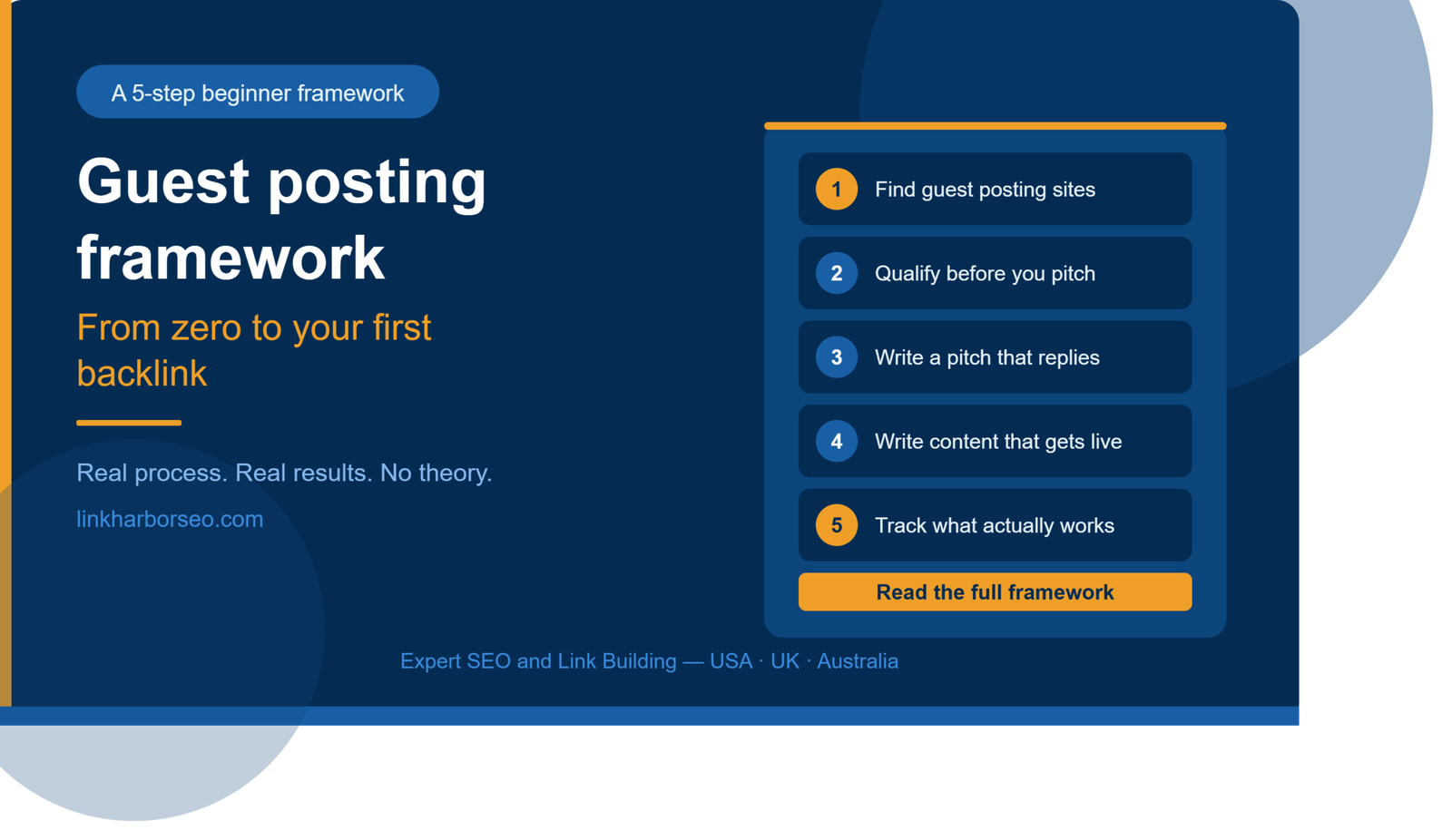
Here is the framework in one sentence before we break it down. Find relevant sites with real traffic, qualify them properly, pitch with a specific idea, write genuinely useful content, and track what works so you can repeat it.
“If you want the full picture of why guest posting works for SEO, I covered that in detail here — this guide picks up exactly where that one left off.”
Step One — Finding Guest Posting Sites
This is where most beginners get stuck immediately. They do not know where to look.
Method 1 — Search Operators
Open Google and combine your niche keyword with phrases website owners commonly use when they accept guest content. Try combinations like these, replacing “your niche” with your actual topic.
your niche + "write for us"
your niche + "guest post guidelines"
your niche + "submit a guest post"
your niche + "contribute to our blog"
your niche + "become a contributor"
Each of these searches will surface dozens of websites that have publicly stated they accept guest content. This alone can give you twenty or thirty starting prospects within an hour.
Method 2 — Competitor Backlink Analysis
This is the method I personally rely on most, and it is more powerful than random searching. Take two or three competitors in your niche and check where their backlinks are coming from using Semrush or Ahrefs. If three different competitors are all getting links from the same site, that site is almost certainly open to guest content in your space.
Method 3 — Author Search
Find someone respected in your industry and search their name alongside terms like “guest post” or “guest author.” If a website has published a known figure in your niche before, there is a strong chance they will consider your pitch too.
Step Two — Qualifying a Site Before You Pitch

Finding a site is only half the job. The other half — and the part most beginners skip — is qualifying it before you waste time pitching.
Here is exactly what to check, in order.
Check the Domain Authority. Open the site in Semrush and look at its Domain Score. A score of 30 or higher is a reasonable starting benchmark for most niches, though this varies depending on how competitive your industry is.
Check the Spam Score. This tells you how trustworthy the site actually is, separate from its authority number. A site can have a high DA and still carry a high spam score if it has been involved in shady link schemes. Avoid anything flagged as high risk.
Check real organic traffic, not just the DA number. A site with a Domain Authority of 70 but almost no actual visitors is far less valuable than a site with DA 35 and 15,000 real monthly visitors. The traffic is what tells you real people will actually read your content.
Check the last five articles published. Open them and look at the outbound links. If those articles are linking out to unrelated industries, casinos, or obvious link farms, walk away. That site has already been compromised for SEO purposes.
Check whether your topic actually fits. A backlink from an unrelated site does very little for you and can occasionally raise red flags with Google. Relevance matters as much as authority.
This entire qualification process takes about five minutes per site once you have done it a few times. Skipping it is the single biggest reason beginners waste weeks pitching sites that were never going to say yes — or worse, sites that actually hurt their SEO.
Whether you send these pitches yourself or have someone do it for you, the same rule applies: every prospect should be checked by a person, not a script. We cover why that matters in our guide to manual link building services.
“If your website still is not ranking despite having some content, weak backlinks could be one of the reasons — I break down all seven reasons here.”
Step Three — Writing a Pitch That Gets Replies
Most guest post pitches get ignored because they are generic. Editors receive dozens of identical, copy-pasted emails every week. Here is what makes a pitch stand out.
Be specific, not vague. Do not say “I would like to write a guest post for your site.” Instead, propose an actual topic with an actual angle. Editors can say yes to a specific idea in ten seconds. They cannot say yes to nothing.
Show you have actually read their site. Mention a recent article you genuinely liked or reference their content style. This single detail separates you from ninety percent of pitches that are obviously sent to a hundred sites at once.
Keep it short. Three to five sentences is enough. Editors are busy. A long pitch signals that you do not respect their time.
Here is a simple structure that works consistently.
Subject line: Guest post idea — [specific topic]

Hi [Name],

I came across your article on [specific article
title] and really liked how you covered [specific
point]. I run an SEO agency working with small
businesses, and I'd love to contribute an article
on [specific topic idea] for your readers — covering
[one or two specific points the article would include].

Happy to share a draft outline first if that's
easier. Let me know what you think.

[Your name]
Notice this pitch does not mention links at all. That is intentional. Editors are far more receptive when the pitch is about value for their readers, not about what you are trying to get out of it.
Step Four — Writing Content That Actually Gets Published
Getting a yes from an editor is only the start. The content itself needs to meet a real bar, or it will get rejected or heavily edited in ways you do not control.
Structure the article around what the reader actually wants to know — not around where you want to place your link. Keep paragraphs short, two to four sentences at most, since most readers are scanning on mobile devices. Use clear H2 and H3 headings so the article is easy to navigate.
Include something that cannot be found in five other articles on the same topic — a specific process, a real example, an original way of explaining a concept. Generic, recycled content gets rejected far more often than it gets published in 2026.
When the family member I mentioned earlier wrote his first guest post draft, it read exactly like every other generic article on the topic — broad advice, no specifics, nothing the editor could not find in ten other articles already on their site. The editor sent it back asking for “more depth and a real example.” We rewrote it around one specific case with real numbers instead of general advice, and it was accepted within two days. The lesson was simple — editors are not looking for information, they already have plenty of that. They are looking for something they cannot get anywhere else.
When it comes to your link, place it naturally inside a paragraph where it genuinely adds value to the point being made — never forced into a sentence where it does not belong, and never stacked together with multiple links in one spot. One relevant, well-placed link inside helpful content will always outperform three forced links that interrupt the reader.
Step Five — Tracking What Actually Works
This is the step almost nobody talks about, and it is the difference between someone who does guest posting once and someone who builds a real system out of it.
Keep a simple spreadsheet with these columns — the site name, its Domain Authority, the date you pitched, whether they replied, and the date the article went live if it was accepted.
After ten or fifteen pitches, patterns start to appear. You will notice certain types of sites reply more often. You will notice certain pitch angles work better than others. You will notice your acceptance rate slowly improve as you get better at qualifying sites before pitching them.
This tracking is exactly what separates someone who treats guest posting as a one-off task from someone who turns it into a repeatable monthly system.
This five-step guest posting framework works the same way regardless of your niche — the process does not change, only the topics and sites do.
How Many Guest Posts Do You Actually Need
For a small business or a newer website, three to five quality guest posts per month is a realistic and effective starting point. This is not about volume. One guest post on a genuinely relevant, trustworthy site with real traffic will outperform ten guest posts on low-quality, irrelevant sites every single time.
The goal is consistency over months, not a short burst of activity. A steady stream of three to five quality backlinks every month, sustained over six months, builds far more authority than fifty backlinks acquired in a single rushed week.
The Most Common Mistake Beginners Make

The single biggest mistake I see is chasing Domain Authority numbers while completely ignoring relevance and real traffic.
A new team member I trained recently found a site with a Domain Authority of 65 — an impressive number on paper. She was excited and ready to pitch immediately. When we checked the site’s actual organic traffic, it had almost none. When we checked its last five articles, they were all linking out to completely unrelated industries — clear signs of a link farm dressed up to look legitimate.
That high DA number meant nothing. A backlink from that site could have done more harm than good. We moved on and found a site with DA 38, real monthly traffic of 12,000 visitors, and genuinely relevant content in our niche. That backlink, from a much “lower” looking site, was worth significantly more.
Numbers on a screen are not the goal. Real authority, real relevance, and real readers are the goal.
Frequently Asked Questions
What is a good Domain Authority for guest posting sites? A Domain Authority of 30 or higher is a reasonable starting benchmark for most niches, but DA alone is not enough. Always check real organic traffic and the relevance of the site’s existing content alongside the DA score before pitching.
How do I find guest posting sites in my niche? Use Google search operators combining your niche with phrases like “write for us” or “guest post guidelines,” analyze where your competitors are getting their backlinks using Semrush or Ahrefs, and search for known figures in your industry alongside “guest author” to find sites that already accept outside contributors.
How long does guest posting take to show SEO results? Guest posting typically starts showing measurable ranking improvements within two to three months of consistent activity. Three to five quality backlinks per month, sustained over several months, produces significantly better results than a large batch of links acquired all at once.
Is guest posting still effective for SEO in 2026? Yes — strategic, high-quality guest posting on relevant, high-traffic websites remains one of the most effective SEO strategies in 2026. What no longer works is bulk, low-quality guest posting on irrelevant or spammy sites purely for link volume, which Google’s algorithms now actively devalue.
What is the difference between Domain Authority and Spam Score? Domain Authority estimates how likely a website is to rank well in search results based on its backlink profile. Spam Score measures how trustworthy a site actually is and flags signs of manipulative or low-quality SEO practices. A site can have a high Domain Authority and still carry a high spam score, which is why both should always be checked together.

Powerful insight—success really does start with clarity. Anyone wanting deeper guidance can explore more at bestattorneyfor.com.