


We keep running into the same spreadsheet problem with clients who’ve tried this before. A long list of “resource pages” pitched by a previous agency, barely any replies, and no links to show for it.
When we open a handful of those pages ourselves, the pattern’s usually obvious. Half haven’t been updated in years. Some still link to tools that shut down long ago. Nobody was pitching resource page link building wrong here, in the sense of using bad email copy. They were pitching dead pages and calling it a strategy.
That’s the real problem with most resource page link building advice floating around right now. It treats every page with the word “resources” in the title as a target. Half of them aren’t worth an email, and no amount of clever outreach copy fixes a prospect list built on pages nobody maintains anymore.
This guide skips the padding. Search operators, sure, everyone has those. The part that actually moves the needle is the vetting step most agencies skip entirely, and we’ll walk through exactly how we do it.
What Is Resource Page Link Building, Really
Resource page link building means getting your site listed on a curated page that already links out to helpful tools, guides, or sites in a niche. Universities do this. Nonprofits do this. Niche blogs and industry associations do this constantly.
Think of a university library page titled “Resources for First-Generation Students,” or a personal finance blog’s “Tools We Recommend” list. Someone built that page by hand, keeps adding to it, and clearly cares whether the links on it still work. That’s the target. Not a directory. Not an auto-generated list of a thousand outbound links nobody reads.
It’s different from guest posting. You’re not writing anything for someone else’s site. It’s different from broken link building too, even though the two get lumped together often. Broken link building finds a dead link and offers your page as the replacement. Resource page link building just asks: would this page benefit from adding me?
Simple pitch. The hard part is finding pages worth pitching, and that’s where most people get resource page link building backwards. They optimize the email before they’ve confirmed the page is even worth emailing.
Why Resource Page Link Building Still Works in 2026
Search engines have gotten better at telling curated, human-maintained pages apart from thin directory spam. A resource page that’s actually maintained, updated, and used by real visitors carries weight that a random guest post rarely matches.
Read that again if you’ve been buying resource page placements from a marketplace. A placement bought on a dead page does nothing. A placement earned on a living one compounds for years.
There’s also a trust signal here that matters more each year. Resource pages are usually built by someone with domain expertise, not an SEO trying to sell links. That kind of curator judgment is harder to fake than a keyword-stuffed guest post, which is part of why resource page link building keeps outperforming lower-effort tactics, even as other link types get noisier.
It also ages well compared to a lot of what passes for link building now. A guest post can get pulled down when a blog changes ownership. A paid placement can vanish the moment an agency stops paying the invoice. A genuinely earned spot on someone’s curated list tends to survive redesigns, ownership changes, even years of neglect, because removing a working, relevant link serves no purpose for whoever inherits the page.
None of this means resource page link building is easy. It’s slower than most tactics, and the total number of good prospects in any niche is finite. But slow and finite isn’t the same as unreliable. Once a placement lands, it tends to stay put, which is more than most other link types can promise.
How to Find Resource Pages Worth Pitching
Most guides stop at search operators. We’ll give you those, but the real skill is knowing which results to ignore.
Search Operators That Actually Work
Start broad, then narrow:
[your niche] inurl:resources[your niche] intitle:resources[your topic] "helpful links"[your topic] "further reading"[your topic] "recommended tools"
That last one matters more than people think. A lot of strong resource-page prospects never use the word “resources” at all. They’re titled “starter guides,” “industry associations,” or “research tools” instead. If you only run the obvious footprints, you miss a big chunk of what’s actually out there.
Competitor Backlink Gaps
Pull a competitor’s backlink profile. Filter for pages that look like curated lists. If a resource page already links to three competitors and not you, that’s close to a guaranteed yes, because the page owner has already shown they’re open to adding sites like yours.
University and Association Pages
.edu and nonprofit resource pages carry serious authority, and they update less often than blogs, so a placement there tends to stick around. They’re also slower to respond. Budget patience here, not persistence.
Places People Forget to Look
Roundup posts and podcast show notes function like resource pages even though nobody calls them that. A podcast episode about your niche often links out to every tool and site mentioned during the recording, and that show-notes page usually stays live for years, indexed and largely untouched. Same goes for conference speaker pages and “further reading” sections tacked onto long-form guides. None of these show up if you only search for the word “resources,” which is exactly why they’re underused.
Local chambers of commerce and industry associations run similar pages too, often titled “member resources” or “industry links.” They’re smaller in number than the blog-style resource pages most guides focus on, but the acceptance rate tends to be higher, since these organizations exist specifically to point their members toward useful tools.
Vetting a Resource Page Before You Pitch It
This is the step most agencies skip, and it’s the reason a lot of resource page link building campaigns come back with nothing.
Before pitching, check three things:
- Is it actually maintained? Look at the last update date if it’s visible. Check whether the linked sites still exist and still work. A page full of broken links and outdated formatting gets crawled less often and helps you less.
- Does it rank or get traffic? A quick check in any SEO tool tells you if the page pulls its own organic traffic. A page nobody visits is a link with no audience behind it.
- Is there a real person behind it? Some pages are clearly run by one person keeping a personal list current. Those respond to email. Others are auto-generated directory pages nobody owns. Skip those entirely.
We usually cut half our prospect list at this stage. That’s normal, and it’s the difference between a 5 to 10 percent placement rate on a genuinely targeted list and a campaign that goes nowhere.
Here’s a real pattern we run into constantly. A page looks perfect on the surface: nice design, dozens of relevant links, clearly on-topic. Then you check three or four of those outbound links and half of them 404. That’s your answer. Nobody’s tending this page anymore, no matter how good it looks at first glance. Skip it and move to the next prospect instead of wasting an email on it.
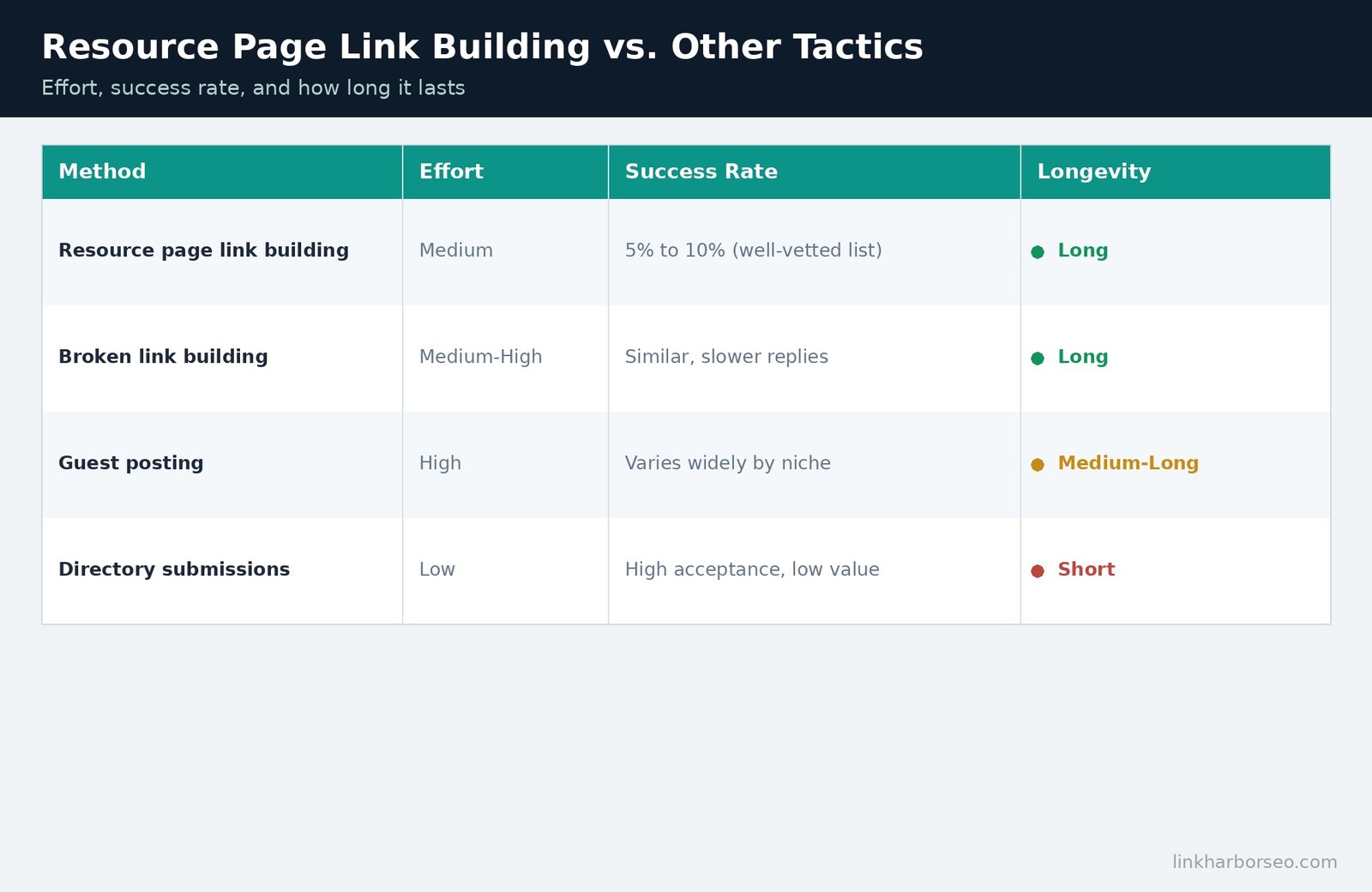
Resource Page Link Building vs. Other Tactics
| Method | Effort | Typical Success Rate | Longevity |
|---|---|---|---|
| Resource page link building | Medium | 5% to 10% on a well-vetted list | Long, pages update infrequently |
| Broken link building | Medium-High | Similar range, slower replies | Long, once fixed |
| Guest posting | High | Varies widely by niche | Medium to long |
| Directory submissions | Low | High acceptance, low value | Short, often ignored by Google |
Worth noticing: resource page link building isn’t the fastest tactic on this list. It’s one of the more durable ones, if you do the vetting step first.
We tend to run resource page link building alongside one other tactic, never as the whole strategy. On its own, the volume of genuinely good prospects in most niches is limited. There are only so many well-maintained resource pages in any given space. Once you’ve worked through your list, you’ve worked through it, and revisiting it too often just annoys the same curators.
Writing an Outreach Email That Actually Gets Read
Most resource page pitches get ignored because they read like a form letter. The fix isn’t a clever subject line. It’s specificity.
Mention the actual page. Mention one specific link already on it. Explain in one sentence why your resource fits next to it, not why your company is great. Then stop. A three-paragraph pitch about your product gets deleted before the second paragraph.
Something like this, structurally: open by naming the exact page and one link you noticed on it. Then one sentence on what your resource adds that isn’t already there. Then a plain link, no attachments, no “let me know if you have any questions” filler at the bottom. Curators skim. Give them nothing to skim past.
A short pitch that respects the curator’s time, and clearly shows you read the page, gets replies. That’s really the whole trick behind resource page link building outreach. It’s not a script. It’s attention.
Follow up once, after a week or two, and leave it there. A second nudge often works. A third one usually reads as pressure, and that’s a bad look when you’re trying to get listed as a helpful resource in the first place.
A Simple Framework for Resource Page Link Building
- Build your prospect list using the search operators above, plus competitor backlink gaps.
- Vet every page against the three checks: maintained, ranked, owned by a real person.
- Cut anything that fails even one check. Don’t pitch it anyway “just in case.”
- Write a short, specific pitch for each remaining page. No templates copy-pasted word for word.
- Track replies and placements separately. A 10 percent reply rate with a 50 percent placement rate beats a 40 percent reply rate that goes nowhere.
- Revisit the list quarterly. Pages that were dead last year sometimes get revived, and pages that were alive can go stale.
None of these steps are complicated on their own. What actually separates a working resource page link building process from a wasted afternoon is doing all six in order, instead of jumping straight to step four because outreach feels like the “real” work.
For the outreach side specifically, our outreach process that works covers a lot of the same groundwork, since the two overlap more than people expect.
Common Mistakes in Resource Page Link Building
- Pitching every page with “resources” in the URL, without checking if it’s still maintained
- Sending the same templated email to fifty different curators, hoping volume makes up for relevance
- Ignoring university and association pages because they’re slower to reply than a niche blog
- Treating a single placement as the finish line instead of a repeatable monthly process
- Skipping the vetting step entirely and wondering why the reply rate sits at zero
That last one is the most common, and the easiest to fix. Cut your list before you pitch it, not after. A shorter list of genuinely good prospects beats a long one padded with pages nobody’s touched since 2022.
Where Resource Page Link Building Fits in a Bigger Strategy
On its own, resource page link building is a solid, steady tactic. Paired with other approaches, it gets stronger. If you’re just getting your link building off the ground, this is one of the more beginner-friendly tactics to start with, since the ask is simple and the targets are easy to identify.
It also fits well next to hands-on manual outreach generally, and it plays nicely with content-driven tactics like the kind we cover in our piece on SaaS-specific link building, where original data becomes the thing curators want to add to their lists in the first place.
Most link building strategies compete for a curator’s attention with something flashy. Resource page link building doesn’t need that. It just needs a page that’s actually maintained, a pitch that shows you read it, and the patience to skip the pages that fail the vetting check instead of pitching them anyway.
If you’d rather hand off the prospecting and outreach entirely, our full-service link building team includes resource page campaigns as a standard part of the process, vetted the same way we described above, not bulk-pitched to whatever shows up in a search operator.
Must Read: How Targeted Link Building Can Explode Your Domain Authority Fast
FAQs
What is resource page link building?
It’s the process of getting your site added to a curated page that already links out to useful tools, guides, or sites in your niche, in order to earn a relevant, durable backlink.
How is resource page link building different from broken link building?
Broken link building offers your page as a replacement for a dead link. Resource page link building simply asks a curator to add your resource to their existing list, whether or not anything on the page is broken.
What’s a realistic success rate for resource page link building?
A well-vetted, highly targeted list typically lands placements on 5 to 10 percent of pitches. Generic, unvetted lists perform far below that.
How do I find resource pages in my niche?
Combine search operators like “inurl:resources” or “helpful links” with competitor backlink-gap analysis, and don’t ignore pages that use different words entirely, like “starter guides” or “recommended tools.”
Are university resource pages worth pursuing?
Yes. They carry strong authority and tend to stay live for years, though they usually take longer to respond than a niche blog.
How long does a resource page link building campaign take to show results?
Expect weeks between outreach and replies, and longer for higher-authority pages like universities. It’s a slower tactic than paid placements, but a more durable one.
Can I do resource page link building without any tools?
Yes, using search operators alone gets you a workable prospect list. Paid tools like Ahrefs or Semrush speed up the backlink-gap step, but they’re not required to start.
Do resource page links help with rankings, or just referral traffic?
Both, usually. A relevant, well-maintained resource page sends a trust signal search engines weigh alongside direct clicks. The referral traffic tends to be small compared to a viral guest post, but it’s steadier and rarely disappears overnight.
How many resource page prospects should I build before I start outreach?
Aim for a vetted list of 30 to 50 before sending a single email. A smaller, cleaner list outperforms a spreadsheet of 300 pages that includes anything with “resources” in the URL.
