


Somebody pitched me an automated outreach tool last month. It promised 500 emails a day, sent from my own inbox, personalized by AI. I said no. Then I watched what happened to a site that said yes.
The owner ran it for six weeks. He got 40 links. He also got flagged by two anti-spam systems, blacklisted by one email provider, and his domain reputation dropped enough that his own cold emails started landing in spam. The 40 links did almost nothing for his rankings. Most sat on pages Google had never bothered to index.
That’s the story behind this guide. Not a hypothetical. A guy who wanted to skip the slow part and paid for it in ways that took longer to fix than the outreach would have taken to do properly.
What Is a Manual Link Building Service?
A manual link building service means a real person researches each site, checks it by hand, and writes a unique pitch for every prospect. No bulk software. No mass-blasted templates. Every link comes from a conversation, not a script.
The word “manual” sounds old-fashioned in an industry obsessed with automation. That’s fair. It is slower. But slower isn’t the same as worse, and in link building specifically, slower is usually the point.
Manual doesn’t mean primitive. We still use tools. Spreadsheets to track prospects. Research tools to check traffic. Even scripts to find candidate sites faster. What we don’t automate is the part that matters: deciding whether a site is worth pitching, and writing the pitch itself. A person reads the site. A person decides if it fits. A person writes something specific to that site, not a variable swapped into a template.
Why This Distinction Even Matters
Automated link building isn’t new. Bulk directory submissions and mass outreach software have been around for well over a decade. What’s new is how much cheaper and more convincing the output has gotten.
AI writing tools made it cheap to spin up outreach emails at scale that no longer read like obvious spam. AI content tools made it cheap to build entire “guest post” sites that exist only to sell placements, dressed up with enough real-looking articles to survive a quick glance. Put those two things together and you get a market flooded with fast, cheap link building that looks identical to the real thing from the outside.
Most business owners can’t tell a vetted placement from a bulk one just by looking at an invoice. Both say “backlink.” Both come with a report. The difference only shows up months later, in whether rankings actually moved. By then the money is already spent.
That gap between what gets sold and what actually works is the entire reason this guide exists.
Manual vs Automated Link Building: What’s the Real Difference
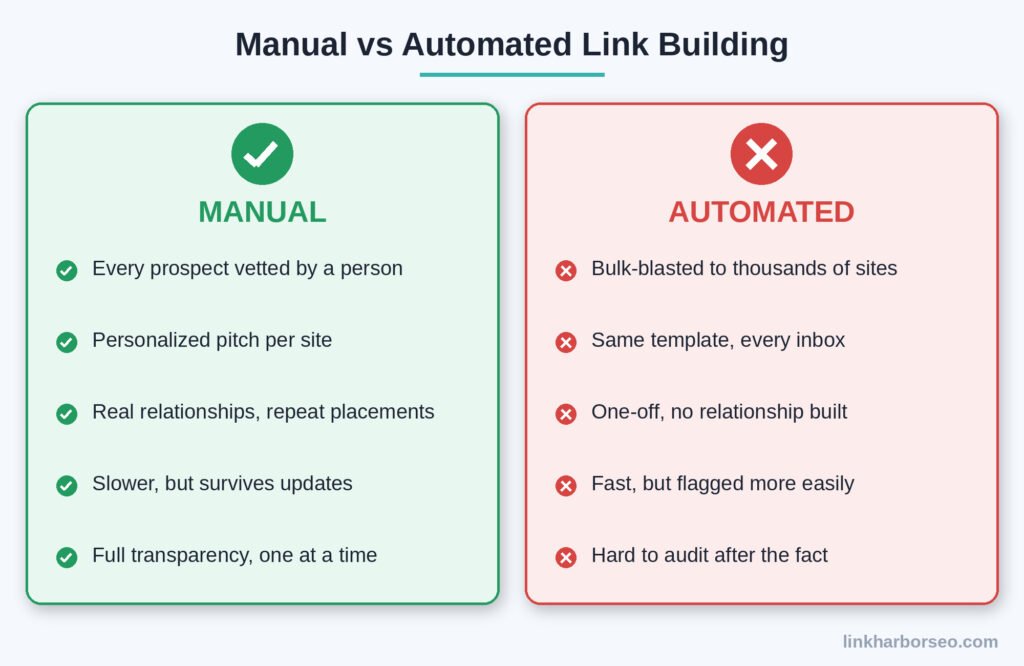
Manual link building vets and pitches one relationship at a time. Automated link building submits your site to hundreds or thousands of targets using software, often without checking whether any of them are relevant or real.
Here’s the table version, since this comparison is the whole argument in one place. Google spells out the automated side of this directly in its own spam policies documentation.
| Manual | Automated | |
|---|---|---|
| Vetting | A person checks traffic, relevance, and content quality | Usually none, or a shallow automated filter |
| Pitch | Written for that specific site | Template with a name swapped in |
| Volume | Low. A handful of quality pitches a week | High. Hundreds a day |
| Google’s stance | Falls within normal outreach | Explicitly named in spam policies |
| Risk if detected | Minimal | Devaluation, and it doesn’t come back |
| What you get | Fewer links, most of which hold | More links, most of which do nothing |
That last row is the one people underestimate. Google’s spam policies name automated link building software directly, the kind that submits a site to large numbers of directories or networks without human review. This isn’t a gray area anymore. It’s written down.
And the risk isn’t symmetrical. If Google’s systems decide a link was manufactured, the value doesn’t just pause. Google has said plainly that once a link’s ranking effect gets removed this way, that effect doesn’t return, even if the link stays live. You can’t earn it back by waiting. You have to build new, real signals from scratch. That asymmetry is the entire case for doing this by hand from day one.
Why Automated Tools Are Getting Riskier, Not Safer
People assume automation gets safer as it gets more sophisticated. The opposite is happening.
Semrush’s 2025 State of Search report tracked a 42% jump in algorithmic penalties tied to link spam in the year after Google tightened language around large-scale content and link creation. Then an Originality.ai analysis run in February 2026 checked newly registered blogs that openly sell guest post placements. Over 68% of them showed clear AI-generated content patterns with no real editorial audience behind them.
Read that number again. Two out of three “guest post opportunity” sites showing up in bulk outreach lists today are essentially link farms wearing a blog’s clothing. Automated tools can’t tell the difference between those and a genuine site. A person, spending three minutes on the homepage, usually can.
Google’s own detection system for this, SpamBrain, keeps getting better at spotting the pattern: a burst of new domains, thin content, and outbound links sold to whoever pays. The tools built to blast pitches at scale are increasingly blasting pitches at exactly the sites Google already plans to ignore.
How Our Manual Process Actually Works
Every manual campaign runs through four stages: research, human vetting against a fixed standard, a custom pitch, and a tracked follow-up. Nothing skips a stage, and nothing gets pitched without passing the check first.
Research. We start with your niche and your competitors. Some prospects come from tools that flag who links to competitor sites. Some come from direct search. Either way, this stage produces a list, not a decision.
Vetting. This is the part software can’t replace. We check three things on every single prospect: does the site actually cover your industry, does it have real organic traffic, and does the link sit inside genuine editorial content rather than a footer or a sold slot. We’ve written the full version of this check in our guide to what actually builds authority when you’re evaluating a link. Sites fail this stage constantly. That’s the point of running it.
The pitch. One email, written for one site, referencing something specific about their content. Not “I love your blog.” Something that proves we read it. If you want the exact structure we use for these, we broke it down step by step in our guide to landing your first backlink through outreach.
Follow-up and tracking. Most replies come from the second email, not the first. We track who responded, what they asked for, and what got published, so nothing falls through and nothing gets pitched twice.
What This Actually Costs
Manual link building typically runs $150 to $500 per placement, or a monthly retainer starting around $1,000 to $1,500 for a smaller campaign. Bulk automated packages sell for far less, which is exactly the warning sign.
The math seems backward until you think about where the money goes. A manual campaign pays for the hours spent checking sites and writing pitches. An automated one pays for server time and a mailing list. One of those has a real cost floor. The other doesn’t, which is why $20 links exist and why they’re worth roughly that.
We covered the wider picture of SEO pricing separately, including how link building fits into a full monthly budget, in our guide to what SEO actually costs for a small business. The short version for link building specifically: if the price seems too low to cover a person’s actual working hours, it probably doesn’t include a person.
How to Tell If a “Manual” Service Is Actually Automated
This gets sold dishonestly more than almost anything else in SEO. Watch for these signs before you sign anything.
The pitch examples all sound the same. Ask to see three past outreach emails for different clients. If the structure is identical and only the niche word changes, that’s a template, not manual work.
They can’t explain why a site got rejected. A real vetting process rejects far more sites than it approves. If a provider can’t tell you why they passed on a specific domain, they probably never actually looked at it.
The volume promised is too high for the price. A person can realistically research, vet, and pitch maybe 15 to 25 quality prospects a week. Anyone promising 50 guaranteed placements a month at a low price is running software, whatever the sales page calls it.
No names, no proof. A legitimate manual provider can usually show you a live, relevant placement from a comparable client. If everything is “confidential” with zero verifiable examples, be skeptical.
A Real Example of the Difference
The clearest case we’ve handled was a home services company that had already burned through one automated campaign before finding us. Their previous provider had run bulk software against a list of a few hundred sites. Roughly 10 links landed. Their target page sat stuck at position 38 for months.
We audited the profile first. Most of those 10 links sat on pages Google had never indexed, which means they were never really counted in the first place. We disavowed the worst of it and started manual outreach from scratch: a research list, a vetting pass, and pitches written one at a time. Over fourteen weeks we landed 8 links. Every one came from a site with real traffic in their exact niche.
The page moved from position 38 to position 9. Eight manual links did what ten bulk ones couldn’t, because eight of them were actually counted, and most of the first batch never was.
When Automation Is Actually Fine
To be fair to the tools themselves: not everything automated is a problem. Prospecting lists, traffic checks, tracking spreadsheets, and internal link placement can all be sped up with software safely. The line isn’t automation in general. It’s automating the parts that require judgment: deciding a site is worth your time, and writing the words that convince them to say yes.
We use tools constantly to build faster prospect lists. We don’t let software decide who gets pitched or what the pitch says. That distinction is the entire service.
Think of it like a recruiter using a database to find candidates, then still doing the interview themselves. The database saves hours. It doesn’t make the hiring decision. That’s also why “manual” pricing looks different from “automated” pricing. You’re not paying for the list, since lists are cheap now, sometimes free. You’re paying for the judgment applied to it, one site at a time.
Is Manual Link Building Worth It?
Less than 1% of indexed sites ever receive a visible manual penalty from Google, a figure that traces back to Google’s transparency reports on manual actions. That statistic gets used to argue automation is safe. Read it the other way instead: most sites running risky link tactics aren’t caught with a formal penalty. Their links just quietly stop counting. No warning arrives. Rankings simply plateau, and the money spent produces nothing, forever.
That’s the actual risk of automated link building in 2026. Not a dramatic penalty notice. A slow, invisible waste of budget that looks like normal SEO until you compare it to what a handful of real links can do.
Manual link building costs more per link and takes longer to show results. It also survives the update that eventually catches the shortcut. If you’re building a link profile you plan to still have value in two years, that trade is worth making.
Ask yourself a simple question before hiring anyone for this work. If Google reviewed every single link in this campaign by hand, would each one survive? Manual link building is built to pass that test by design. Automated link building is a bet that nobody ever checks closely enough. That bet gets riskier every year, not safer.
And yes, this is the actual service we run. Every prospect gets checked by a person. Every pitch gets written once, for one site. If a provider can’t say the same, ask them why not before you pay.
What to Expect in the First Month
Manual outreach doesn’t produce links in week one. It’s worth knowing that going in, because the silence at the start is normal, not a sign something’s wrong.
Weeks one and two are research and vetting. You won’t see a single link land, and you shouldn’t expect to. This is where most of the actual work happens, even though it’s invisible from the outside.
Weeks three and four are when pitches go out and replies start trickling in. Most sites take days to respond, sometimes longer. A handful will say yes quickly. Most won’t reply at all, and that’s expected too. Realistic reply rates for well-targeted manual outreach sit between 8% and 20%.
First live placements typically show up by the end of month one, with the bulk of a campaign’s links landing across months two and three. Anyone promising a stack of links inside the first ten days is either not vetting anything or not being straight with you about the process.
Frequently Asked Questions
What is manual link building?
Manual link building means a real person researches, checks, and pitches each website individually rather than using software to mass-submit or mass-email prospects. Every link comes from an individually vetted relationship, not an automated process.
Is automated link building against Google’s guidelines?
Yes. Google’s spam policies explicitly name software that automatically submits a site to large numbers of directories, networks, or link targets. Automated link placement at scale is treated as a manipulation risk, not a neutral shortcut.
How much does manual link building cost?
Typical pricing runs $150 to $500 per placement, or a monthly retainer starting around $1,000 to $1,500 for a smaller campaign. Pricing far below that range usually means the vetting and personalized outreach were skipped.
How many links does manual outreach typically produce per month?
A realistic manual campaign lands somewhere between 2 and 6 quality links per month for a tightly targeted niche, sometimes more once relationships are established. That’s far lower than automated volume, and it’s intentional: quality vetting takes real time per prospect.
Can automated link building get my site penalized?
It can trigger algorithmic devaluation, which is more common than a formal manual penalty. Google has stated that once a link’s ranking value is removed this way, it does not return, even if the link remains live on the page.
How do I know if an agency’s ‘manual’ service is actually automated?
Ask to see three different past pitch emails. If they all follow an identical structure with only the niche swapped in, that’s a template. A genuine manual process also rejects far more prospects than it approves, and the agency should be able to explain specific rejections.
Is manual link building slower than automated methods?
Yes, noticeably. A person can realistically vet and pitch 15 to 25 quality prospects a week. But the links that result are far more likely to hold their value through future Google updates, which automated bulk links frequently do not.

1 comment on “Manual Link Building Service: Why It Beats Automated Outreach”