


A business owner who reached out to us last year had hired one of the popular blogger outreach services. He got exactly what he paid for on paper: 15 “placements” in one month. He was thrilled. Then he opened the links.
Twelve sat on blogs with fewer than 200 monthly visitors. Three had a “sponsored” tag buried in the footer. The FTC requires that disclosure to be visible, and Google requires the link itself to be marked as sponsored. His agency hadn’t bothered with either. He paid $1,800 for links that did almost nothing for his rankings. Worse, it put him at minor risk under Google’s link spam policies.
That’s the gap most people miss. “Placement” gets used the same way whether it’s a real blog with real readers, or a link farm dressed up as one. The price tag rarely tells you which you’re getting.
What Are Blogger Outreach Services?
Blogger outreach services are done-for-you campaigns where an agency or freelancer finds relevant bloggers in your niche, pitches your content or product, and secures links, reviews, or mentions on your behalf. The label covers everything from relationship-driven agencies to volume link sellers, so quality varies enormously.
The idea is simple. You skip the hours of research, pitch-writing, and follow-up. Someone else does it. What varies is who they’re pitching, and how they land the placement.
Some agencies build real blogger relationships over years. Others just buy access to networks of low-quality sites built to sell links. Both get called blogger outreach services. Only one helps your site.
Why Businesses Use Blogger Outreach Services Instead of Doing It Themselves
Outreach sounds simple. It eats entire weeks.
Finding the right blogs takes hours per niche. Then comes the pitch, the follow-up, the negotiation once someone finally says yes. Most business owners try it once, get a 2-3% reply rate, and decide their time is better spent running the business.
There’s also trust. Agencies that specialize in this often already know dozens, sometimes hundreds, of bloggers in a given space. A pitch from someone a blogger already trusts lands differently than a cold email from a stranger.
Outsourcing doesn’t remove risk, though. It just moves the risk. Now the risk is picking the right provider.
The Different Types of Blogger Outreach Campaigns
Campaigns aren’t all the same. Knowing the type helps you judge whether a provider’s pitch actually fits your goals.
Link-focused campaigns chase one thing: a backlink, usually through a guest post or a mention in existing content. This is the most common type for SEO work. Product review outreach is different. You send a product, physical or digital, and the blogger writes an honest review. It suits ecommerce and SaaS brands with something to show.
Sponsored content is another path. You pay a blogger directly for a dedicated post. It moves fast, but it needs proper disclosure, and the link usually gets marked nofollow. That means less SEO weight than most people expect. Affiliate-based outreach plays the long game instead. Bloggers earn a commission on sales their content drives. Done well, it turns a single placement into an ongoing relationship.
Resource and roundup outreach is usually the fastest to pull off. You’re pitching an addition to a blogger’s existing “best of” list. Nothing new gets created. Just one more line added to something that already exists. That smaller ask tends to get faster replies.
Most agencies specialize in one or two of these, no matter what their marketing claims. Ask which type a provider runs most often in your specific niche. Here’s how the types map to goals at a glance:
| Campaign type | Best for | SEO weight |
|---|---|---|
| Link-focused (guest posts, mentions) | Rankings | Strong |
| Resource / roundup additions | Rankings, fast wins | Strong |
| Product reviews | Brand awareness, sales | Moderate |
| Affiliate outreach | Ongoing sales | Moderate |
| Sponsored content | Visibility | Weak (nofollow + disclosure) |
Match the campaign type to the actual goal, not just the lowest price on the menu.
What’s Actually Included in a Good Blogger Outreach Service
A solid blogger outreach service includes six things: niche research, real traffic vetting, personalized pitching, content or product delivery, compliant placement, and reporting with live URLs. If a provider can’t walk you through even one of these, that tells you something.
Here’s where providers start to differ:
- Niche and relevance research, so blogs actually fit your industry, not just whoever will publish a link
- Real vetting of engagement, visitor numbers, and domain authority, not just a blogger’s media kit taken at face value
- Personalized pitching that references the blogger’s actual content, not a mass-blasted template
- Content or product delivery, whatever the campaign needs, a written guest article or a sample sent for review
- Placement and compliance, meaning the link goes live and gets disclosed properly if it’s paid. Skipping this is exactly what got the owner in our intro in trouble
- Reporting with live URLs, real metrics, and the anchor text used, not a vague “campaign complete” email
How Blogger Outreach Services Work, Step by Step
A typical campaign runs six steps, from strategy and pitching through negotiation, content, publication, and reporting, and takes 4 to 8 weeks per batch of placements.
Step 1: Strategy and target list. The agency builds a list based on your niche, audience, and goals. A narrower, more relevant list beats a long generic one almost every time.
Step 2: Outreach and pitching. Personalized emails go out, followed by a polite nudge or two. Reply rates in this industry usually land between 8% and 20%.
Step 3: Negotiation. Terms get worked out. A fee, a product swap, specific content requirements. This also decides whether the link is dofollow or nofollow, and whether disclosure language gets added. Skip that last part, and you risk Google’s guidelines.
Step 4: Content creation or coordination. A guest post gets written and sent for approval. A review gets whatever the blogger needs to write it honestly.
Step 5: Publication and verification. The content goes live. Someone checks the link works and matches the agreed terms.
Step 6: Reporting. You get a summary. What published, where, and what those sites carry in terms of metrics.
The whole cycle, start to finish, usually runs 4 to 8 weeks for a single batch of placements. Agencies running multiple batches in parallel can compress that somewhat, but real vetting and real negotiation both take time no shortcut removes.
Questions to Ask Before Hiring a Blogger Outreach Service
A short list of questions on a sales call exposes more than any portfolio page.
- Can you show me examples of blogs you’ve placed content on for clients in a similar industry to mine?
- How do you vet a blog before pitching it, and what minimum traffic or relevance bar do you use?
- Will sponsored or paid placements be disclosed according to FTC and Google guidelines?
- What happens if a blogger takes payment and then never publishes, or publishes and removes the link later?
- Do you guarantee a specific number of placements, or a specific quality bar?
That last one matters most. A guaranteed number is easy to hit with low-effort sites. A guaranteed quality bar is not.
Red Flags That Signal a Bad Blogger Outreach Service
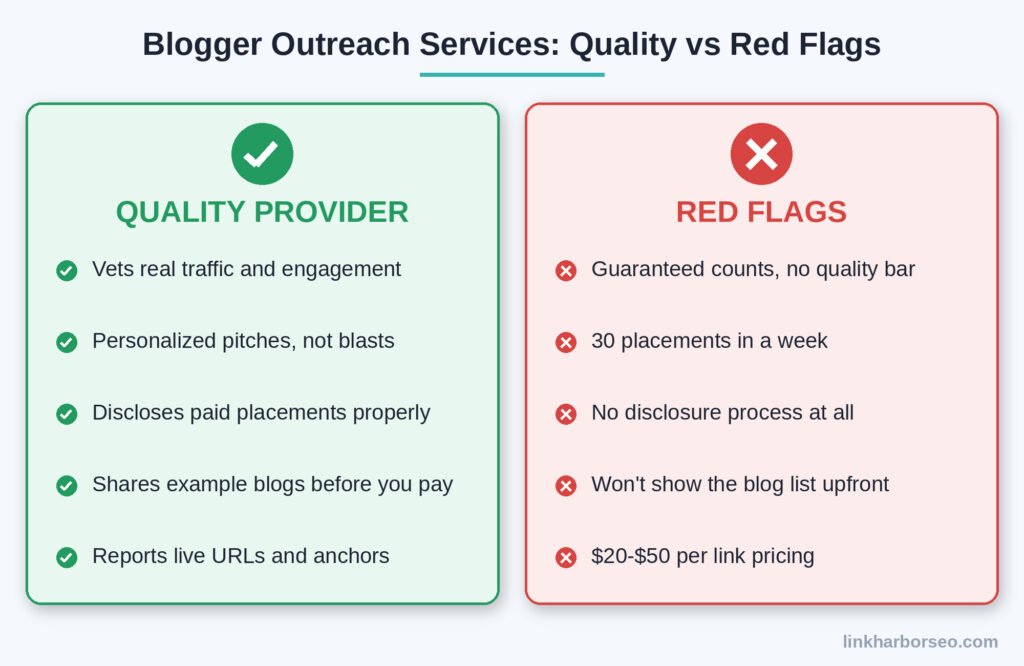
The five biggest red flags: guaranteed placement counts with no quality bar, overnight turnaround, no disclosure process, refusal to share the blog list before you commit, and pricing too cheap for real vetting to exist.
Here’s what most agencies won’t volunteer. So watch for it yourself.
Guaranteed placement counts with no mention of relevance or quality. If someone promises “20 placements guaranteed” without ever asking about your niche, they’re likely pulling from a fixed network that accepts anything.
Suspiciously fast turnaround. Real blogger trust doesn’t get built overnight. A campaign promising 30 placements in a week almost never comes from genuine relationships.
No disclosure process mentioned. Undisclosed paid content isn’t a shortcut. It’s a liability sitting on your site.
Refusal to share the actual blog list before you commit. A legitimate provider can usually show examples from similar clients without hesitation.
Pricing that seems too good for the promised volume. Real vetting takes real time, and time costs money. Rock-bottom pricing for high volume almost always means the vetting got skipped.
The owner from the intro hit three of these five red flags without noticing. A guaranteed count, no disclosure process, and pricing that looked cheap for the volume promised. Any one of these alone is worth a question. Two or more, and it’s worth walking away.
Signs You’ve Found a Good Provider
Red flags only get you halfway. Here’s the other side.
Business comes first, before the pitch. A good provider asks about your niche, your existing backlinks, what you’ve already tried. Generic packages rarely fit every industry the same way.
Ask how they check real traffic versus inflated numbers, and watch the answer. A legitimate provider names specific tools without getting defensive. “We only work with quality sites” isn’t an answer, it’s a dodge.
Realistic beats impressive when it comes to timelines. Real blogger relationships take time, and a provider who admits that upfront is more trustworthy than one promising fast results on everything.
Reporting you could verify yourself is another good sign. Every link, every metric, checkable on your end. That transparency speaks for itself.
There’s one more tell worth watching for: a provider willing to turn away work that doesn’t fit. Hearing “your niche isn’t a great match for our network” is rare, and it’s usually a sign of honesty most agencies would rather skip.
What a Reasonable Contract Looks Like
Most legitimate providers work on a per-placement basis or a monthly retainer. Both are fine, as long as the terms are clear.
Per-placement pricing means you pay only for links that go live. More risk sits with the provider, so it usually costs more per link. Retainer pricing means a fixed monthly fee for an agreed volume of effort. It won’t always guarantee an exact placement count, since some months simply produce more responses than others.
Either model can work. What matters is the fine print. What happens if a placement gets removed later. Whether unused budget rolls over. How quality disputes get resolved. A provider that won’t put any of this in writing is one to walk away from, no matter how good the pitch sounded.
Ask for the contract before the sales call ends, not after you’ve already paid a deposit. A legitimate agency has one ready to send within a day.
How Much Do Blogger Outreach Services Cost
Expect $150 to $500 per placement on relevant, real-traffic blogs, or monthly retainers starting around $1,000 to $1,500. Rates of $20 to $50 per link almost always mean the vetting got skipped.
Pricing varies, but a few patterns hold across the industry.
Per-placement pricing on relevant, real-traffic blogs usually runs $150 to $500 per link, depending on authority and niche. Monthly retainers with a set placement volume often start around $1,000 to $1,500 for smaller campaigns, and scale up from there.
Anything priced at $20 to $50 per placement should raise a question fast. What quality of site accepts that rate? For a broader sense of what SEO work costs overall, not just outreach, we’ve covered that separately.
Cheap outreach isn’t automatically a scam. It usually just means volume over relevance. And volume without relevance rarely moves rankings.
Niche matters too. Finance and B2B SaaS placements tend to sit at the higher end, since fewer bloggers cover those spaces well. Lifestyle and general business niches have more supply, so pricing often runs lower for comparable quality.
How to Know If Your Blogger Outreach Is Working
Placement count isn’t the metric that matters. Track these three instead:
- Referring domains gained from the campaign, and whether they’re actually relevant to your niche
- Referral traffic from the published links, visible directly in Google Analytics
- Keyword position movement for the pages that received new links, tracked over 8 to 12 weeks
Getting placement reports full of links with none of these three numbers moving? Something in the quality is off, no matter how good the count looks on paper.
The Bottom Line
Blogger outreach services aren’t good or bad by default. The label covers both relationship-driven agencies and volume-focused link sellers. What separates them shows up in the questions you ask before signing, not the price on the proposal. Pay a bit more for someone who’ll walk you through their vetting process and show real examples. Skip the one promising the highest count at the lowest price. That price gap usually reflects a quality gap.
And yes, full disclosure: this is the work we do at LinkHarbor SEO. Ask us the same five questions above. A provider who wrote them down should have no trouble answering them.
If you want the fundamentals of how guest posting works before diving into outreach specifically, that’s worth reading first. And once you understand the placement side, our guest posting framework walks through exactly how to land your first one.
Frequently Asked Questions
Is blogger outreach the same thing as guest posting?
They overlap, but they’re not identical. Guest posting means writing content for another site. Blogger outreach is broader. It can include product reviews, mentions, interviews, or resource page additions, not just full articles.
How long does a blogger outreach campaign take to show results?
Most campaigns take 4 to 8 weeks just to secure placements. Real outreach means waiting on replies and negotiating terms. Ranking impact from those links usually shows up 8 to 16 weeks after the content goes live.
Can I do blogger outreach myself instead of paying for a service?
Yes. Plenty of people do. It takes real time for research, personalized pitching, and follow-up. If you have the hours and the patience for a low initial reply rate, DIY works fine.
What’s a reasonable reply rate to expect from outreach emails?
Somewhere between 8% and 20% for well-targeted, personalized outreach. Anything under 5% usually points to a poorly matched list or generic pitches.
Do I need to pay bloggers for placements?
Not always. Some link out for free if your content or product genuinely fits their audience. Others expect payment, a free product, or an affiliate deal. A good outreach service tells you upfront which applies to each placement.
Should every blogger outreach placement include a dofollow link?
No, and that’s fine. A natural link profile mixes dofollow and nofollow. An agency promising 100% dofollow on every placement is often prioritizing link value over disclosure compliance.
What niches are hardest to run blogger outreach campaigns in?
Finance, legal, and healthcare tend to move slower. Bloggers get more cautious about what they publish, and compliance adds extra steps. It’s not impossible, just slower. Expect longer timelines and lower response rates.
How many bloggers should an agency contact to land one placement?
Often 8 to 15 contacts per successful placement, depending on the niche and how targeted the list is. A narrow, well-matched list needs fewer. A broad, loosely relevant list needs more, and usually delivers weaker results even when it works.
Is a smaller blog ever worth a placement?
Yes, if it’s genuinely relevant and engaged. A blog with 3,000 monthly readers who trust the writer’s recommendations can outperform a 50,000-visitor site with disengaged traffic. Traffic numbers alone don’t tell the full story.

2 comments on “Blogger Outreach Services: What They Actually Include (And What to Expect)”