


We keep seeing the same pattern with SaaS founders who come to us. A pile of backlinks, mostly from directory submissions, and a domain rating that hasn’t moved in months.
Usually it started with a freelancer promising fast, bulk backlinks. Classic mistake. SaaS link building doesn’t work like e-commerce or local business link building. Different buyers. Different content. Different sites that will actually link to you.
Here’s what we’ve learned running link campaigns for SaaS clients over the past year.
What Is SaaS Link Building (And Why It’s Not Like Other Niches)
Link building for a SaaS product means earning backlinks from sites your buyers actually trust: review platforms, industry blogs, comparison sites, integration marketplaces. Not random guest posts on “digital marketing” blogs that accept anything. It’s one piece of the bigger SEO puzzle, but for SaaS it carries more weight than most other tactics.
SaaS buyers research differently. They compare tools. They check G2 and Capterra. They read “alternative to X” threads on Reddit before they read your homepage. Your link strategy needs to show up where that research happens.
Read that again if you’re still buying generic guest post packages. Volume doesn’t fix this. Relevance does.
Why Most SaaS Link Building Advice Fails
Most SEO agencies treat SaaS like any other client. They run the same guest-posting playbook they use for a plumbing company. It doesn’t translate.
A few reasons why. Buyers are technical, so they spot thin content fast, faster than most other niches. Every SaaS category also has four or five agencies fighting over the same 200 blogs, which makes generic pitches land in a full inbox. And it’s not just blog posts that need links. Pricing pages, feature pages, integration pages all need authority too, something the generic playbook usually ignores completely.
We often see the opposite problem when we audit a link profile: nearly all the links point to the homepage, almost none to the comparison pages where most of the organic traffic actually converts. That’s a wasted campaign, and it circles back to the same quality-over-quantity question that trips up most link building, not just the SaaS kind.
Tactics That Actually Move the Needle
1. Original Data and Digital PR
SaaS companies sit on data nobody else has: usage patterns, survey results, industry benchmarks. Publish it, and journalists cite it without being asked. We ran this for a client last quarter with a dataset that took maybe six hours to pull from their own product analytics. Nothing fancy. It still got picked up by two industry newsletters within a month, because nobody else had bothered to publish it first.
Toast, a restaurant point-of-sale company, grew organic traffic past 600,000 monthly visits partly by turning its own operational data and case studies into content other sites picked up and linked to on their own.
2. Product Review and Free-Access Links
Offer a free account to a niche blogger or reviewer in your category. Genuine reviews earn links naturally, and increasingly get cited by AI search tools too.
3. Competitor Gap Mapping
Pull your top competitor’s referring domains. Find pages that link to them but not you: roundups, “best tools” lists, comparison posts. Pitch yourself as the missing option.
This one’s underrated, honestly. It’s an easier yes than cold outreach, because the site already links to tools like yours, they just don’t know you exist yet.
4. Marketplace and Integration Listings
If you integrate with Salesforce, HubSpot, Shopify, or similar platforms, get listed in their app marketplace. These pages are high-authority, evergreen, and rarely expire.
5. Selective Guest Posting
Not volume guest posting. Two or three genuinely useful articles on real SaaS or marketing blogs beat twenty low-quality placements. For the mechanics of doing this properly, our guest posting framework walks through vetting a site before you pitch it.
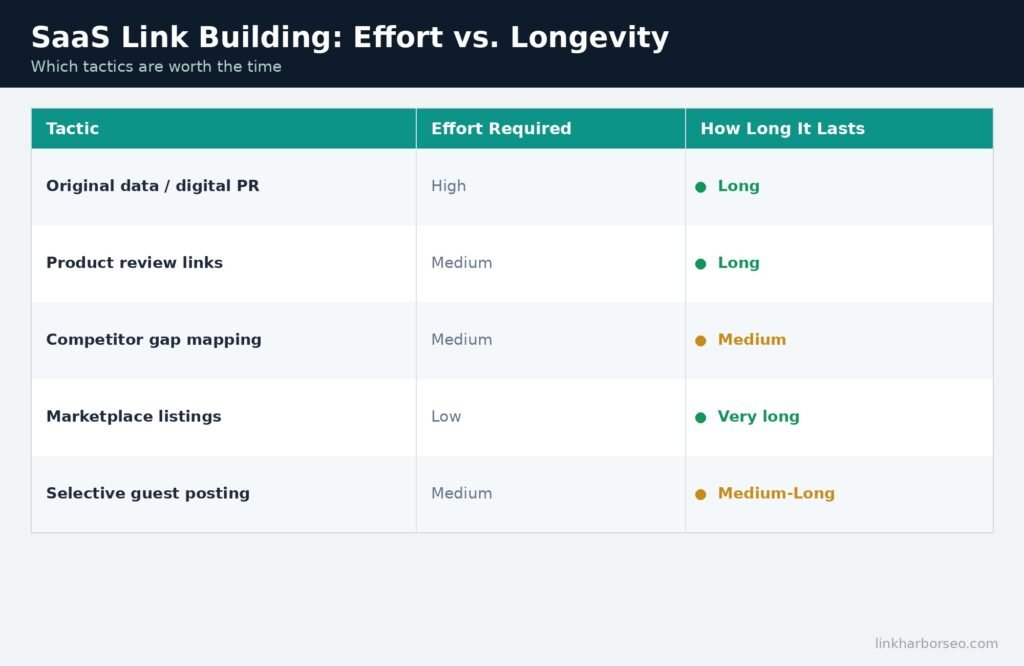
Tactic Comparison: Effort vs. Longevity
| Tactic | Effort Required | How Long It Lasts |
|---|---|---|
| Original data / digital PR | High (research + design) | Long — links accumulate for years |
| Product review links | Medium | Long — stays live as long as the review does |
| Competitor gap mapping | Medium | Medium — depends on the page’s own lifespan |
| Marketplace listings | Low (one-time setup) | Very long — evergreen |
| Selective guest posting | Medium | Medium to long |
AI Search Is Changing the Math
AI Overviews show up on a lot more searches than they did a year ago. One widely cited analysis of over 10 million keywords found the feature went from appearing on about 6.5% of queries in January 2025 to roughly 13% by March, and prevalence has stayed well above those early-2025 levels since. Fewer clicks reach organic listings when that happens.
That doesn’t kill link building. It changes what a link is for. A citation in an AI answer still traces back to whichever sites AI systems trust as sources. Directory listings, marketplace pages, and original research are exactly the kind of content that keeps showing up in those answers.
A Simple Framework If You’re Starting From Zero
- Map your product pages first: decide which comparison, feature, and pricing pages actually need links, not just the homepage.
- Build one piece of original data or research. This becomes your outreach anchor for months.
- Get your marketplace listings live before anything else. They’re free authority sitting on the table.
- Run competitor gap mapping monthly. It’s the fastest way to find easy placements, especially once you pair it with focused blogger outreach instead of mass emailing every blog in the niche.
- Track link building against organic sessions on target URLs, not domain rating alone. Domain rating doesn’t pay bills; ranked pages do.
For a hands-on, done-for-you version of this process, our manual link building service covers steps 2 through 4 end to end.
Mistakes We See SaaS Founders Make
- Buying bulk backlink packages with no relevance filter, because the invoice looked professional
- Links pointing only at the homepage, nowhere near the pages that actually convert
- Marketplace and integration listings sitting completely unclaimed
- Treating one guest post as “done” instead of something you repeat monthly
- Skipping the white-hat guidelines right before a funding round, which is exactly the wrong time for a manual action
We’ve seen that happen more than once. Not worth the risk.
Building Real Authority, Not Just Rankings
Link building for SaaS is slower than most founders expect. It compounds instead of spiking. If you’re still working out the fundamentals, our guide on how to start building links covers the basics before you layer SaaS-specific tactics on top. The authority backlinks that actually move rankings come from relevance and patience, not volume.
If you’d rather hand this off, our link building services are built around exactly this process: product-page mapping, original data, marketplace listings, and monthly gap analysis, tracked against real organic traffic, not vanity metrics.
FAQs
What is SaaS link building?
Same idea as regular link building, just aimed at the sites your specific buyers actually trust: review platforms, industry blogs, integration marketplaces. The goal is still backlinks that improve rankings and visibility, the sourcing is what changes.
How is SaaS link building different from regular link building?
SaaS buyers research more before converting. They compare tools on review sites and marketplaces. Link building needs to target those specific spaces, not generic guest post blogs.
How many backlinks does a SaaS site need?
There’s no fixed number, and anyone who gives you one is guessing. Relevance and placement on the right pages matter more than total count. Ten links from trusted, relevant sites outperform a hundred from unrelated ones.
Do marketplace listings count as backlinks?
Yes. Integration and app marketplace listings (Salesforce AppExchange, HubSpot Marketplace, etc.) are backlinks, and they tend to be some of the longest-lasting ones a SaaS company can get.
Does AI search make link building pointless?
No, if anything it raises the stakes. It changes what gets cited. Original research, marketplace listings, and genuinely useful content are more likely to be pulled into AI-generated answers.
Can I do SaaS link building myself, or do I need an agency?
You can, if you actually have the hours for research, pitching, and monthly tracking. Most founders end up outsourcing it once the product itself starts needing their full attention, and the decision usually comes down to budget once you’ve seen what SEO actually costs versus the time it would take in-house.
How long before SaaS link building shows results?
Usually two to four months before you see meaningful movement, longer for competitive niches. It’s a compounding process, not a one-time push.
