


A client came to us in April with 340 backlinks pointing to his site. He was proud of that number. He’d paid a freelancer $200 for a “link building package” six months earlier and figured more links meant better rankings.
That’s the mindset most people have before they understand what building links is supposed to do for a website in the first place.
His traffic had dropped 22% in that time. Not despite the links. Because of them.
We pulled his backlink profile and found the problem in about ten minutes. Almost all 340 links came from the same three link farms — sites with no real traffic, no relevant content, and spam scores above 40%. Google wasn’t ignoring these links. It was punishing him for them, which is a much harder problem to fix than simply having too few links.
That’s the story we tell every new client before they start building links, because it’s the mistake almost everyone makes first.
What Does “Building Links” Actually Mean?
Building links means earning hyperlinks from other websites that point back to your site, in a way that signals real trust and relevance to Google, not just accumulating a number.
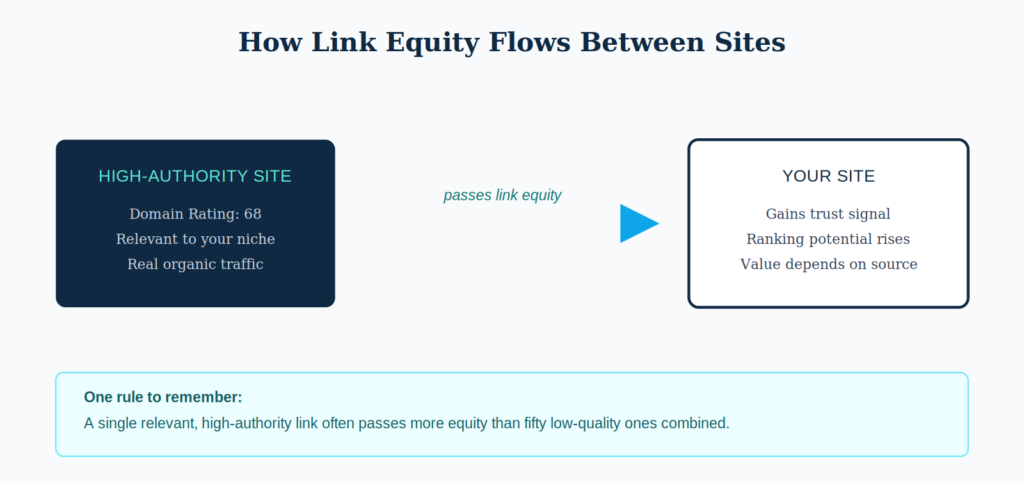
The distinction matters more than most people think. A backlink from a well-known niche blog with 5,000 monthly visitors is worth more than fifty backlinks from directories nobody has heard of. Google’s algorithm evaluates the referring domain’s authority, its relevance to your topic, and whether the link looks naturally earned or artificially placed. Some people call this domain authority, others call it domain rating depending on which tool they use, but the underlying idea is the same either way.
Two websites can have wildly different backlink counts, and the one with fewer links often outranks the other anyway. Volume was never really the point of building links. Link equity is, meaning the trust and ranking power that flows through a link from one site to another.
Why Building Links Still Matters in 2026
Some people online claim link building is dead. It isn’t, and here’s the honest reason why.
Google still uses backlinks as one of its strongest ranking signals, alongside content quality and user experience. Sites that keep building links from relevant, trusted referring domains consistently outrank sites with thin or manipulated link profiles, even when the content quality is similar.
We’ve seen this play out with our own clients. One SaaS company we worked with moved from position 34 to position 6 for a competitive keyword after earning 12 genuinely relevant editorial links over four months. His content stayed the same the whole time, and we didn’t touch anything technical either. Building links was the only variable that changed, and it was enough.
The keyword “authority backlinks” gets meaningful monthly search volume for a reason. Business owners are actively looking for this because they’ve noticed the same thing you probably have: content alone isn’t enough anymore.
Types of Links You Can Build
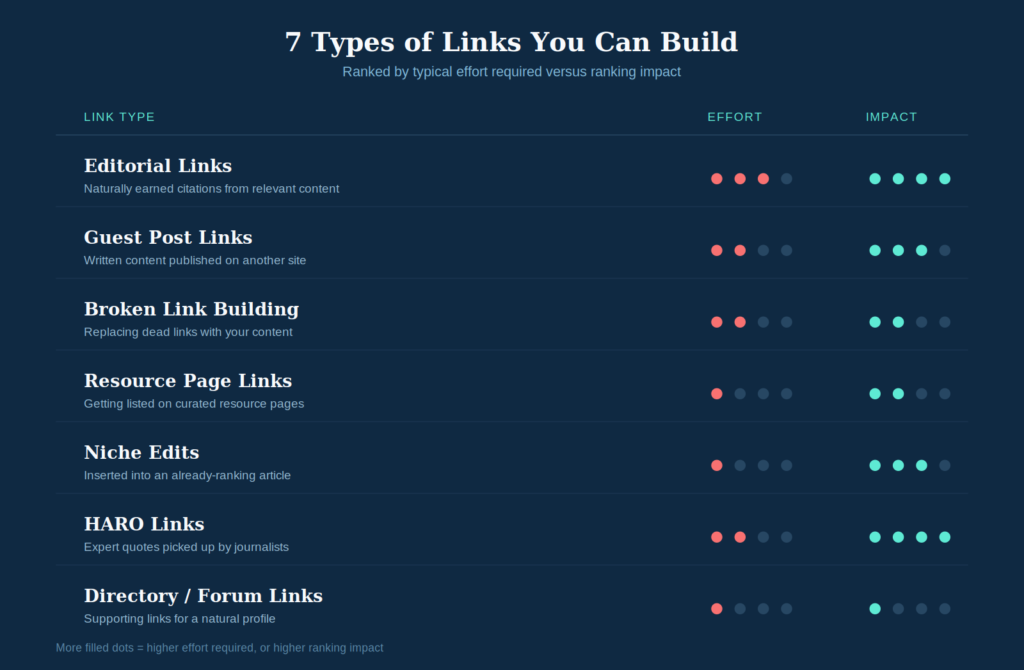
Not every link is created equal, and knowing the difference helps you prioritize where to spend your time when you’re building links for a newer site.
Editorial links are the gold standard. These happen when another website naturally references your content because it’s genuinely useful, like a journalist citing your data or a blogger linking to your guide. You can’t force these, but you can make content that earns them.
Guest post links come from writing content for another website in exchange for a link back to yours. If you’re still fuzzy on what guest posting involves and how it builds authority, that’s worth reading first. Once the basics make sense, our guest posting framework walks through exactly how to go from zero to your first placement.
Broken link building is one of the most underused tactics. You find a dead link on a relevant site, then reach out and suggest your own content as the replacement. Site owners often say yes because you’re solving a problem for them, not just asking for a favor.
Resource page links come from getting your content added to a curated “best resources” or “useful tools” page. These pages exist in almost every niche and they’re actively looking for content to add.
Niche edits (sometimes called link insertions) involve adding your link into an already-published, already-ranking article on a relevant site. These can be powerful because the page already has authority, but they need to be handled carefully, which we’ll get to.
HARO links come from responding to journalist queries on platforms like Connectively (formerly HARO). You provide expert commentary, and if a journalist uses your quote, you often get a link from a major publication.
Directory and forum links exist too, but their impact is smaller today. They still play a role in a natural-looking backlink profile. Just don’t expect them to move rankings on their own.
A quick way to think about priority when you’re building links with limited time: editorial and HARO links take the most effort but carry the most weight. Guest posts and broken link building sit in the middle. Niche edits and resource page links are usually the fastest wins for a new website with limited outreach capacity.
How to Build Links Step by Step
Here’s the actual process we use with clients, broken into five stages.
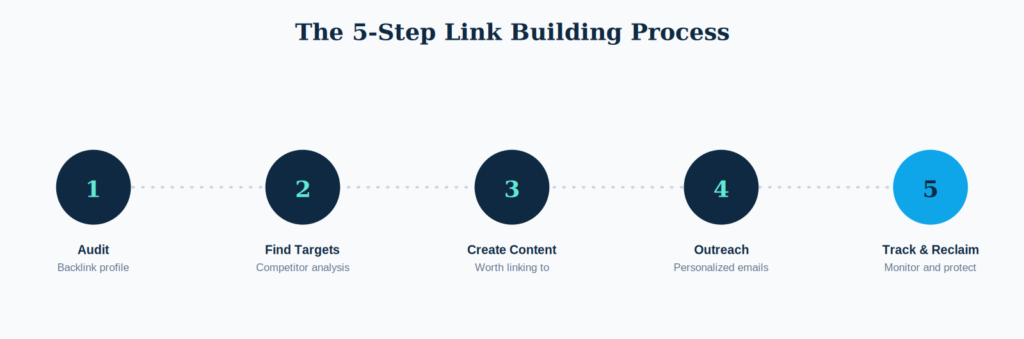
Step 1: Audit Your Current Backlink Profile
Before building anything new, check what you already have. Pull your backlink data from Google Search Console or a tool like Ahrefs or Semrush. Look at your referring domains, your overall domain rating, and, this part matters, check for toxic or spammy links that might already be dragging you down.
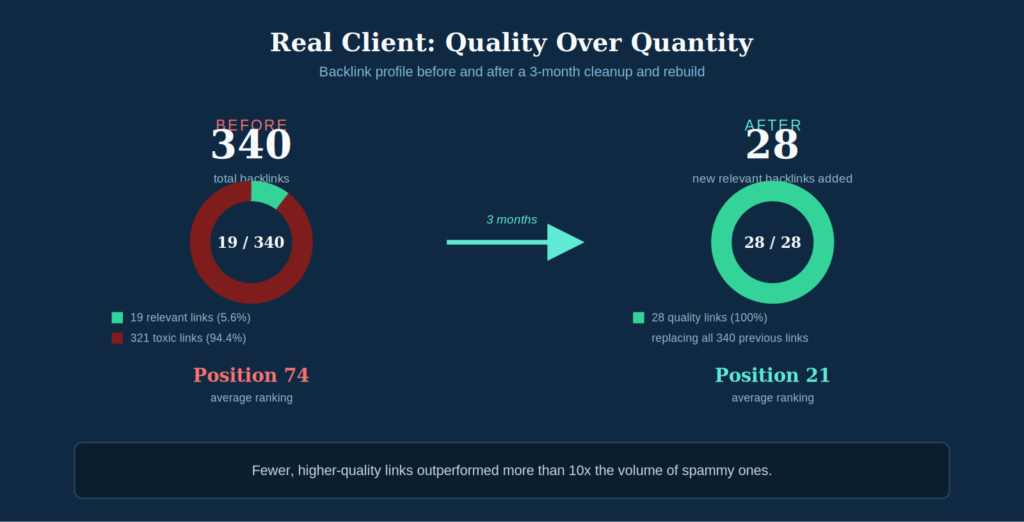
This audit is what caught the problem for the client we mentioned earlier. Out of his 340 backlinks, only 19 came from domains with any real traffic or topical relevance. The other 321 were working against him, not just sitting there uselessly. We disavowed the worst offenders through Search Console and started building links fresh with a target of quality over quantity. Three months later, with just 28 new relevant links added, he was ranking higher than he’d ever been with 340.
Step 2: Find Relevant Link Targets
Competitor backlink analysis is the fastest way to find realistic opportunities for building links in a niche you already understand. Pull the backlink profile of a competitor who’s outranking you and see where their links are coming from. If a site linked to them, there’s a decent chance it’ll link to you too, especially if you offer something better.
Build a simple spreadsheet with four columns: the referring domain, its domain rating, its relevance to your niche on a scale of 1 to 5, and a contact email if you can find one. Sort by relevance first, authority second. A moderately authoritative site that’s a perfect topical match will usually outperform a high-authority site that has nothing to do with your industry.
Don’t limit yourself to just one competitor either. Pull backlinks for your top three competitors and look for domains that appear in more than one list. Those sites clearly link out to your niche regularly, which makes them warmer prospects than a random cold outreach target.
Step 3: Create Content Worth Linking To
Nobody links to mediocre content. The skyscraper technique, finding a popular piece of content in your niche and creating something noticeably better, works because it gives you a real reason to reach out to the sites already linking to the original.
Step 4: Do the Outreach
Most people give up right around here. Not because outreach doesn’t work, but because the first 20 emails usually go nowhere and it feels like a waste of time. Send a short, specific email anyway. Mention exactly why your content is relevant to their audience. Don’t send templates that read like they were blasted to 500 people at once, because everyone can tell, and it kills your reply rate.
We track anchor text carefully at this stage too. Using the exact same phrase every time looks manipulative to Google. Mix in your brand name, partial phrases, and natural language like “this guide” or “here” alongside your target keywords.
Expect somewhere between a 5% and 15% reply rate on cold outreach, and a lower conversion rate than that into an actual placed link. That’s normal when you’re building links from scratch. It’s a volume game early on, and it gets easier once you have a handful of live links to point to as social proof in future pitches.
Step 5: Track and Reclaim
Set a quarterly reminder to check your backlinks again. Sites get redesigned, content gets deleted, and links you worked hard to earn can quietly disappear. Link reclamation, reaching out to get a broken or removed link restored, recovers value you already earned once through building links the first time around.
Which Method Should You Start With If You’re a New Website?
If your site is brand new with little to no existing authority, start with broken link building and resource page links before chasing editorial placements or HARO.
The reasoning is simple. Editorial links and journalist-sourced links tend to go to sources that already look credible, an established site, a recognizable name, some existing coverage. A brand-new domain with no track record has a harder time earning those on the first attempt. Broken link building and resource page outreach don’t require that same credibility. You’re offering a practical fix to an existing problem, which lowers the bar for a yes.
Guest posting sits in a good middle spot too, since many sites accepting guest content care more about writing quality than domain age. Once you’ve landed 10 to 15 solid links this way and built some track record, editorial and HARO opportunities start converting at a noticeably higher rate.
As for budget, this is where expectations need to be realistic. DIY outreach costs time rather than money, but it’s genuinely time-consuming. Hiring it out typically runs anywhere from a few hundred to a few thousand dollars a month depending on volume and link quality. If you want a broader breakdown of what SEO work costs in general, not just link building, we’ve laid that out separately. Either way, building links is worth treating the same way you’d treat any other marketing spend: as an investment with a payback period measured in months, not days.
What Doesn’t Work Anymore
Here’s the part most agencies won’t tell you honestly. Everything in this section falls into what’s usually called black hat link building, the opposite of the white hat approach we’ve covered so far, and the risk-to-reward ratio just isn’t there anymore.
Buying links in bulk from marketplaces almost always backfires. Google has gotten good at spotting patterns. A sudden spike of 50 links in one week from unrelated, low-quality sites is a red flag, not a ranking boost. Link velocity is exactly what catches this kind of pattern, and unnatural velocity gets noticed fast.
PBNs (private blog networks) might still work short-term for some sites, but the risk isn’t worth it for most businesses. One algorithm update or manual action, and you lose the domain entirely along with every link pointing to it.
Reciprocal link exchanges, “I’ll link to you if you link to me,” used to work in the early 2000s. Today, Google can detect these patterns easily, and they contribute almost nothing to a natural link profile.
And honestly, the biggest mistake isn’t even a shady tactic. It’s impatience. People spend a month building links, ten decent ones, see no movement in two weeks, and assume it’s not working.
How Do You Know If Your Link Building Is Actually Working?
Track referring domain growth, not total backlink count, and watch it alongside keyword position over time.
Total backlink count is a vanity metric. A site can gain 40 low-quality links and see zero movement, or gain 6 highly relevant ones and jump several positions. What correlates with ranking improvement, in our experience, is growth in unique referring domains from relevant, trusted sites.
A simple monthly tracking sheet works better than any expensive dashboard. Track these three numbers side by side:
- Referring domains this month versus last month
- Average position for your target keywords
- Organic traffic to the specific pages you’re building links to
If referring domains go up but position and traffic stay flat for more than three or four months, something in the relevance or quality of those links is probably off, and it’s worth auditing again.
Google Search Console is enough to track this for most small businesses. You don’t need an expensive enterprise tool starting out. Check the Links report every couple of weeks and watch the trend line, not any single day’s number.
How Long Does It Take to See Results From Building Links?
Most sites start seeing measurable ranking improvement 8 to 16 weeks after a consistent link building effort begins, though this varies based on your starting domain authority and competition level.
New websites with little existing authority tend to be on the slower end of that range. A site with some existing trust and a handful of relevant referring domains already in place will often see movement faster. The client we mentioned earlier saw his first ranking jump around week 10 after he started building links the right way, not overnight, but faster than most of the guides online admit.
Frequently Asked Questions
How many links do I need before I see ranking movement?
There’s no fixed number. We’ve seen sites move rankings with 8 highly relevant links, and we’ve seen other sites need 30+ because they’re in a more competitive niche. Quality and relevance matter more than hitting a specific count.
Can I do link building myself, or do I need an agency?
You can absolutely do it yourself if you have the time. The outreach process isn’t complicated, it’s just time-consuming. Most business owners hire this out because they’d rather spend their hours running their business.
Is guest posting still an effective way of building links in 2026?
Yes, when done on genuinely relevant sites with real traffic. It’s one of the more reliable methods because you have some control over anchor text and placement.
What’s a “toxic” backlink, exactly?
A toxic backlink typically comes from a spammy, low-quality, or irrelevant site, think link farms, hacked websites, or sites in completely unrelated languages and niches. A handful won’t hurt you much. A pattern of them can trigger algorithmic penalties, which is exactly why auditing before building links matters so much.
Do nofollow links help at all?
Yes, though differently than dofollow links. They don’t pass link equity the same way, but they still drive referral traffic and contribute to a natural-looking backlink profile, which matters more than people assume.
Should I worry about my competitors having way more backlinks than me?
Not necessarily. Check the quality of those links before panicking. We’ve had clients outrank competitors with three times more backlinks simply because their own links were more relevant and came from higher-trust sites.
How is building links different from just doing SEO in general?
Link building is one piece of SEO, not the whole thing. On-page SEO and content quality get your site into contention, but building links from relevant, trusted sites is often what pushes a page from page two into the top five once the on-page work is already solid.
If your website still isn’t showing up on Google after publishing content, there are usually a few specific reasons why, and most of them are fixable in a weekend. And if you’re trying to figure out whether your current backlinks are helping or quietly hurting you, our guide on authority backlinks breaks down exactly what to check first.
Umar, ye raha code directly — copy karke apni website mein paste kar dein:
html
