


This guide breaks down link building vs content marketing in plain English. You’ll see 10 real differences, real 2026 pricing, and a simple way to use both together.
What Is Link Building vs Content Marketing?
Before comparing the two, let’s define them clearly. This is where most confusion starts.
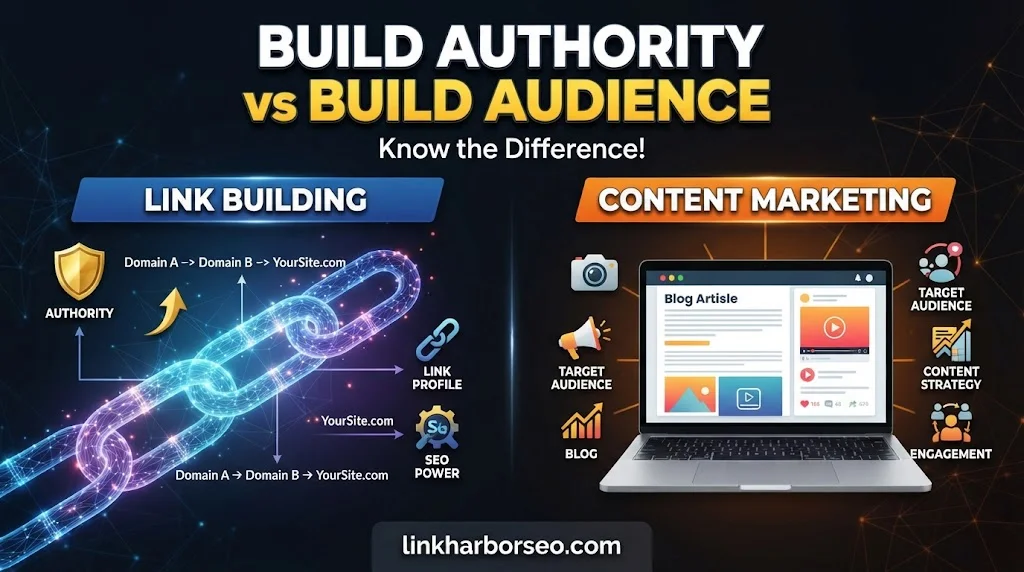
Link building is the process of earning backlinks from other websites. A backlink is a hyperlink from another site that points back to yours. Google treats these links as votes of trust. This idea comes from PageRank, Google’s original ranking algorithm.
Content marketing is different. It means creating valuable content — blogs, guides, videos, or tools — that attracts and keeps an audience. The Content Marketing Institute defines it as a strategic approach focused on creating content that drives profitable customer action.
Here’s the simplest way to remember it: content marketing builds your audience. Link building builds your authority. Both feed your SEO strategy, but they work in different ways.
10 Key Differences Between Link Building and Content Marketing
Now for the core comparison. These 10 differences cover goals, cost, risk, and even how each strategy affects AI search in 2026.
| Factor | Link Building | Content Marketing |
|---|---|---|
| Primary Goal | Boost rankings through backlinks | Build authority and audience trust |
| Time to Results | Weeks to a few months | Several months to a year |
| Ownership | Rented (you don’t control other sites) | Owned (your asset forever) |
| Risk Level | Higher (spam links can trigger penalties) | Low |
| Best For | Fast keyword rankings | Long-term brand growth |
1. The primary goal is different. Link building targets specific keywords and rankings. Content marketing targets audience trust and brand authority over time.
2. Speed of results varies a lot. Link building can lift rankings within weeks if you land quality editorial links. Content marketing usually needs several months before it compounds into steady traffic.
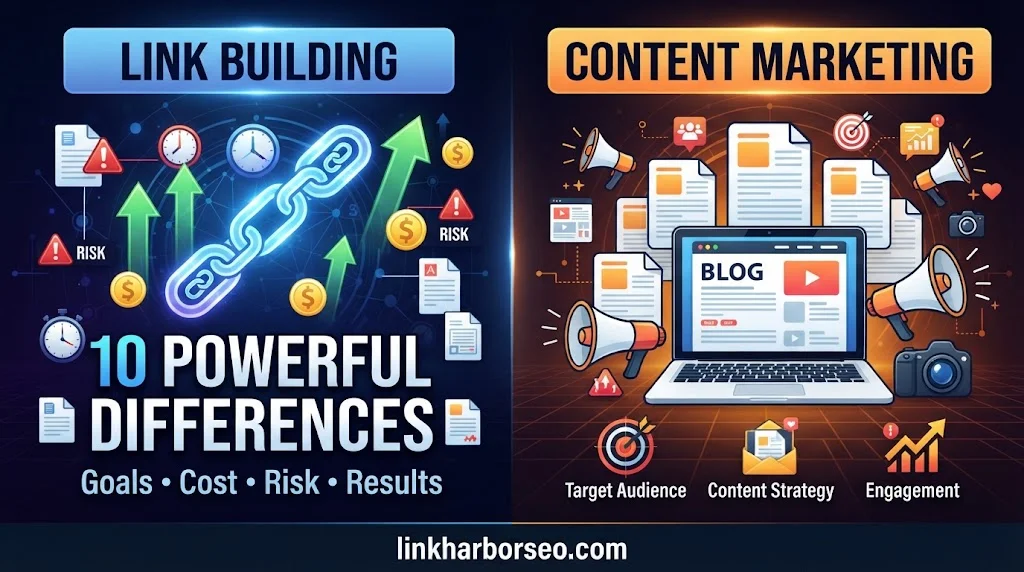
3. Cost structures aren’t the same. Link building is priced per link or per campaign. Content marketing is usually priced per article or as a monthly retainer. We’ll break down real numbers below.
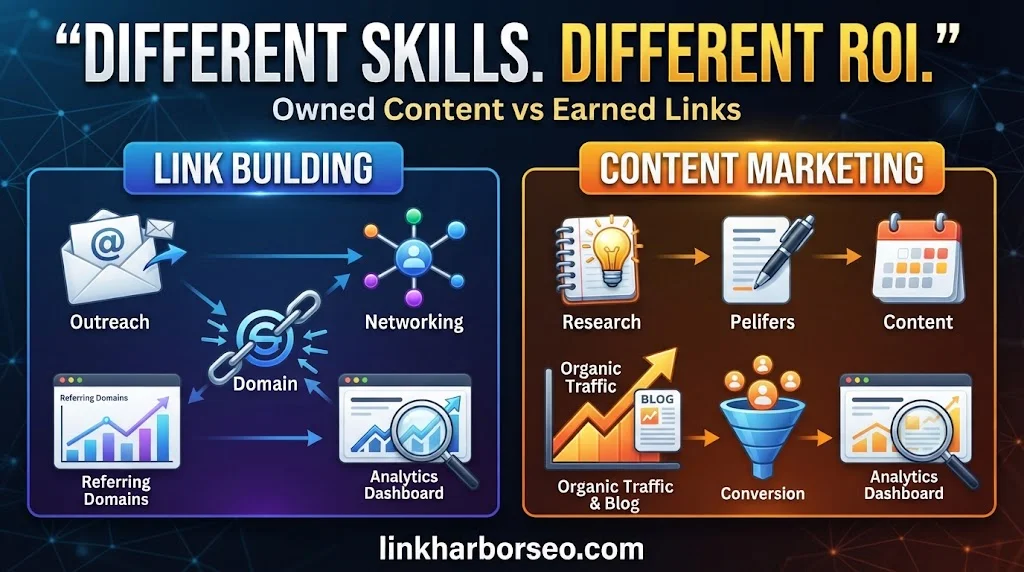
4. The skill sets barely overlap. Link building needs outreach, relationship-building, and negotiation. Content marketing needs research, writing, and on-page SEO know-how.
5. Risk level is not equal. Buying spammy links or joining a link farm can trigger a Google penalty. Content marketing carries almost no penalty risk — the worst case is content that simply doesn’t rank.
6. Ownership works differently. A backlink lives on someone else’s website. If that site takes it down, you lose it. Your content lives on your own domain. It’s a true owned media asset.
7. Measuring ROI takes different tools. Link building is tracked through referring domains, domain authority (DA), and anchor text distribution. Content marketing is tracked through organic traffic, time on page, and lead conversion.
8. Impact on domain authority differs in scale. Backlinks directly influence DA scores. Content influences DA indirectly — great content earns links naturally, which then lifts your DA over time.
9. Their role in AI search is growing apart. This is new for 2026. Research from Editorial.Link found that 73.2% of marketers believe backlinks affect whether a brand gets featured in AI Overviews and other AI-generated answers. Meanwhile, content built for Answer Engine Optimization (AEO) and Generative Engine Optimization (GEO) — meaning content structured for AI citation — is becoming its own skill inside content marketing.
10. Longevity and compounding value differ. A single backlink’s value can fade if the linking site loses authority. A strong piece of content can keep earning traffic, shares, and new links for years without extra spend.
Must Read: How Targeted Link Building Can Explode Your Domain Authority Fast
Which One Should You Choose: Link Building or Content Marketing?
Neither strategy wins outright. The right pick depends on your goal, budget, and timeline.
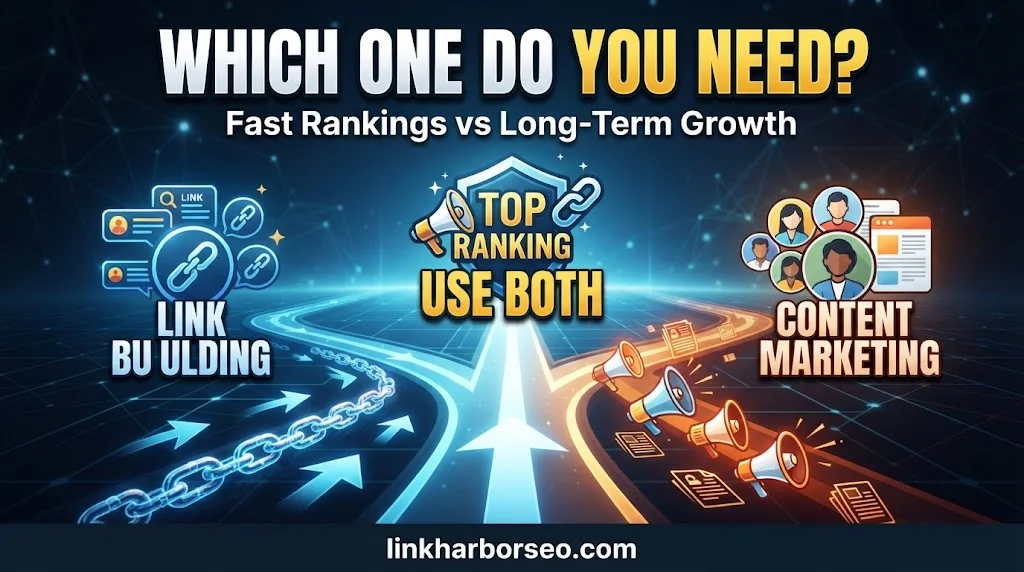
Choose link building if: you need faster movement on competitive keywords, your content is already solid but under-linked, or you’re in a niche where domain authority decides who ranks (finance, legal, health).
Choose content marketing if: you’re building a brand from scratch, you want compounding organic traffic, or you want visibility inside AI search results and featured snippets.
Use both if: you want sustainable rankings. Data from Ahrefs shows backlinks remain a top-three Google ranking signal in 2026, but they work best when pointing to genuinely useful content. Neither strategy performs at its best alone.
How to Combine Link Building and Content Marketing
Here’s a simple sequence that works for most US businesses, from small brands to SaaS companies.
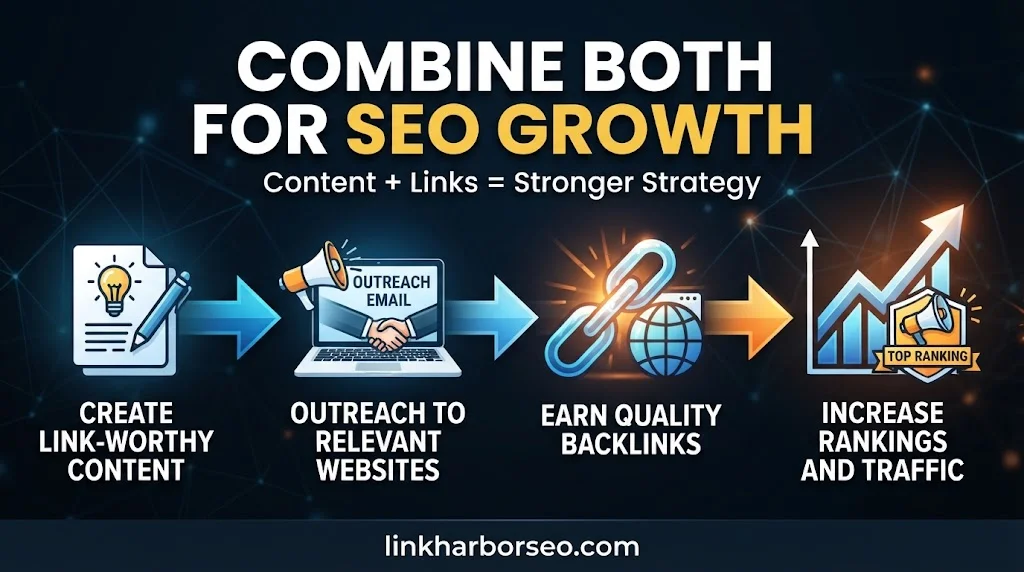
Start with content that’s actually link-worthy. Original research, data studies, and expert guides earn links naturally. “Why” posts and “what” posts consistently earn the most backlinks, according to industry data.
Then prioritize outreach to relevant, high-authority sites. Don’t chase every website. A few backlinks from relevant, trusted domains beat dozens from low-quality ones.
Repurpose your best content into linkable assets. Turn a blog post into an infographic, a tool, or a data visual. These formats attract links far more easily than plain text.
Track combined impact, not each channel separately. Watch how referring domains and content traffic move together. That combined lift is the real signal your SEO strategy is working.
Link Building vs Content Marketing Cost in the USA (2026)
Budget is often the deciding factor. Here’s what US businesses are actually paying in 2026.
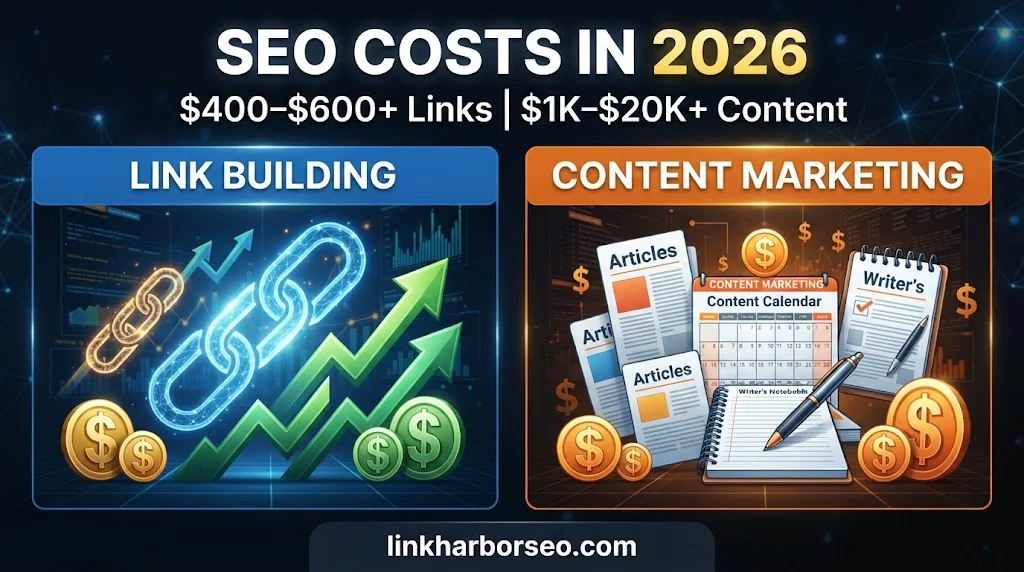
Link building costs per backlink average $508.95 for a high-quality placement, according to Editorial.Link’s 2026 report. Guest post links from strong sites can run $400 to $600, while premium digital PR placements in national outlets range from $500 to $5,000 per feature.
Agency retainers for link building typically run $1,500 to $6,000 per month for small to mid-sized campaigns, based on data from Bluetree Digital.
Content marketing costs are usually billed differently. Most US businesses spend $1,000 to $20,000+ per month, depending on volume and quality, per WebFX research. A single well-researched article can range from $100 for 500 words to $250+ per 500 words for expert-level writing, according to Media Shower data.
In-house teams cost more upfront but scale better. An in-house content or link building specialist typically costs $5,000 to $8,000+ per month once salary, tools, and training are factored in.
Must Read: Link Building Outreach Strategies That Actually Get Replies and Backlinks in 2026
FAQs
Is link building part of SEO?
Yes. Link building is one of the three core pillars of SEO, alongside on-page SEO and technical SEO. It specifically supports off-page SEO, helping search engines judge your site’s authority and trustworthiness through backlinks.
What are 7 types of digital marketing?
The seven main types are Search Engine Optimization (SEO), Pay-Per-Click (PPC) advertising, content marketing, social media marketing, email marketing, affiliate marketing, and mobile marketing. Link building falls under the SEO category, and content marketing is its own dedicated type.
Are backlinks still relevant in 2026?
Yes. Backlinks remain a top-three Google ranking factor in 2026, according to multiple industry studies, including research from Ahrefs. Quality now matters far more than quantity — a handful of relevant, authoritative links outperforms hundreds of weak ones.
How much does link building cost?
Most US businesses pay $400 to $600 per high-quality backlink, with an industry average of $508.95 per link. Monthly retainers for managed campaigns typically range from $1,500 to $6,000, though enterprise campaigns can exceed $20,000 per month.
Conclusion
Link building and content marketing aren’t rivals — they’re two halves of the same SEO engine. Content gives people a reason to visit and link to your site. Links give that content the authority to rank. Businesses that treat them as one connected strategy, not separate line items, are the ones winning search visibility — both on Google and inside AI-generated answers — in 2026.

2 comments on “Link Building vs Content Marketing: 10 Powerful Differences You Need to Know”