


White hat link building is the slow way to earn links. It’s also the only way left that works.
I say that as someone who audits the other kind for a living. Every month we open backlink profiles stuffed with purchased placements, PBN links, and directory blasts, and every month the story is the same: money spent, rankings unchanged, and an owner who’s concluded that link building itself is a scam. It isn’t. The shortcut version of it is.
This guide covers what white hat link building actually means in 2026, how it differs from the black hat and gray hat tactics still being sold everywhere, and the seven techniques we use for clients because they hold up when Google’s next update lands.
What Is White Hat Link Building?
White hat link building means earning backlinks through methods Google’s guidelines explicitly allow: creating content worth citing, contributing genuine value to other sites, and building real relationships in your niche. The links are editorial, meaning the other site chose to give them.
That last word, chose, is the whole definition. Every white hat technique, whatever it’s called, comes down to giving another site a reason to link that benefits them or their readers. Guest posting works because the host gets free expert content. Data studies work because writers need sources to cite. Journalist quotes work because reporters need experts on deadline.
Black hat link building removes the choosing. The link exists because someone paid for it, automated it, or planted it where nobody was watching. Google’s spam policies have a long list of these, and the list keeps growing because the tactics keep mutating.
White Hat vs Black Hat vs Gray Hat: The Real Differences
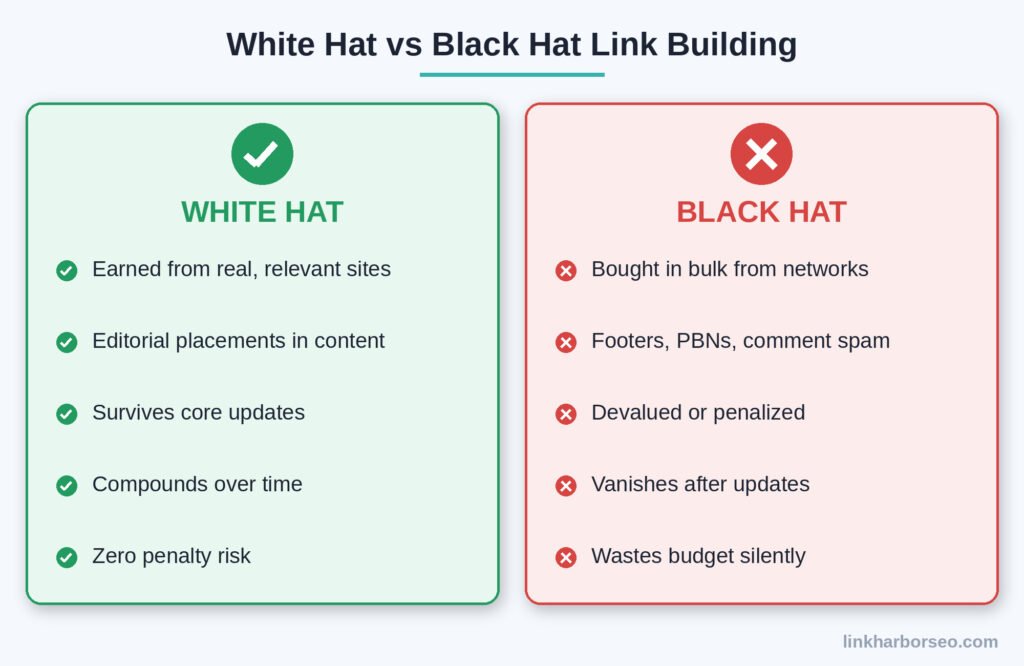
White hat tactics earn links editorially and carry zero penalty risk. Black hat tactics manufacture links at scale and get devalued or penalized. Gray hat sits in between, and in 2026 it behaves more like black hat than most sellers admit.
| White Hat | Gray Hat | Black Hat | |
|---|---|---|---|
| How links happen | Earned editorially, site chooses to link | Paid placements dressed as editorial | Bought in bulk, automated, or hidden |
| Examples | Guest posts on real sites, data studies, journalist quotes | Undisclosed sponsored posts, link exchanges | PBNs, comment spam, hacked links, link farms |
| Google’s response | Rewarded, compounds over time | Increasingly devalued, silent | Devalued or penalized |
| Survives core updates? | Yes, and usually gains | Unpredictable | Rarely |
| Cost over 12 months | Higher upfront, keeps paying | Medium, decays | Cheap, worth roughly nothing |
The honest part most guides skip: the line between white and gray moved a lot this decade. Plenty of “guest posting” sold today is actually gray hat, paid placement on sites that publish anyone. The technique isn’t what makes it white hat. The site’s editorial standard is. A guest post on a site with real readers and real judgment is white hat. The same article on a site that publishes whatever arrives with payment is not, whatever the invoice calls it.
Why White Hat Is the Only Approach Left Standing
Google’s March 2026 core update made this argument better than I can.
The sites that lost hardest in the audits we ran afterward shared two traits: content with nothing original in it, and link profiles built from marketplaces. Their links weren’t penalized in most cases. They were ignored, which costs the same and stings less visibly. Meanwhile, sites holding editorial links from relevant, trafficked sources held their positions or climbed into the space the others vacated.
That’s the pattern of every major update since Penguin. Manufactured links don’t usually get you punished anymore. They get you nothing, quietly, while you keep paying. White hat link building is slower and harder, and it’s the only spend in this category that compounds instead of evaporating. It’s the true-or-false case for backlinks in one sentence: links still build authority, but only the earned kind count.
7 White Hat Link Building Techniques That Work in 2026
The techniques that reliably earn white hat links right now: guest posting on vetted sites, journalist and expert quotes, original data studies, resource page outreach, unlinked brand mentions, broken link building, and community or industry participation.
1. Guest posting on genuinely vetted sites. Still the workhorse, and still the most abused term in SEO. The white hat version means contributing real expertise to a site that has editorial standards, actual readers, and relevance to your niche. We qualify every prospect before pitching, and we published our full vetting standard in our field guide to authority backlinks. If you’re starting completely from zero, the step-by-step guest posting framework covers finding, qualifying, and pitching your first site.
If you’d rather see exactly why we do this by hand instead of running bulk outreach software, our guide to manual link building explains why manual outreach beats automated tools.
2. Journalist and expert quotes. Reporters need sources on deadline, every single day. Platforms like Qwoted and Featured connect them with experts, and a sharp three-line answer with a specific example can land you a link from a publication you could never buy your way into. This is the highest-authority white hat channel available to small businesses, and most never touch it.
3. Original data and research. Writers link to statistics because they have to cite something. Publish a number nobody else has, even from a small dataset you collected yourself, and you’ve built an asset that earns links while you sleep. It doesn’t need to be a university study. “We analyzed 100 of X and found Y” is enough, as long as Y is real and interesting.
4. Resource page outreach. Thousands of pages exist purely to list useful resources on a topic. If you’ve built something genuinely useful, a guide, a tool, a template, pitching it for inclusion is a small ask with a decent hit rate. The link lives inside a page built for linking, which is exactly where Google expects links to live.
5. Unlinked brand mentions. As your brand grows, sites will mention you without linking. A short, polite email converts many of those mentions into links. It’s the easiest win in this whole list, and it costs ten minutes a month to check.
6. Broken link building. Find dead links on relevant sites, offer your working resource as the replacement. You’re doing the site owner a favor, which is why it works. Slower than it used to be, but still white hat and still effective in niches with older established sites.
7. Community and industry participation. Answering questions where your audience gathers, contributing to industry roundups, speaking, being quoted in newsletters. Most of these links are nofollow, and they still matter: they build the brand mentions and visibility that AI search increasingly runs on, and they regularly lead to the dofollow editorial links that count directly. If you’d rather see how these techniques fit together from day one, how to start building links from zero walks the beginner’s path in order.
Where Does Paying for Placements Fit?
Time for the part most agencies dance around, since we’re an agency and people ask us directly.
Paying anyone for a guaranteed link violates Google’s guidelines. That’s not ambiguous. What’s also true is that a large share of “outreach” across every industry involves compensation somewhere, and Google’s practical response in 2026 is mostly to devalue what it detects rather than penalize it. The result is a market where businesses pay for links that silently count for nothing, which we wrote about recently in a piece TechBullion published on whether backlinks still work.
Our position is boring and we’re sticking to it: put the budget into earning links from sites that would say no to a bad pitch. A site that can refuse you is a site whose link means something. If you’re evaluating providers, our guide to vetting blogger outreach services lists the exact red flags that separate earned placements from dressed-up link sales.
How Long Does White Hat Link Building Take?
Expect your first placements within 4 to 8 weeks of starting outreach, ranking impact from those links within 6 to 12 weeks of going live, and compounding results from month four onward. White hat link building is measured in quarters, not weeks.
Anyone promising faster is describing a different color of hat. The timeline is the tax you pay for links that don’t evaporate, and it front-loads the pain: the first month feels like nothing is happening, then placements land, then Google processes them, then movement shows. Every client who stuck through month one has been glad by month four. The ones who quit at week three funded their competitors’ patience.
Getting Started This Month
A realistic first-month plan for a small business doing this in-house:
- Week 1: pick your one linkable page (best guide or tool you have) and fix it until it deserves links
- Week 2: build a list of 15 relevant sites, qualify each for real traffic and editorial standards, discard half
- Week 3: send 8 to 10 personalized pitches, sign up for one journalist-request platform, answer three requests
- Week 4: follow up once, convert any unlinked mentions you find, start batch two
And yes, the standing disclosure: this is the work our white hat link building service does for clients who’d rather not spend their weeks on it. Either way, the standard doesn’t change. Earn from sites that could say no.
Frequently Asked Questions
What is white hat link building in simple terms?
White hat link building means earning backlinks in ways Google’s guidelines allow: publishing content worth citing, contributing genuine expertise to other websites, and building real industry relationships. The defining trait is that the linking site chooses to link because it benefits them or their readers.
Is guest posting white hat or black hat?
It depends entirely on the site. A guest post contributed to a site with real editorial standards, real readers, and relevance to your niche is white hat. The same article paid onto a site that publishes anything for money is gray to black hat, regardless of what it’s called on the invoice.
What are examples of black hat link building?
Private blog networks (PBNs), bulk purchased link packages, comment and forum spam, hidden links, hacked-site links, and automated directory blasts. Google’s spam policies list these explicitly, and its systems now mostly devalue them silently rather than issuing visible penalties.
Can white hat link building get my site penalized?
No. That’s the entire point of it. Links earned editorially from relevant sites carry no penalty risk, which is why they’re the only category of link building that survives every Google core update.
How many white hat links do I need to see results?
Fewer than most people expect. For small business niches, 10 to 20 editorial links from relevant sites with real traffic typically outperforms hundreds of manufactured links. Referring domains and relevance matter far more than raw counts.
How much does white hat link building cost?
Done in-house, it mostly costs time: expect 10 to 15 hours per month for research, pitching, and content. Done through an agency, genuine white hat placements typically run $150 to $500 per earned link, reflecting the vetting and outreach work involved. Prices far below that range usually signal the vetting was skipped.
Does white hat link building still work with AI search?
Yes, arguably more than before. AI Overviews and assistants cite sources that already carry authority, and authority is still measured largely through editorial links and brand mentions. White hat techniques build both at once, which is why the same work now pays out in traditional rankings and AI visibility together.
