


A client asked me something last month that I think about a lot.
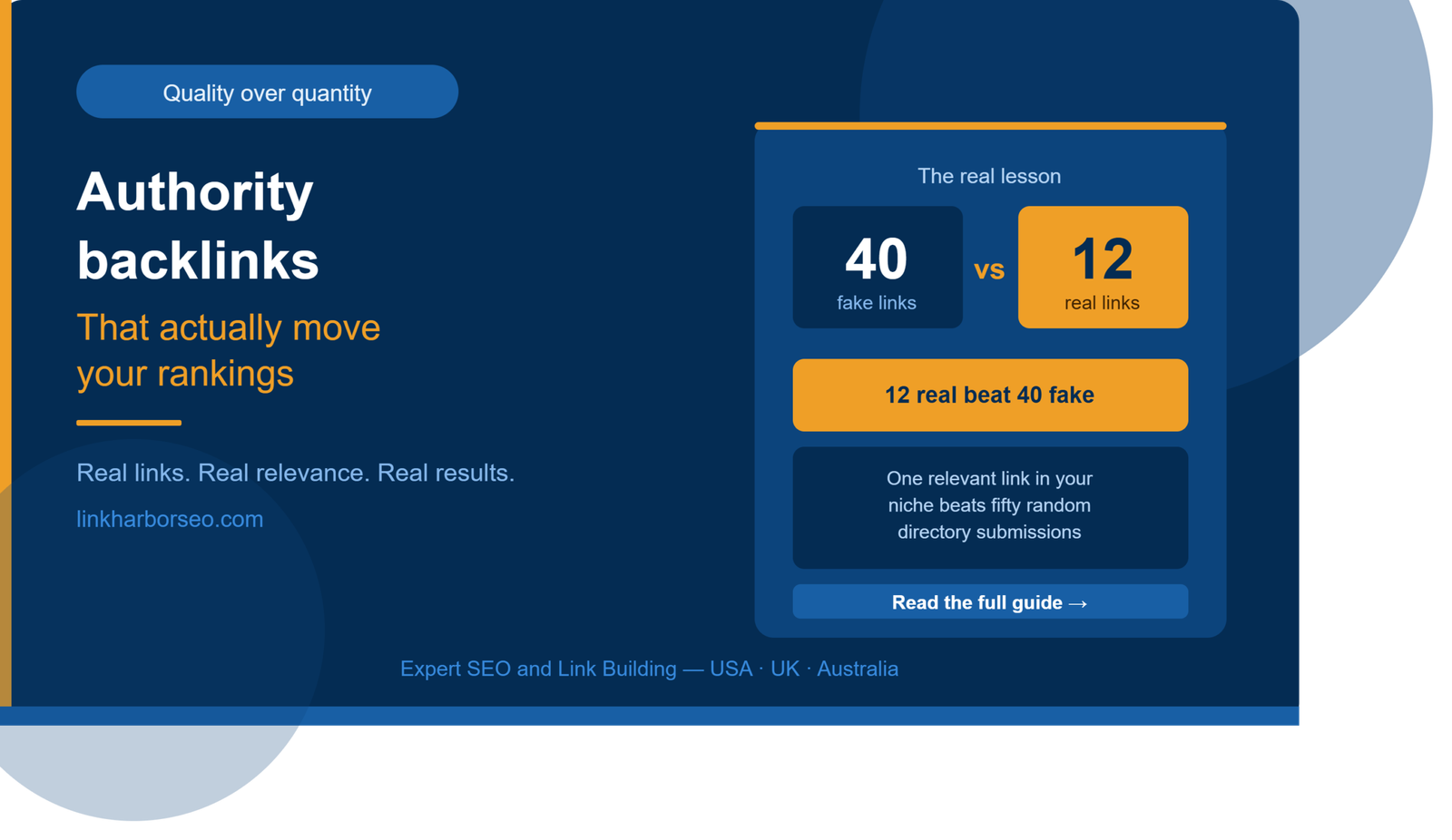
“I have 40 backlinks now. My competitor has 12. Why are they outranking me?”
I pulled up his backlink profile. All 40 were from directory submission sites, comment sections, and a handful of guest posts on sites that would publish literally anything for fifty dollars. His competitor’s 12 backlinks included one from a respected industry publication, one from a local business journal, and ten from genuinely relevant niche sites in their field.
Twelve real backlinks beat forty fake ones. That is the entire lesson of this article, and if you only remember one sentence from everything below, remember that one.
Most small business owners think backlink building is a numbers game. Get as many as you can, as fast as you can. That approach made some sense ten years ago. It does not work in 2026, and chasing it can actually hurt you. What works now is building authority backlinks — a much smaller number of links from sources that genuinely matter. If you’re still new to SEO overall, this guide covers the fundamentals first.
This guide explains exactly what authority backlinks are, how they differ from the backlinks most people chase, and the realistic process for getting them even if you are starting with a brand new website and no connections in your industry yet.
What Are Authority Backlinks and Why They Matter More Than Volume
An authority backlink is a link from a website that search engines and real users already trust. This could be an established industry publication, a respected local organization, a well-known niche blog with a genuine audience, or a site your potential customers actually read.
The opposite of an authority backlink is what most beginners end up collecting without realizing it. These are links from directory submission sites nobody visits, comment sections, low-quality guest post farms, and link exchange networks. These links exist. Google can see them. But they carry almost no weight. In large enough quantities, they can actually raise red flags rather than help.
Here is the distinction that matters most, and it comes down to one word — relevance. One relevant link from a respected site in your exact niche is worth more than fifty random directory submissions combined. This is not an exaggeration.
Think about why this makes sense from Google’s perspective. If a plumbing company gets linked by a home repair blog, that link makes complete sense — two related businesses, two related audiences. If the same plumbing company gets linked by a random gambling site or an unrelated tech directory, that link looks suspicious. It does not match the natural pattern of how real recommendations happen in the real world. Google’s systems are built specifically to spot this mismatch.
This is exactly why niche relevance has become the real authority signal in 2026, even more than raw Domain Authority numbers. A site does not need millions of visitors to pass real authority to your business. It needs to be genuinely connected to your industry. One link from a small, relevant site in your exact field will move your rankings further than fifty links from large, unrelated sites — because relevance is what tells Google the recommendation is real.
The Two Types of Authority Links Worth Building
Most small business owners think there is only one kind of valuable backlink. There are actually two. Understanding the difference changes how you approach outreach entirely.
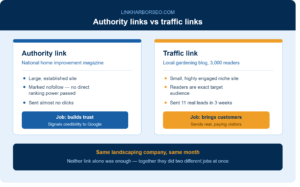
Authority links come from large, well-established sites in your broader industry. Think major publications or large platforms with strong domain strength. These links are sometimes marked “nofollow.” That means they do not pass direct ranking power in the traditional sense. But the brand association and trust signal they send is still genuinely valuable — both to search engines reading the wider web of mentions around your brand, and to real customers who recognize the name.
Traffic links come from smaller, highly engaged niche sites where your actual customers spend their time. These sites look more modest on paper. But the people reading them are your exact target audience. A traffic link from the right niche blog can send real, converting visitors straight to your site — something a nofollow link from a massive publication will rarely do on its own.
Here is what this looked like in practice for a small landscaping company I worked with. We got them one mention in a national home improvement magazine — a strong authority link, but nofollow, with almost no direct traffic. In the same month, we got them featured on a local gardening blog with just 3,000 monthly readers — a smaller traffic link, but it sent them eleven actual leads in three weeks. Neither link alone would have been enough. Together, they did two different jobs at once — one built trust signals, the other brought paying customers straight to the door.
The mistake most businesses make is chasing only one type. The strongest backlink profiles combine both — a handful of high-authority mentions for trust, layered with a steady stream of relevant traffic links that bring in real visitors month after month.
Where Most Small Businesses Get This Wrong
The most common mistake is chasing high Domain Authority numbers while ignoring relevance and real traffic. This wastes months of effort on links that never move rankings.
I want to be specific about this mistake because I see it constantly.
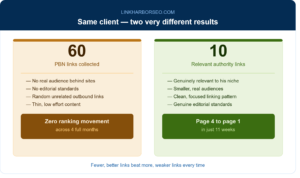
A new client came to me having spent several months building backlinks entirely on his own. He had collected close to sixty links. When I reviewed his backlink profile, most of them were from what are sometimes called PBNs — private blog networks built specifically to sell links. These sites had no real audience, no editorial standards, and content that existed purely to host outbound links.
These sites looked fine on the surface. Their Domain Authority scores were decent. But there was no real traffic behind any of them. Several showed clear warning signs — sudden bursts of unrelated outbound links, thin content, and zero genuine engagement.
His rankings had not moved in four months despite all this activity. We stopped pursuing these links. We redirected that same effort toward ten genuinely relevant, smaller authority sites in his niche instead. His primary keyword moved from page four to page one within eleven weeks.
The lesson was not that backlinks do not work. The wrong backlinks waste your time. The right ones, even in much smaller numbers, work fast.
If you are still questioning whether backlinks really build authority in the first place, we answered that exact true-or-false question with data in a separate guide.
How to Actually Find Authority Sites Worth Pursuing
The fastest way to find authority sites is to check where your competitors already get linked, search for respected publications in your industry, and identify the smaller niche blogs your actual customers read.
Here is the practical part most articles skip.
Start with industry publications and trade websites. Every industry has two or three respected publications or associations that practitioners actually read. A local accountant has industry bodies and finance publications. A landscaping business has trade magazines and supplier blogs. Search for “[your industry] publication” or “[your industry] association.” You will usually find three to five realistic targets on the first page of results.
Look at where your competitors are already mentioned. Run your top two or three competitors through Semrush or Ahrefs. Check their backlink profile. Filter for links coming from sites with genuinely strong Domain Authority and real organic traffic, not just a high score on paper. If three competitors are all mentioned on the same regional business journal, that journal is a realistic, proven target for you too.
Identify niche blogs your actual customers read. This means thinking like your customer, not like a marketer. If you run a small dental practice, your customers are not reading dental industry journals. They are reading local parenting blogs, health and wellness sites, and community pages. These smaller, highly relevant sites are exactly where traffic links come from. They are usually far easier to get a response from than a major publication.
Become a source for journalists. This is the highest-leverage tactic available to small businesses, and the most underused. Journalists constantly need expert quotes and real-world examples for the stories they write. Services exist specifically to connect journalists with sources — search for them, sign up, and respond quickly when a relevant request comes through. A single mention in a respected publication, even a short quote, can be the strongest backlink in your entire profile.
What Authority Sites Actually Want From You
Authority sites say yes to pitches that genuinely serve their existing readers — not pitches that only want a backlink placed.
Before reaching out to any authority site, ask yourself honestly — would this site’s actual readers find what I am offering genuinely useful? Or am I only trying to get a link placed? If the honest answer is the second one, that pitch will get ignored. It should.
The pitches that actually work bring something specific to the table. A real data point from your own business that nobody else has published. A genuinely useful local resource the publication’s readers would benefit from. A specific quote that adds something a journalist’s other sources have not already said. Generic “can I write for you” pitches get deleted within seconds. Specific, useful contributions get replies.
How Long Authority Backlinks Take to Show Results
Search engines usually discover a new backlink within about a week. The full impact on rankings typically takes four to ten weeks to stabilize.
Be realistic about timing. This is where most small business owners lose patience too early.
After a quality authority link goes live, search engines crawl it within about a week. The actual impact on your rankings takes another four to ten weeks to show up clearly in your position tracking. This is not instant. Anyone promising overnight ranking jumps from a single backlink is not being honest with you.
What you should expect realistically is this — a handful of genuine authority links, combined with consistent on-page SEO and quality content, compounding steadily over three to six months. The client I mentioned earlier moved from page four to page one over eleven weeks, not overnight. That timeline is actually on the faster end of what is realistic.
A Simple Framework for Prioritizing Your Outreach
The best order to pursue authority backlinks is — existing connections first, then niche blogs, then industry publications, then journalist opportunities last.
With limited time, you need to know where to focus first. Here is the order I use with clients.
Start with sites where you already have some connection — a past client, a supplier, a local business association you are already part of. These conversations are easier and convert faster than cold outreach.
Move next to the niche blogs your actual customers read. These sites are usually run by individuals or small teams. They respond personally and are often genuinely happy to feature a useful local business or expert.
Then pursue industry publications and trade sites. These take longer and have lower response rates, but carry meaningful authority when they say yes.
Finally, set up journalist source alerts and respond quickly whenever a relevant opportunity appears. This is a slower, more occasional source of links, but the highest authority payoff when it lands.
Frequently Asked Questions
What is the difference between an authority backlink and a regular backlink? An authority backlink comes from a site that search engines and real users already trust, such as an established industry publication or a respected niche site with genuine traffic. A regular or low-quality backlink typically comes from directories, link farms, or low-effort guest post sites with little real audience or editorial standard, and carries far less ranking value.
How many authority backlinks does a small business actually need? There is no fixed number, but ten to twenty genuinely relevant, high-quality backlinks built consistently over six to twelve months will outperform hundreds of low-quality links. Quality and relevance to your specific niche matter significantly more than raw volume.
How long does it take for authority backlinks to improve rankings? Search engines typically discover a new backlink within about a week, but the full impact on rankings usually takes four to ten weeks to stabilize. Meaningful, sustained improvement generally builds over three to six months of consistent, genuine link building.
Are nofollow links from authority sites still worth pursuing? Yes — even when a link is marked nofollow, the brand association, referral traffic, and trust signal from being mentioned on a respected site still carries real value. Search engines also evaluate the broader pattern of mentions and citations around a brand, not only direct ranking signals from individual links.
Is buying backlinks safe for SEO in 2026? No — purchasing backlinks carries significant risk in 2026. Search engines have become increasingly effective at detecting unnatural link patterns, and rather than directly penalizing a site, they often simply ignore the purchased links entirely, meaning the time and money spent produces no real benefit.

7 comments on “How to Build Authority Backlinks That Actually Move Rankings”