


Why does my competitor rank higher with fewer backlinks? You check Ahrefs. Your competitor has 40 referring domains. You have 90. And somehow they’re sitting at position 3 while you’re stuck at position 11.
The instinct is to blame the tool, or assume the data is wrong. It usually isn’t. Backlinks are one ranking signal among many, and when a page with fewer links outranks yours, the answer almost always lives somewhere outside your link profile.
This isn’t another article telling you backlinks still matter, quality over quantity, blah blah. You already know that part. This is a checklist. Go through it in order, against the actual competitor page that’s beating you, and you’ll usually find why your competitor ranks higher with fewer backlinks by the fourth or fifth item.
It’s a more common situation than most site owners realize. A lighter link profile outranking a heavier one isn’t a glitch or a fluke. It’s usually a sign that something else on the page is doing more work than the links are.
Start Here: Confirm It’s Actually a Backlink Gap
Before diagnosing anything else, check what’s actually being compared. Pull both URLs into Ahrefs, Semrush, or even the free version of Ubersuggest. Look at referring domains specifically, not raw backlink count.
If your competitor has fewer referring domains but their links come from more relevant, higher-traffic sites, that’s not really “fewer backlinks winning.” That’s better backlinks winning, and it belongs in a different conversation entirely, covered in our breakdown of what actually makes a backlink count. This checklist assumes you’ve already ruled that out, and the link profiles are genuinely comparable in quality.
Once that’s confirmed, work through the list below.
1. Search Intent Match
This is the single most common reason a lighter-linked page outranks a heavier one. Google isn’t just measuring authority. It’s measuring whether a page answers what the searcher actually wants.
Open the top three results for your target keyword. Look at the format. Are they listicles? Comparison tables? Step-by-step guides? Product pages? If your competitor matches that format and your page doesn’t, no amount of backlinks fixes that mismatch. A perfectly optimized long-form guide will lose to a shorter, better-matched page every time the searcher wanted something quick.
Check this before anything else on the list. It’s the fastest diagnosis and often the whole answer. A surprising number of cases where a competitor ranks higher with fewer backlinks trace back to exactly this, and nothing further down the list even needs investigating once it’s fixed.
2. Content Depth and Information Gain
Two pages can both “cover the topic” while one genuinely adds something the other doesn’t. Google increasingly rewards pages that offer information gain, meaning they tell the searcher something not already sitting on the first three results.
Read your competitor’s page start to finish. Note what they include that you don’t. Original examples, specific numbers, an angle you hadn’t considered. Then check the reverse. If your page reads like a slightly reordered version of what’s already ranking, that’s the gap, not your link count.
This is also where a lot of AI-assisted content quietly loses. A page that technically covers every subtopic but says nothing you couldn’t find on five other sites doesn’t add information gain, no matter how comprehensive it looks on paper. Search systems have gotten noticeably better at spotting that kind of surface-level thoroughness and ranking real depth above it instead.
3. Topical Authority Around the Page
A single page rarely ranks in isolation. Google also looks at what else your site covers around that topic.
If your competitor has fifteen related articles building out the same subject, and you have this one page sitting alone with no supporting content, their site carries more topical weight even with fewer total links. Internal linking between related pages reinforces this signal further. Our plain-English SEO fundamentals guide covers how topical clusters get built if this is new territory.
This factor explains a lot of cases where a competitor ranks higher with fewer backlinks but seems to have a much bigger site overall. Google isn’t just scoring the one page. It’s scoring the page in the context of everything else the domain has published on that subject.
4. Page Experience and Core Web Vitals
Run both URLs through PageSpeed Insights. Look specifically at Largest Contentful Paint, Interaction to Next Paint, and Cumulative Layout Shift.
A page that loads slowly, shifts around while loading, or feels sluggish to interact with can lose ground to a faster page, even with a weaker backlink profile. This factor rarely explains the entire gap on its own, but it’s often the tiebreaker when everything else is close.
5. Domain Age and Trust History
Newer domains, even with strong content and decent links, sometimes take longer to earn full trust. If your competitor’s domain has been established for years and yours launched more recently, that history works in their favor independently of backlinks.
This one you can’t fix quickly. What you can do is compensate with everything else on this list, since domain age alone rarely explains a full ranking gap when the newer site does the rest of the work well.
Don’t overweight this factor either. It’s tempting to write off a loss as “they’ve just been around longer,” but that explanation rarely survives a closer look. Most cases where domain age gets blamed turn out to have a search intent or content depth issue sitting underneath it.
6. On-Page Optimization Basics
Check the fundamentals before assuming something exotic is happening. Title tag, H1, meta description, keyword placement in the first hundred words, image alt text, URL structure.
It sounds too simple to matter, but a surprising number of ranking gaps trace back to a title tag that doesn’t clearly match the query, or a page that buries its main point three scrolls down. Compare yours against the competitor page line by line.
We’ve seen this be the entire answer more than once. A page owner convinced they need a bigger link campaign discovers, after actually comparing the two title tags side by side, that theirs hasn’t been touched in years while the competitor’s has been refined more than once since it first went live.
7. Backlink Relevance, Not Just Volume
Circle back to the links themselves, but ask a sharper question this time. Are your 90 referring domains actually relevant to your niche, or are a lot of them generic directories and low-effort guest posts?
A page with 40 links from sites genuinely inside your industry can outrank a page with 90 links from a mixed bag of unrelated sources. This is where getting your link building strategy right from the start matters more than the raw count ever will.
It’s worth running this check even if you’re confident your links are solid. Profiles built up over a year or two often include a handful of low-relevance links from early, less selective outreach. Those don’t actively hurt much, but they don’t help either, and they can make a 90-link profile functionally weaker than it looks on paper next to a tighter 40-link one.
8. User Engagement Signals
Google watches how people behave after clicking through. Pages with high bounce-back rates, meaning people click, then immediately return to the results, tend to lose ground over time.
You can’t see this data directly for a competitor, but you can infer it. If their page answers the query cleanly in the first screen and yours makes people scroll and dig, that difference shows up in behavior data Google can see even if you can’t.
This is one of the harder factors to diagnose from the outside, but it’s also one of the more common quiet reasons a competitor with a thinner link profile keeps holding position. A page people actually stay on and read sends a stronger signal than a page people bounce off within seconds, regardless of how many domains link to either one.
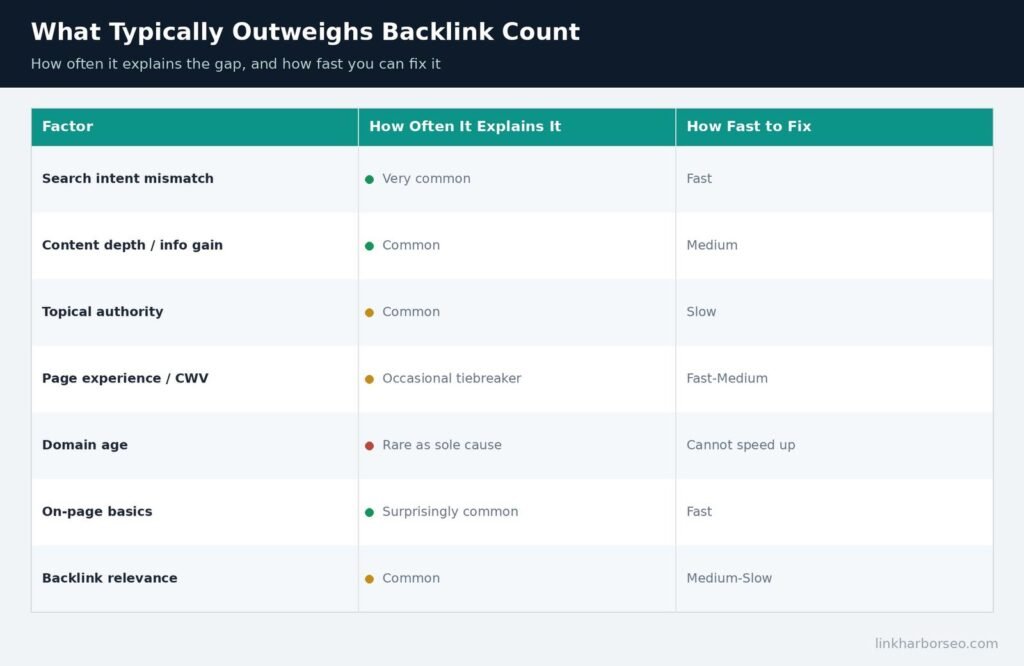
Comparison: What Typically Outweighs Backlink Count
| Factor | How Often It Explains the Gap | How Fast You Can Fix It |
|---|---|---|
| Search intent mismatch | Very common | Fast, once identified |
| Content depth / information gain | Common | Medium, needs real rework |
| Topical authority | Common | Slow, needs supporting content |
| Page experience / Core Web Vitals | Occasional tiebreaker | Fast to medium |
| Domain age | Rare as sole cause | Cannot be sped up |
| On-page basics | Surprisingly common | Fast |
| Backlink relevance | Common | Medium to slow |
Notice how many of these are fixable faster than building forty new referring domains. That’s usually the more efficient place to start.
Why This Matters More in 2026
Google’s own Gary Illyes has said publicly that links are no longer among the top few ranking factors the way they once were. He specifically noted links are “not in the top three” ranking factors anymore, down from their earlier dominance. That doesn’t mean backlinks stopped mattering. It means the gap between a heavily-linked page and a lightly-linked one gets closed more easily now by everything else on this list than it did five years ago.
Search systems have also gotten better at reading intent and rewarding genuine usefulness over surface-level optimization. A page stacked with links but thin on real substance increasingly loses to a leaner page that actually satisfies the searcher. That shift is exactly why this diagnostic matters more now than it used to, and it’s a big part of why a competitor ranking higher with fewer backlinks isn’t the anomaly it might have seemed a few years ago.
Long-form content and comprehensive guides still tend to attract more backlinks naturally over time, so this isn’t an argument for thinner content across the board. It’s a reminder that the link count alone was never the full picture, and treating it as the only lever left on the table gets more expensive and less effective every year.
A Simple Process to Run This Yourself
- Confirm the backlink gap is real and the profiles are otherwise comparable in quality.
- Check search intent match first. It resolves more cases than anything else.
- Read both pages side by side for content depth and information gain.
- Check topical authority: does the competitor’s site support the page with related content?
- Run both URLs through PageSpeed Insights for Core Web Vitals.
- Compare on-page basics line by line.
- Look at backlink relevance, not just the count.
- Fix the fastest, highest-impact item first, then move down the list.
None of this replaces a solid link building foundation. It just means a smaller, better link profile paired with a page that nails the rest of this checklist will often beat a bigger one that doesn’t.
Common Mistakes When Diagnosing This
Most site owners run this checklist backwards, starting with the hardest fix instead of the easiest one. Before assuming you need a bigger link building budget, rule out the cheaper explanations first.
- Comparing raw backlink count instead of referring domain quality
- Skipping the search intent check and jumping straight to technical fixes
- Assuming domain age explains everything, when it’s rarely the sole cause
- Fixing on-page basics but never touching content depth
- Giving up on organic growth entirely and just buying more links to compensate
That last one usually makes things worse. Piling more links onto a page that doesn’t match search intent rarely moves the needle, and it risks the kind of profile problems covered in our guide on staying within white-hat link building practices.
When It’s Time to Get Help
If you’ve worked through this checklist and the gap still doesn’t make sense, sometimes a second set of eyes catches what’s easy to miss on your own page. Our SEO and link building team runs this same diagnostic for clients regularly, and more often than not, the answer isn’t more links. It’s fixing two or three items on this list first.
We’ve walked clients through this exact question, why does a competitor rank higher with fewer backlinks, more times than we can count, and the pattern holds more often than not. The fix is rarely a bigger link budget. It’s usually one overlooked item further up this checklist.
FAQs
Why does a competitor with fewer backlinks outrank me?
Usually because they match search intent better, offer more content depth, or benefit from stronger topical authority and page experience. Backlinks are one ranking factor among many, not the deciding one on their own.
Is backlink quality more important than quantity?
Generally, yes. A smaller number of relevant, high-traffic referring domains tends to outperform a larger number of generic or unrelated ones.
How do I check if my content matches search intent?
Look at the top three ranking results for your target keyword and compare their format and depth to your own page. A mismatch in format is one of the most common reasons a page underperforms.
Do Core Web Vitals really affect rankings that much?
They’re rarely the whole story, but they can act as a tiebreaker when content and links are otherwise close. Slow, unstable pages tend to lose ground over time.
Can a newer website ever outrank an older, more established competitor?
Yes, but it usually needs to win clearly on the other factors, since domain age and trust history work in the older site’s favor by default.
Should I focus on links or content first if my competitor has fewer backlinks?
Start with content and search intent. If those are already strong, then backlink relevance and topical authority are the next places to look.
How long does it take to close a ranking gap like this?
Fixing on-page and intent issues can show movement within weeks. Building topical authority or a stronger backlink profile usually takes a few months to show up clearly.
Is it normal for a competitor to rank higher with fewer backlinks?
Yes, more so now than in past years. As search systems weigh intent match, content depth, and page experience more heavily, backlink count alone explains a shrinking share of ranking differences.
What tool should I use to compare backlink profiles with a competitor?
Ahrefs and Semrush both work well for referring domain and link-quality comparisons. Free options like Ubersuggest give a rougher but still useful starting picture.
