


Your agency has a client asking for more backlinks, and you don’t have the team, the publisher relationships, or the spare hours to build them in-house. That gap is exactly what white label link building is built to close.
By the end of this guide, you’ll know exactly how the white label model works, what it should cost you, how to spot a provider that will get your client penalized, and how to decide whether outsourcing even makes sense for your agency right now.
Quick Answer
White label link building is a service where a specialist provider builds backlinks on your agency’s behalf, and you deliver those results to your client under your own brand. The provider handles prospecting, outreach, and placement. Your client never sees the provider’s name — only yours. You pay a wholesale rate, bill your client at your own price, and keep the margin. It only works well if the provider avoids private blog networks (PBNs), link farms, and automated outreach — those are the shortcuts that get clients penalized.
What Is White Label Link Building?
Behind the buzzword, the arrangement is simple: one company does the work, another company puts its name on it.
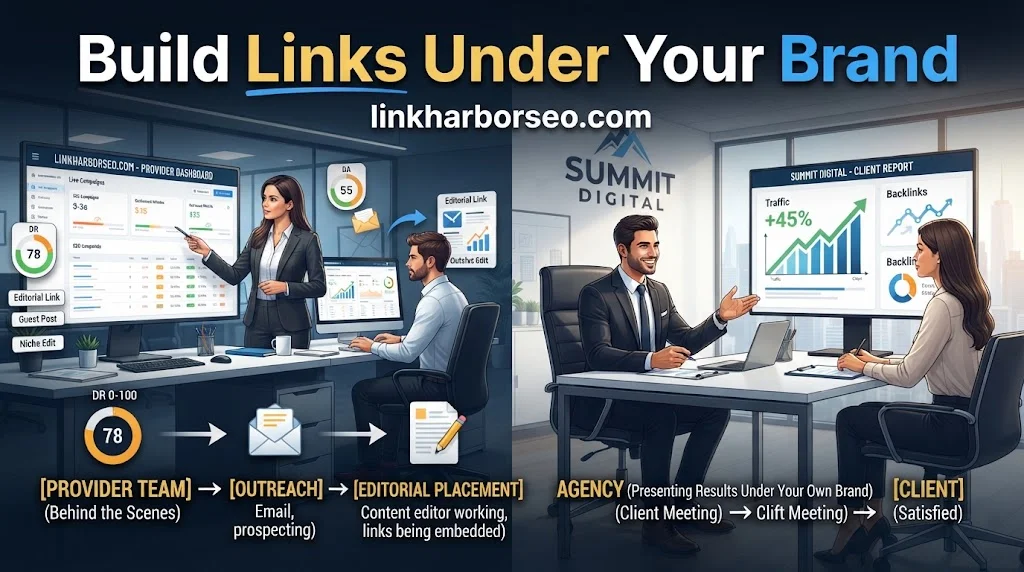
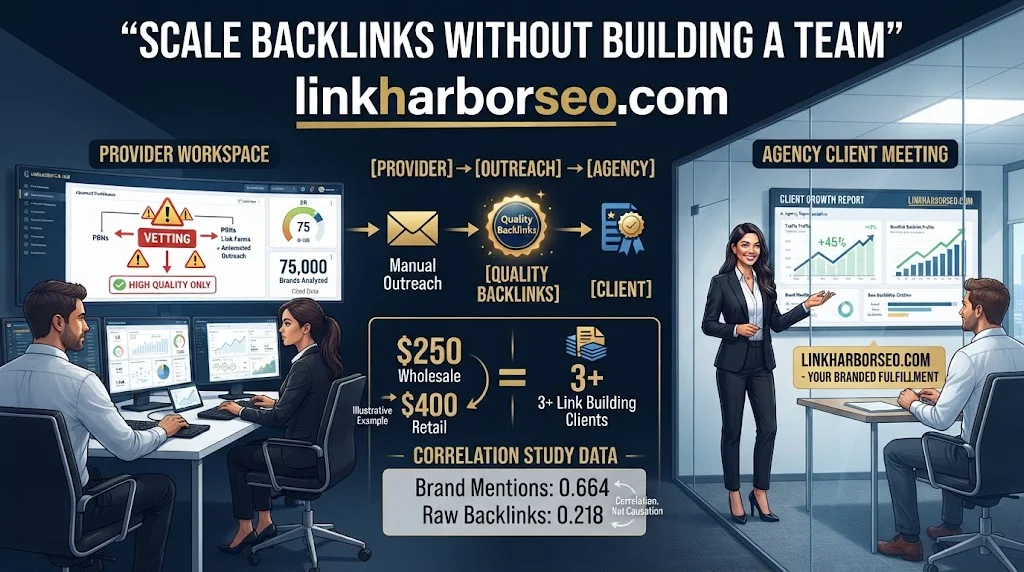
White label link building is when a specialist agency builds backlinks for your clients, and you present those links as your own work. You place an order, approve the target sites, and hand your client a branded report. The provider’s name appears nowhere — not in outreach emails, not on invoices, not in the final report.
This is different from simply buying backlinks, which usually means paying directly for a placement with no vetting, no outreach relationship, and often no real editorial standard behind it. Legitimate white label link building still relies on manual outreach and earned placements — the “white label” part only describes who gets credit, not how the link was obtained.
It’s also worth separating from white label SEO more broadly. White label SEO can include technical audits, on-page optimization, content, and reporting dashboards — link building is just one service inside that larger umbrella, and some providers specialize in link building alone rather than full-service SEO.
A few terms worth knowing before you go further:
- Domain Rating (DR) — Ahrefs’ 0–100 score measuring the strength of a site’s backlink profile.
- Domain Authority (DA) — Moz’s equivalent metric, calculated differently but used for the same purpose.
- Editorial link — a link placed inside an existing article on a site, added because the content genuinely fits.
- Guest post — a new article written specifically for a target site, with a contextual link included.
- Niche edit — a link inserted into content that’s already published and already ranking.
How the Reseller Economics Work
Before anything else, most agency owners want to know one thing: does the math actually work?
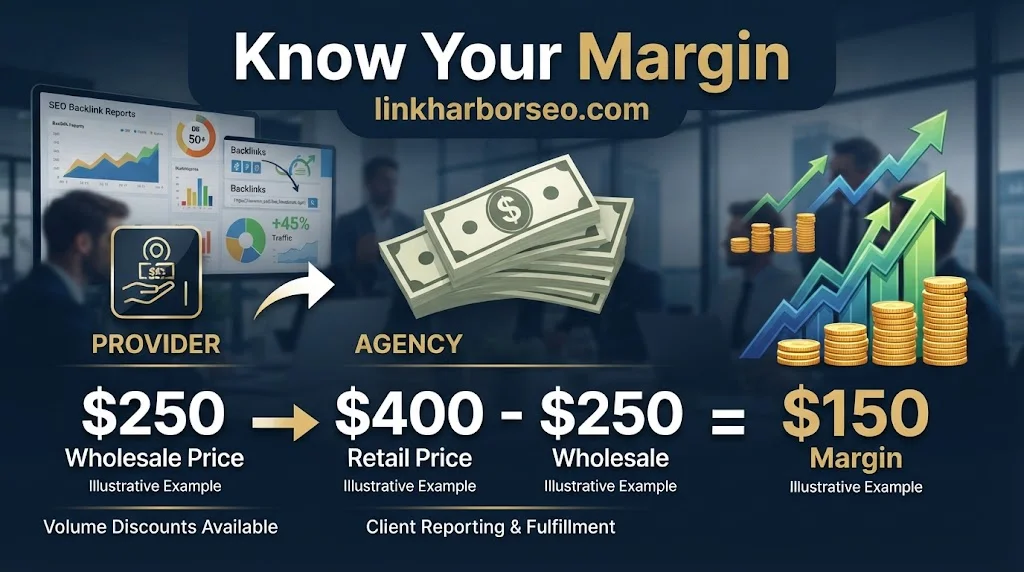
You pay your provider a wholesale rate, per link or per campaign. You bill your client your own retail rate. The gap between the two is your margin — and because there’s no salaried team behind it, that margin holds whether you’re running two clients or twenty.
Here’s a simplified example, using illustrative numbers rather than claimed industry averages: if a provider charges you $250 for an editorial placement and you bill your client $400 for that same link as part of a package, your margin is $150 per link before accounting for your own time spent approving targets and reporting to the client.
Volume and turnaround vary a lot by provider and niche, so treat any fixed number with caution — but as a general shape, expect a handful of high-quality placements per month at entry-level spend, scaling into dozens at higher retainer tiers, with each individual placement typically taking several weeks from prospecting to live link.
| In-house link building | White label link building | |
|---|---|---|
| Upfront cost | Salaries for outreach staff, writers, managers before any link goes live | None — you pay per link or per campaign |
| Scalability | Capped by team bandwidth | Scales with demand, no new hires needed |
| Speed to launch | Months to build publisher relationships | Days to weeks — the network already exists |
| Control | Full control over strategy and execution | You approve placements; the provider executes |
| Main risk | Quality depends entirely on internal skill | Quality depends on choosing the right partner |
A few things worth building into your pricing:
- Mark up on outcomes, not on cost alone. Clients are buying rankings and visibility, not a line-item link. Agencies that price link-by-link tend to get squeezed on margin; agencies that fold link building into a growth retainer usually keep it healthier.
- Price for your own time. Approving targets, briefing pages, and presenting reports to the client takes real hours — even though you’re not doing the outreach yourself.
- Ask about volume discounts. Many providers offer better per-link pricing at higher monthly spend, which affects how you should structure your own packages.
What’s Included in a Legitimate White Label Package
Not every “link” is worth the same, and a good provider should offer more than one type.
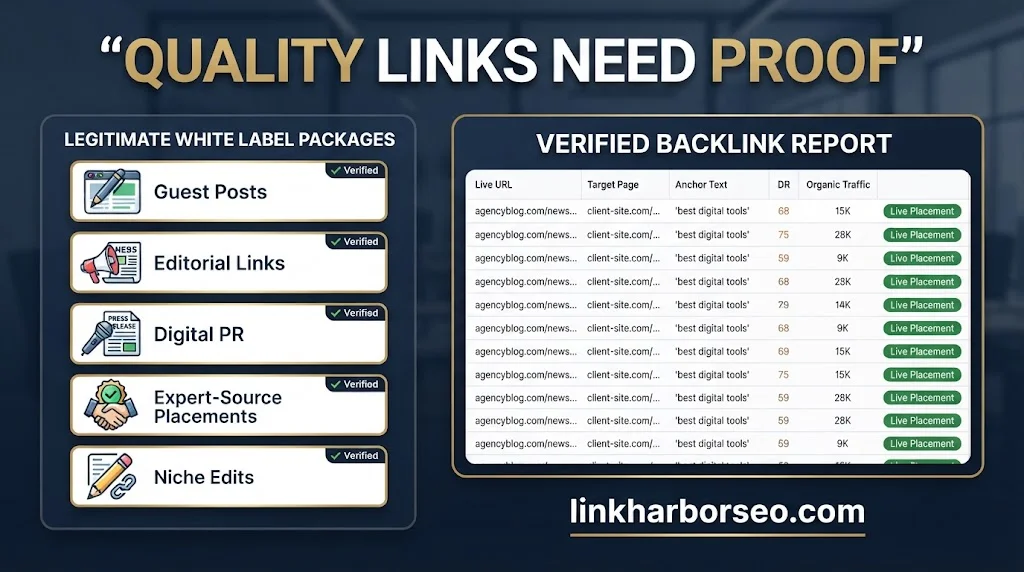
The strongest white label campaigns combine several placement types rather than relying on just one, because a mix of link types looks natural to Google and builds a more resilient backlink profile:
- Guest posts — an original article written for a relevant third-party site, with a contextual link included.
- Editorial links (link insertions) — a link added inside an existing article on an authoritative site.
- Digital PR — coverage earned through a newsworthy angle or original research, usually on high-authority news and media sites.
- Expert-source placements — your client quoted as a source in an article a journalist is already writing (once dominated by HARO, now spread across several platforms after HARO’s 2024 shutdown and relaunch under new ownership as Connectively).
- Niche edits — a link added to content that’s already indexed and already ranking, which can move quickly since the page already carries authority.
Every legitimate placement should come with a report that includes the live URL, the target page it links to, the anchor text used, the site’s DR, and an organic traffic estimate. If a provider can’t give you that level of detail, don’t pass their links off as your own work.
What a weak link looks like, for comparison: a link buried in a comment section, a forum signature, or an article on a site that exists only to host paid links and has almost no real readers. These placements might technically “exist,” but they carry little to no ranking value and can flag a backlink profile as unnatural.
How to Vet a White Label Provider (Red Flags to Avoid)
This is the section that protects your agency’s reputation, so it deserves more scrutiny than any pricing sheet.
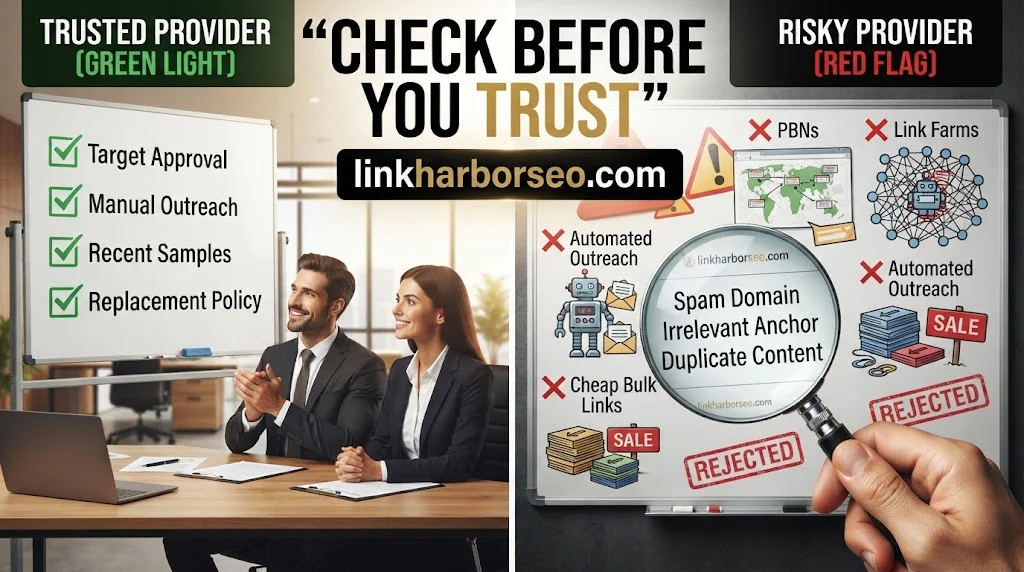
Watch for these red flags before you sign anything:
- Private blog networks (PBNs). Sites that exist purely to pass link equity. These are a direct violation of Google’s guidelines and put your client at real risk of a manual action.
- Link farms. Sites that look legitimate on the surface but exist only to host paid links, often with far more outbound links than genuine content.
- Automated, mass outreach. Links earned through templated blasts to thousands of sites rarely hold up — and the sites willing to accept them are usually low-quality.
- Pricing that seems too good to be true. Real outreach and editorial relationships take time. Unusually cheap “bulk” link packages are a strong signal of PBNs or link farms behind the scenes.
- No ability to pre-approve targets. If a provider won’t let you review and approve each site before outreach begins, they’re likely working from a fixed, low-effort list.
Before you commit a client’s budget, ask the provider directly:
- Can I review and approve every target site before you reach out?
- What’s your replacement or guarantee policy if a link drops?
- Who communicates with my client, and what appears on the invoice?
- Can you share recent, verifiable samples in my client’s niche?
- Do you use manual outreach, or automated tools, for prospecting?
A provider with nothing to hide will answer all of these without hesitation. According to Google’s own guidance on link schemes, links intended purely to manipulate rankings — including those from PBNs or link-buying schemes — violate its spam policies and can lead to a site being demoted or removed from search results entirely. That’s the standard your provider needs to meet, regardless of how convincing their sales pitch sounds.
In-House vs. White Label vs. Hybrid: How to Decide
Not every agency should outsource, and not every agency should build a team from scratch. The right call usually comes down to volume and specialization.
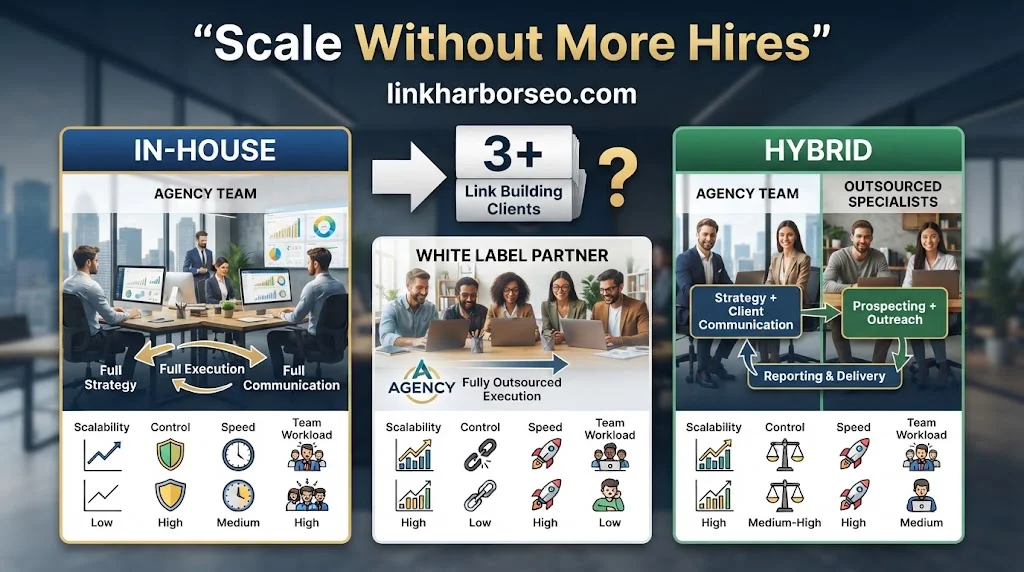
| Outsource if… | Keep in-house if… |
|---|---|
| You’re managing three or more link building clients at once and turnaround is slipping | Your volume is low enough that one specialist manages it comfortably |
| You’re entering a niche with no existing publisher relationships | You’re in a highly sensitive niche where you want direct oversight of every outreach message |
| You’re winning clients faster than your team can fulfill the work | Building long-term publisher relationships is itself a strategic asset you want to own |
| You want to test link building as a service line before committing to a hire | You already have a proven in-house process that’s working |
A hybrid approach — keeping strategy and client communication in-house while outsourcing the actual prospecting and outreach — is common for agencies that want control over messaging without carrying the full fulfillment burden.
Is White Label Link Building Safe? Penalty Risk and Liability
This is usually the real question underneath all the others, so it’s worth answering plainly.
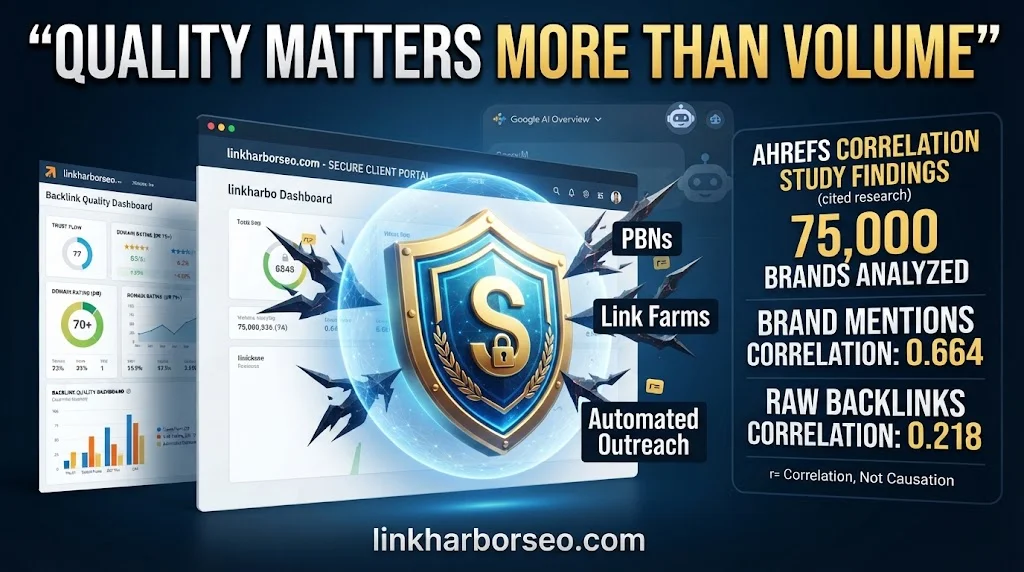
White label link building is exactly as safe as the provider you choose. Links earned through legitimate manual outreach carry no more risk than links your own in-house team would build. The risk comes entirely from providers using PBNs, link farms, or automated outreach — and if one of those links triggers a Google manual action, your agency is the one your client holds responsible, because as far as they know, you built it.
That’s why pre-approval on every placement matters more than any other single safeguard in this guide.
There’s also a newer reason link quality matters beyond rankings alone. A May 2025 Ahrefs study of 75,000 brands measured the Spearman correlation between various signals and a brand’s visibility in Google’s AI Overviews. Branded web mentions came out strongest, at 0.664 — roughly three times higher than the correlation for raw backlink counts alone, which measured 0.218. A well-run link building campaign creates both a ranking signal and a brand mention at the same time, which means the quality bar for a placement now affects more than where a page ranks in traditional search.
FAQs
What is white label link building?
It’s when a specialist provider builds backlinks on behalf of your agency, and you deliver those results to your client under your own brand. The provider handles outreach and placement; you keep the client relationship and the credit.
How much does white label link building cost?
Pricing is usually per link or as a monthly retainer, scaling with the authority and relevance of the target sites. Be cautious of pricing far below market rates — it usually signals PBNs, link farms, or sites with little real traffic behind them.
Will my client find out I’m outsourcing?
Not with a properly run white label service. Reporting is unbranded, the provider doesn’t contact your client directly, and no provider branding appears in the deliverables. Confirm this process before you start.
Is white label link building safe?
It’s as safe as the provider you choose. Manual, editorial outreach carries the same low risk as building links yourself. The danger comes specifically from PBNs, link farms, and automated outreach.
How is this different from buying backlinks?
“Buying backlinks” usually implies a direct, unvetted paid placement with no real outreach relationship behind it. Legitimate white label link building still relies on manual outreach and earned editorial placements — the branding, not the method, is what changes.
How long before I see results?
Meaningful ranking movement typically takes three to six months, depending on competition and your client’s starting authority. Be wary of any provider promising results in weeks.
Conclusion
White label link building lets your agency offer high-quality backlinks without building an outreach team from scratch, but the model only works if you choose a provider that earns links manually and lets you approve every placement. If you’re new to this, start by testing one provider on a small order before committing to a large retainer — it’s the fastest way to judge their quality without exposing a client’s site to risk. From there, use the vetting checklist above before you sign anything long-term.
