


A potential client messaged me a few months back. He’d been quoted $299 a month by one agency and $4,500 a month by another for “the same service.” He wanted to know which one was right.
Both of them, actually.
SEO pricing is confusing because “SEO” means completely different things depending on who’s quoting you. One agency offers basic directory listings. Another delivers technical fixes, content strategy, link building, and monthly reporting tied to actual revenue. Same word. Completely different scope. Completely different results.
This guide cuts through that. Real numbers, what you actually get at each budget level, and the warning signs that tell you an agency is about to waste your money.
Why SEO Pricing Is So Confusing
Search any question about SEO cost and you’ll find ranges like “$300 to $30,000 per month.” Technically accurate. Practically worthless.
Before we get into numbers, here’s why SEO investment matters in the first place. 53% of all website traffic comes from organic search. 68% of online experiences begin with a search engine. And 75% of users never scroll past page one of Google results. These numbers explain why businesses keep investing in SEO even when it takes time — the traffic is real, consistent, and doesn’t stop the moment you turn off a budget.
The range exists because SEO scope varies enormously. A local plumber trying to show up in Google Maps searches has completely different needs from a national ecommerce brand competing for thousands of product keywords. Lumping both into the same price range tells you almost nothing useful.
Three things drive SEO cost more than anything else.
The first is your market’s competition level. Ranking a landscaper in a small town takes a fraction of the effort and budget it takes to rank a personal injury law firm in New York City. Both are “SEO.” The price difference is justified.
The second is what work actually needs to happen. Some websites need months of technical cleanup before any content or link work makes sense. Others are technically solid and just need consistent content and backlinks. Your starting point matters a lot.
The third is the agency’s experience and team depth. A junior freelancer working part-time and a specialist agency with a full team of strategists, writers, and link builders don’t cost the same. The output difference is usually significant too.
SEO Pricing Models — Which One Should You Use
Before looking at numbers, it helps to understand how agencies actually charge.
Monthly retainer is by far the most common model. According to Ahrefs’ 2026 survey, 78% of SEO providers charge this way. You pay a fixed monthly fee and get a defined scope of ongoing work. This makes sense for SEO because search performance compounds over time — it’s not a one-off job.
Hourly consulting still exists, usually from independent specialists. Rates typically run $100 to $300 per hour for experienced practitioners in the US and UK. This works well for specific audits, strategy sessions, or getting a second opinion on existing work. It’s less predictable for ongoing campaigns.
Project-based pricing covers one-time work like technical audits, site migrations, or penalty recovery. A basic SEO audit for a small site might run $500 to $2,000. A comprehensive enterprise audit from a senior agency can reach $10,000 or more. The price reflects the depth and the size of the site being reviewed.
Most small businesses end up on monthly retainers once they move past the initial audit stage, and that’s usually the right call.
What SEO Actually Costs by Business Type
Here’s where I’ll give you real numbers instead of useless ranges.
But first — which category are you actually in? Most people aren’t sure.
If your customers come from one city or a specific local area — you’re a plumber, dentist, restaurant, law firm, or any service business with a physical location — you’re in the local SEO category. Local SEO pricing is typically lower than national SEO because your competition is other businesses in your city, not brands across the country. Local SEO is more targeted, faster to show results, and a more realistic starting point for most small businesses.
If you’re competing nationally, running an ecommerce store, or trying to rank for keywords that people search from anywhere — that’s national SEO. Much bigger scope, longer timeline, and higher cost.
Most small business owners reading this are in the local category. Here’s what each level actually costs.
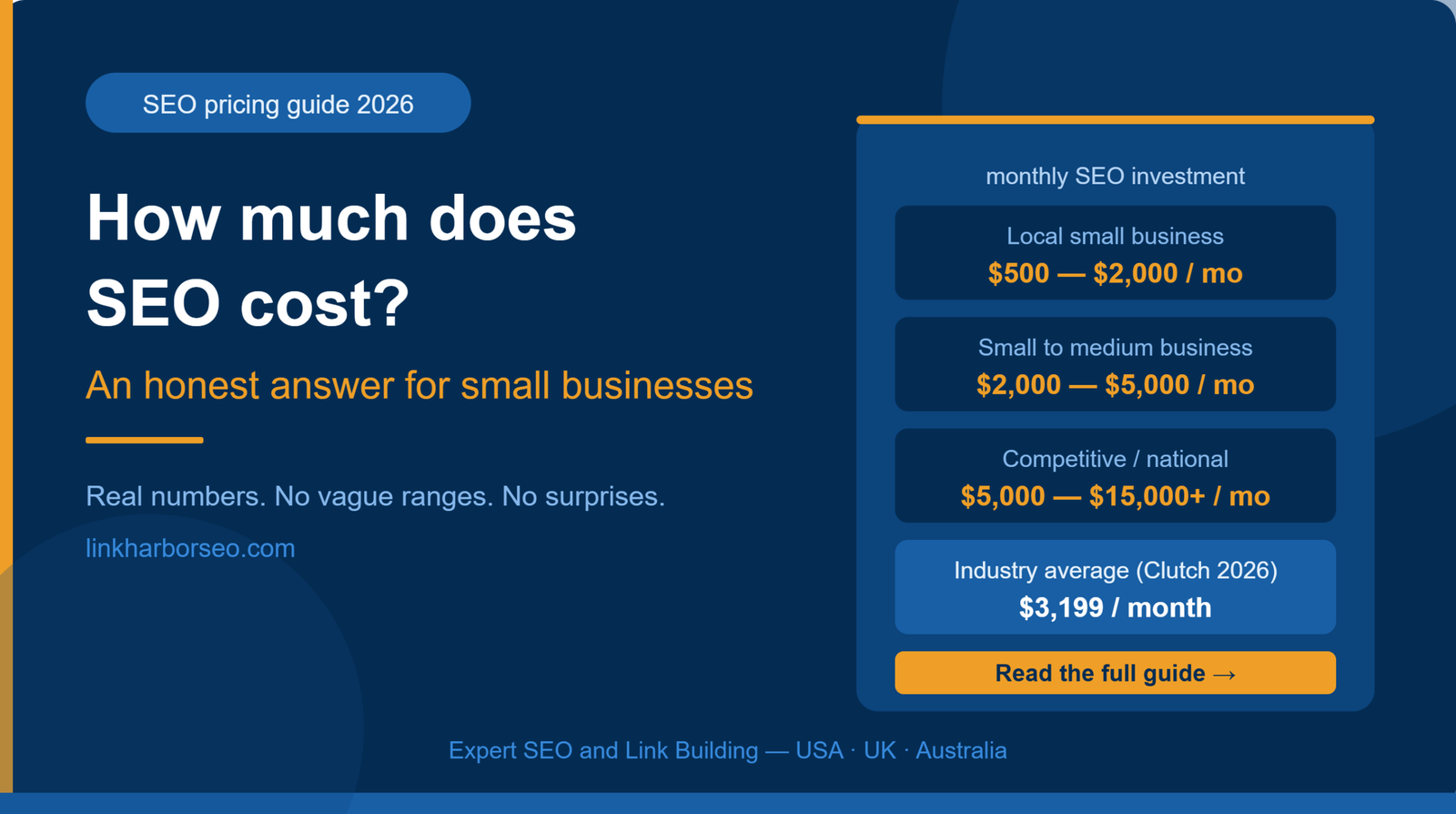
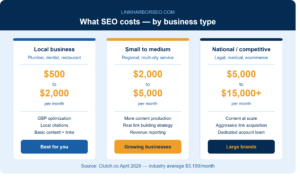
Local small business — $500 to $2,000 per month
This is the budget range for a single-location business trying to show up in local search — a dentist, a plumber, a restaurant, a law firm serving one city. At this level, a solid agency should be covering your Google Business Profile setup and ongoing optimization, local citation building, basic on-page fixes, and a small amount of content and link work each month. If you want to understand what local SEO work actually involves, I’ve covered that in detail separately.
At $500 a month, you’re getting the essentials done. At $1,500 to $2,000, you’re getting more content, more links, and someone who’s proactively monitoring your rankings rather than just running the same checklist each month.
Small to medium business — $2,000 to $5,000 per month
At this level, you’re typically competing across a broader set of keywords, maybe targeting multiple cities or a regional market. The work includes more content production, a real link building strategy, technical SEO monitoring, and reporting that connects activity to actual leads or revenue.
This is where most growing service businesses end up once they’ve seen SEO work and want to scale it properly.
Larger businesses and competitive markets — $5,000 to $15,000+ per month
National brands, competitive industries like legal, medical, or finance, and ecommerce businesses with large catalogs fall here. The scope of work at this level is significantly broader — multiple content pieces per month, aggressive link acquisition, technical work across hundreds or thousands of pages, and dedicated account management.
According to Clutch.co data from April 2026, the average monthly SEO cost across all business sizes is $3,199. That average includes a lot of enterprise spend pulling it upward, so don’t use it as a benchmark for a local business.
Here is a simple comparison of what you actually get at each SEO budget level.
| Budget | Best For | What’s Included |
|---|---|---|
| $500/month | Single location, low competition | GBP basics, citations, minor on-page fixes |
| $1,500/month | Local business, moderate competition | Content, link building, monthly reporting |
| $2,000-$5,000/month | Regional or multi-city | More content, real link outreach, technical monitoring |
| $5,000+/month | National, ecommerce, competitive industries | Full strategy, content at scale, aggressive link acquisition |
$500 a Month vs $2,000 a Month — What’s Actually Different
This is the question I get asked most often, and it’s a fair one.
At $500 a month, after tools (Semrush or Ahrefs alone runs $100 to $400 per month), project management, and overhead, there’s realistically two to three hours of actual work available. That’s enough to run a basic checklist — fix a few on-page issues, update citations, maybe post something to your Google Business Profile. It’s not enough to build real momentum.
At $2,000 a month, you’re getting somewhere around fifteen to twenty hours of actual strategy and execution time. That’s enough to be doing meaningful content work, running real outreach for authority backlinks, monitoring technical issues proactively, and producing reporting that actually tells you something.
The difference isn’t just price. It’s a fundamentally different program.
I had a client who’d been paying $400 a month for “SEO services” for over a year. His rankings had barely moved. When I audited what had actually been done, it was mostly automated directory submissions and a couple of minor title tag changes. He switched to a proper program at $1,800 a month. Within five months he was ranking on page one for four of his six target keywords.
The cheap option cost him a year and real money. The right option cost more per month but paid back significantly faster.
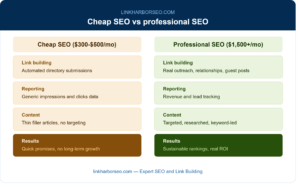
Here’s what cheap SEO vs professional SEO actually looks like in practice.
| Cheap SEO | Professional SEO | |
|---|---|---|
| Link building | Automated submissions | Real outreach and relationships |
| Reporting | Generic impressions data | Revenue and lead tracking |
| Strategy | One-size-fits-all | Custom to your market |
| Content | Thin filler articles | Targeted, researched content |
| Results | Quick promises | Long-term sustainable growth |
Red Flags That Tell You an Agency Is About to Waste Your Money
This section might save you more than anything else in this guide.
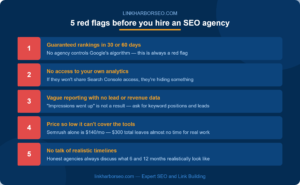
Guaranteed rankings in 30 or 60 days. No legitimate SEO provider guarantees specific rankings in a fixed timeline. Search algorithms are not something any agency controls. Agencies that make this promise are either targeting easy, low-intent keywords nobody actually searches, or they’re about to do something that’ll get your site penalized later.
No access to your own analytics. If an agency won’t share login access to Google Analytics and Search Console, they don’t want you seeing what they’re actually doing. Walk away.
Vague reporting. Reports that show “impressions up” and “keywords improved” without connecting to actual leads, calls, or revenue are hiding a lack of real results. Ask specifically: which keywords, what positions, and what traffic came from them.
A price so low it doesn’t cover tools. SEMrush alone starts at around $140 a month. Ahrefs is similar. If someone is quoting you $300 for full-service SEO, do the math on what’s left after tools and basic overhead. There’s almost nothing there for actual work.
No talk of timeline or realistic expectations. Honest agencies tell you SEO takes time. Anyone rushing you toward a commitment without discussing what realistic results look like in six or twelve months isn’t being straight with you.
Is SEO Actually Worth It
Fair question, and I’ll answer it honestly.
For most small businesses, yes. Significantly so. Research from First Page Sage puts the median ROI from SEO at 748% — meaning for every dollar invested, businesses see $7.48 back over time. Real estate businesses average even higher, at 1,389%. These figures come from one research firm’s methodology and your actual results will depend heavily on your market, your competition, and how consistently the work gets done — but the directional point holds. SEO compounds, and the return over time tends to be strong compared to paid advertising once rankings are established.
But “most” isn’t “all.” SEO is a longer-term investment. You won’t see dramatic results in the first two months. For businesses that need leads next week, paid advertising makes more sense right now. SEO is the right investment for businesses that are thinking six to twelve months ahead and want traffic that doesn’t stop the moment they stop paying for ads.
One more thing worth knowing. 56% of SEO agencies raised their prices in 2026 according to SE Ranking’s agency survey. The cost of waiting isn’t zero — competition increases, agencies charge more, and the gap you need to close gets larger the longer you wait.
What $1,500 a Month Should Get You — A Realistic Checklist
If you’re evaluating proposals from agencies, here’s roughly what a serious $1,500 per month engagement should include for a local small business.
A fully optimized Google Business Profile with regular posts and review response management. This alone is something most agencies skip or do once and forget.
Monthly technical monitoring to catch and fix issues before they compound. Not a one-time audit — ongoing checks.
At least two to four pieces of content per month, written around keywords your customers actually search. Not generic filler, actual targeted content.
A link building program that earns two to four quality backlinks per month through real outreach, not automated directory submissions. Guest posting on relevant sites is one of the most effective ways this gets done.
Monthly reporting that shows keyword positions, traffic trends, and where leads are actually coming from — not just “impressions went up.”
If an agency’s proposal at this budget doesn’t include most of those things, ask them specifically what they’re leaving out and why. The answer will tell you a lot.
Frequently Asked Questions
How much does SEO cost per month for a small business? Most small businesses with local or regional focus spend $500 to $2,000 per month for meaningful SEO work. At the lower end you’re getting the essentials covered. At $1,500 to $2,000 you’re getting a real program with content, links, and proactive monitoring.
Is it worth paying for SEO? For most businesses, yes. The median ROI from SEO is around 748% over time. But it’s a longer-term investment — expect six months before seeing significant movement, and twelve months before you can properly judge the results. If you need leads next week, paid ads are faster. If you’re thinking about next year, SEO pays back more sustainably.
Why do SEO prices vary so much? Because the scope of work varies enormously. A local plumber ranking in one city needs fundamentally different work than a national brand competing for thousands of keywords. Market competition, website starting point, and the depth of the agency’s team all affect cost more than most buyers realize.
What are red flags when hiring an SEO agency? Guaranteed rankings in 30 to 60 days, no access to your own analytics, vague reporting that doesn’t connect to real leads or revenue, pricing so low it can’t cover basic tools, and pressure to commit quickly without discussing realistic timelines.
How long does SEO take to show results? For local businesses targeting lower-competition keywords, early movement typically shows within three to six months. Stronger, more consistent rankings usually take six to twelve months of steady work. Businesses in competitive industries or starting from a weak technical foundation should plan for longer.
Not Sure What SEO Budget Is Right For You?
Every business is different. Your market, your competition, and your current website’s starting point all change what the right investment actually looks like.
If you want a straight answer for your specific situation — what it would actually take to rank in your market and what a realistic timeline looks like get a free SEO audit. We’ll look at your website, your competitors, and your goals, and tell you exactly what it’ll take. No generic packages, no pressure.

1 comment on “How Much Does SEO Cost? An Honest Pricing Guide for Small Businesses”