


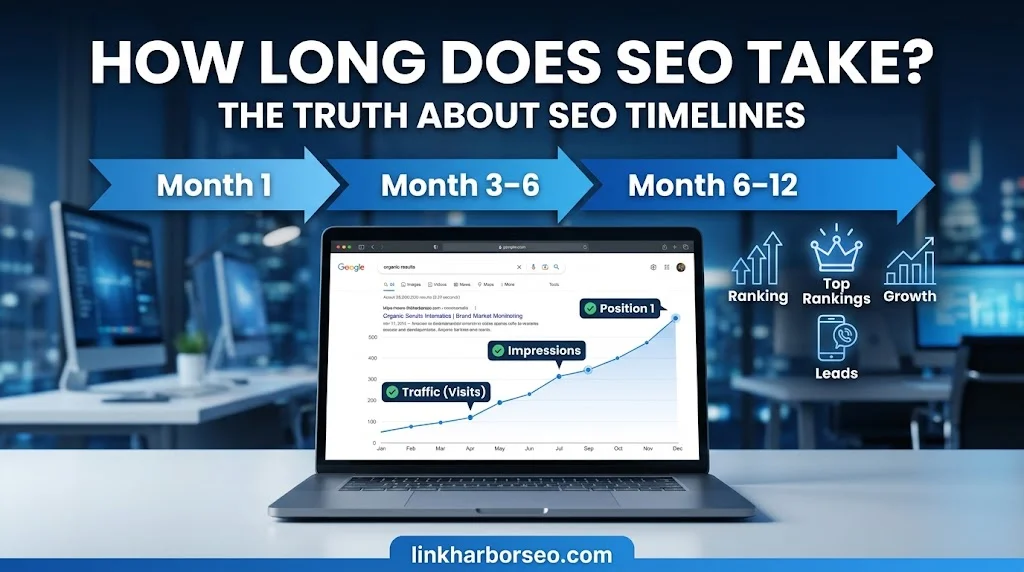
How long does SEO take to show results? Most sites see first results in 3 to 6 months. Bigger gains, like leads and revenue, often need 6 to 12 months. A poll of 3,680 marketers on LinkedIn and X points to the same 3 to 6 month range.
There is no fixed date, though. Your SEO timeline depends on your site’s age, your competition, and how fast you act. This guide shows what to expect, month by month, and how to speed things up.
How Long Does SEO Take to Work? The Quick Answer
SEO is not a switch. It is a slow build.
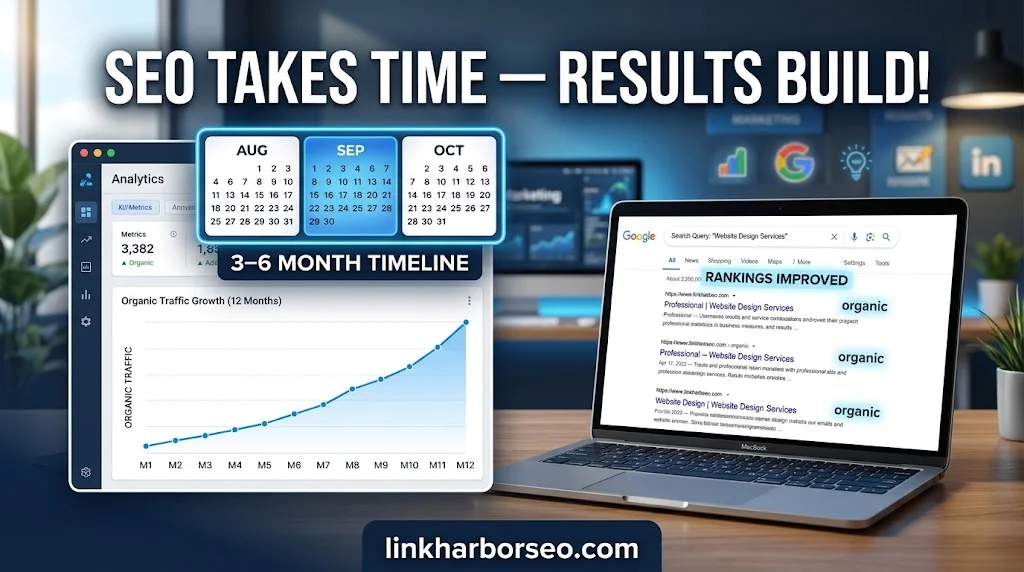
Google says the impact of a change can show up in a few hours or take several months. That wide range explains why timelines vary so much.
Here is a simple guide to the SEO results timeline by site type:
| Site type | First signs | Solid growth |
|---|---|---|
| Established site with good content | 1 to 3 months | 4 to 8 months |
| Brand-new website | 3 to 6 months | 9 to 12+ months |
| Local US business | 2 to 4 months | 5 to 8 months |
| Ecommerce or B2B site | 3 to 6 months | 8 to 12 months |
These are typical ranges, not promises. Your results can move faster or slower.
Different tasks also pay off at different speeds:
- Technical fixes (like removing a stray noindex tag): days to weeks
- New content: 2 to 4 months
- Backlinks and authority: 6 to 12 months
- Hard, high-competition keywords: 12 months or more
Patience matters here. Pages in the top 10 are, on average, about two years old. Great rankings are earned over time.
Why Does SEO Take So Long? Key Factors Behind Every SEO Timeline
SEO takes time because Google must find, test, and trust your pages. That cannot be rushed.
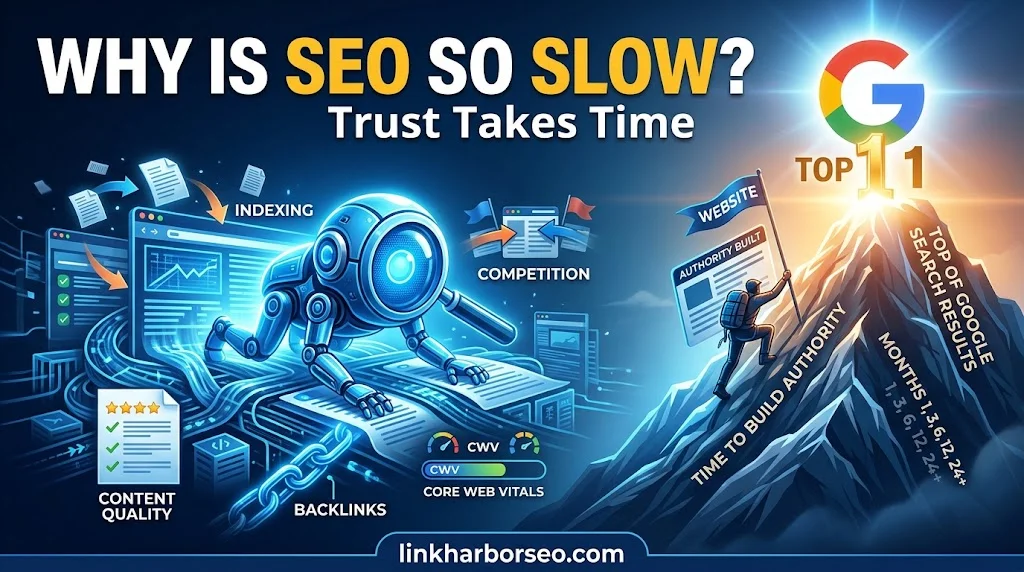
Why is SEO so slow? These are the main reasons:
- Crawling and indexing. Google needs hours to weeks to index new content. If your page is not indexed, it cannot rank.
- Website history. Older sites often have more content and backlinks. Google’s John Mueller has said new sites can see rankings shift for up to a year.
- Competition. A keyword like “insurance” is much harder than “renters insurance for college students in Texas.”
- Content quality and E-E-A-T. Google rewards helpful, people-first content that shows real experience, expertise, authoritativeness, and trust.
- Backlink profile. Links from trusted sites act like votes of confidence. They take time to earn.
- Page experience. Google’s Core Web Vitals set targets for load speed, responsiveness, and layout stability.
- Search intent. If your page does not match what searchers want, it will stall. This is a hidden cause of “slow” SEO.
- Execution speed. A strong plan means little if fixes wait months for approval.
What mistakes slow SEO down? Stopping and restarting campaigns, chasing huge keywords on day one, tracking the wrong KPIs, and trusting agencies that promise page-one rankings by a set date. Google uses 200+ ranking signals, so nobody can guarantee a date.
SEO Timeline: What to Expect Month by Month
A good SEO timeline starts with groundwork and ends with growth. Here is a realistic path.

Months 1 to 2: Foundation. Set up Google Search Console and Google Analytics 4. Run a technical audit. Check crawling, your XML sitemap, and mobile usability. Research long-tail keywords and map them to pages. Fix the biggest issues first.
Months 3 to 4: Content and links. Publish pages built around search intent. Add internal links between related pages. Start outreach for quality backlinks. Expect early movement here.
Months 5 to 6: First proof. You should see growth in impressions, new ranking keywords, and better positions. Clicks follow. Review what works and double down.
Months 7 to 12: Growth. Results begin to compound. New pages lift older ones. Traffic, leads, and sales rise. SEO usually reaches its break-even point at 6 to 12 months because costs come first.
What shows up first in SEO? Impressions usually move before clicks. The order is typically:
Impressions → rankings → clicks → leads → revenue
So do not judge SEO by traffic alone in month two.
What does a healthy month 6 look like? More keywords ranking, steady impressions growth, and some page-one entries. What are red flags? Pages stuck out of the index, flat impressions after six months, or traffic that arrives but never converts. These point to an indexing, targeting, or intent problem.
How does SEO compare to PPC? Paid ads bring traffic the day you pay. SEO takes months, but costs per lead drop as rankings hold. Many brands run both: PPC for fast wins, SEO for lasting growth.
How to Get SEO Results Faster
You cannot force Google’s timeline. You can remove delays and focus on quick wins.

How can I speed up SEO results? Try these steps:
- Target low-competition keywords. Go after specific, long-tail phrases you can win now.
- Win featured snippets. Give a clear, 40 to 60 word answer under a question-style heading.
- Fix indexing. Submit your sitemap in Search Console and remove accidental noindex tags.
- Strengthen internal links. Point links from strong pages to the ones you want to lift.
- Refresh old content. Update stale posts with new facts, since fresh pages often regain traffic.
- Build quality backlinks. Earn links from relevant sites through guest posts, digital PR, and useful resources.
- Improve speed. Aim for a fast load, quick response, and stable layout.
- Add structured data. Schema markup helps search engines read your page and can earn rich results.
How does AI search change SEO timelines? AI Overviews and chat tools pull answers from pages they can read and trust. Clear headings, direct answers, and well-defined entities help your content get picked. This is called answer engine optimization (AEO), and it builds on strong classic SEO.
How much should I spend? Small US businesses often start with a focused plan on a few key pages. Larger sites need a wider budget for content, tools, and links. More resources shorten the timeline, but money alone cannot buy rankings.
FAQs
Is SEO dead now with AI?
No. AI changed how people search, but AI tools still draw from web pages. Those pages need to be crawlable, accurate, and trusted. SEO now includes AI search visibility, not just blue links.
What is the 80/20 rule in SEO?
It is the Pareto principle. A small share of your work, often about 20%, drives most of your results. In practice, that means a few key pages, keywords, and links bring most of your traffic. Fix indexing, improve your best pages, and build strong links first.
Can ChatGPT do an SEO audit?
Only in part. It can review title tags, spot content gaps, suggest schema, and explain data you paste in. It cannot crawl your whole site or read your Search Console data on its own, and it can make mistakes. Use it as a helper, alongside a crawler and Google Search Console.
Is SEO difficult to learn?
The basics take a few weeks. Mastery takes years of practice. Start with Google’s free SEO Starter Guide, then learn by testing on a real site.
Conclusion
So, how long does SEO take to show results? Plan for 3 to 6 months to see movement and 6 to 12 months for strong returns. Start with a clean foundation, match search intent, and stay consistent. Track impressions, rankings, clicks, and leads, not just traffic. Results build slowly, then they compound.
