


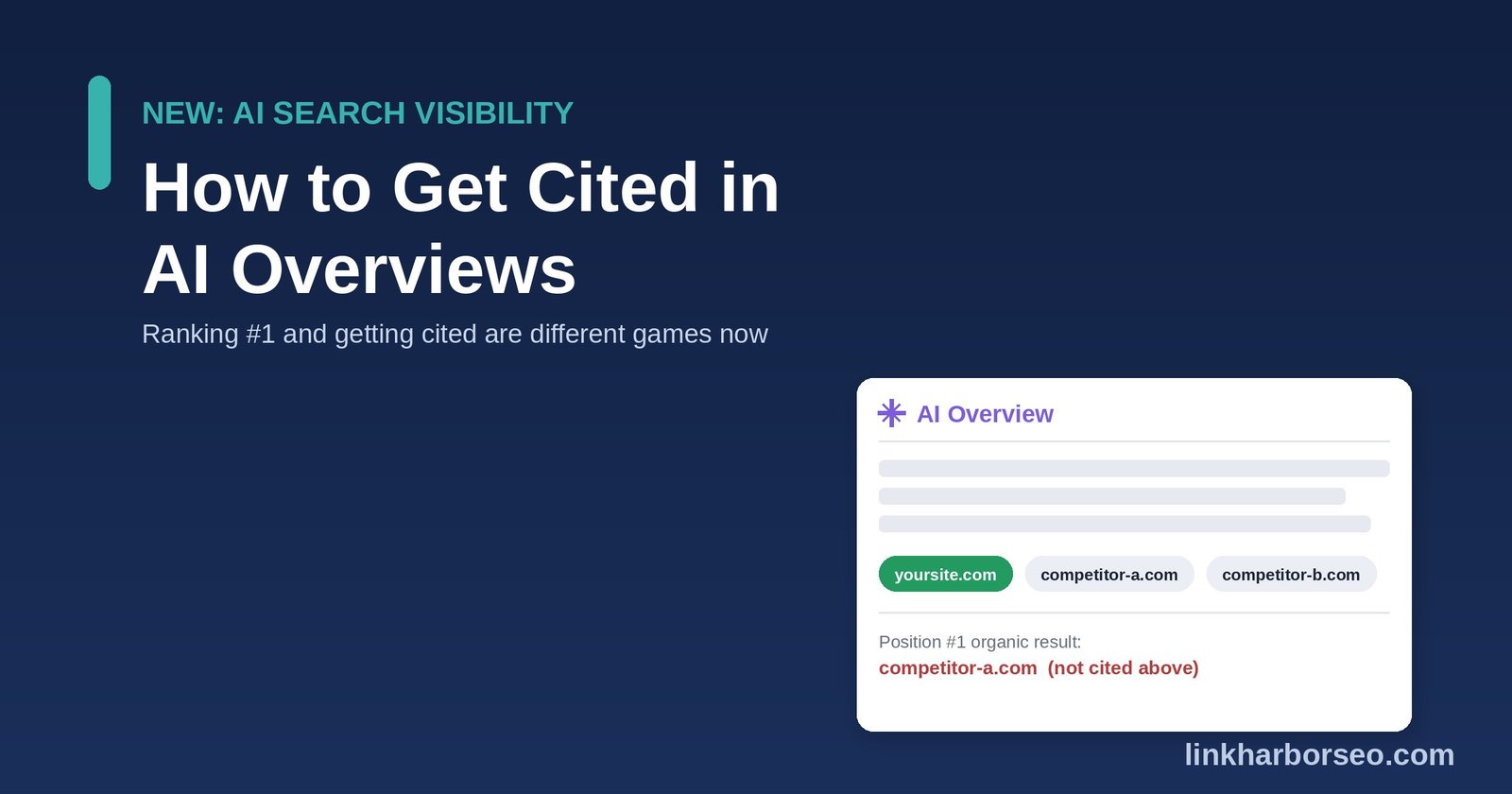
We see this constantly now, and it still catches people off guard. A site finally hits position 1 for its main keyword, sometimes after months of work. The traffic barely moves anyway.
Here’s the usual explanation. Google shows an AI Overview above that result. The AI Overview quotes a different site entirely, one sitting several spots lower. The position 1 listing is technically still there. Almost nobody scrolls down far enough to see it.
That pattern is becoming normal. Ranking and getting cited are turning into two different games, and most site owners are still only playing one of them.
Quick answer: how to get cited in Google AI Overviews comes down to five things — being indexed and crawlable, ranking reasonably well across related queries, showing clear E-E-A-T signals, structuring answers so they’re extractable on their own, and covering a topic comprehensively rather than thinly. No single trick replaces those fundamentals.
What Does It Mean to Get “Cited” in an AI Overview?
An AI Overview citation is a clickable source link Google’s AI includes when it generates a summary answer at the top of search results. Being cited means the AI selected your page as a source, whether or not your page ranks number one for that search.
Those two things, ranking and citation, used to move together. They don’t anymore. Multiple industry analyses tracking large samples of AI Overview citations have found that well under half of cited pages actually sit in the traditional top 10 results for that exact query, a sharp drop from studies run only months earlier. Reports vary on the exact figures, since measurement methods keep changing along with Google’s system, but the direction is consistent across every analysis we’ve seen: the gap between ranking well and getting cited is widening, not shrinking.
Why Ranking #1 Doesn’t Guarantee a Citation
Google’s AI Overview system searches multiple related versions of your query, not just the one you typed, then pulls sources from whichever pages answer those variations consistently. A page ranking outside the top 10 for your exact phrase can still get cited if it covers the surrounding questions well.
This process has a name inside the industry: query fan-out. Type “best CRM for small business” and Google’s AI doesn’t just look at pages ranking for that phrase. It quietly runs related searches too. What’s the cheapest CRM. CRM vs spreadsheet. CRM for a five-person team. Then it looks for pages that hold up across that whole cluster of questions, not just the one you searched.
That explains something that used to seem like a bug. A page sitting at position 40, sometimes further, shows up cited above a page ranking number one. It’s not a glitch. The cited page simply answered more of the surrounding questions a real searcher would have next.
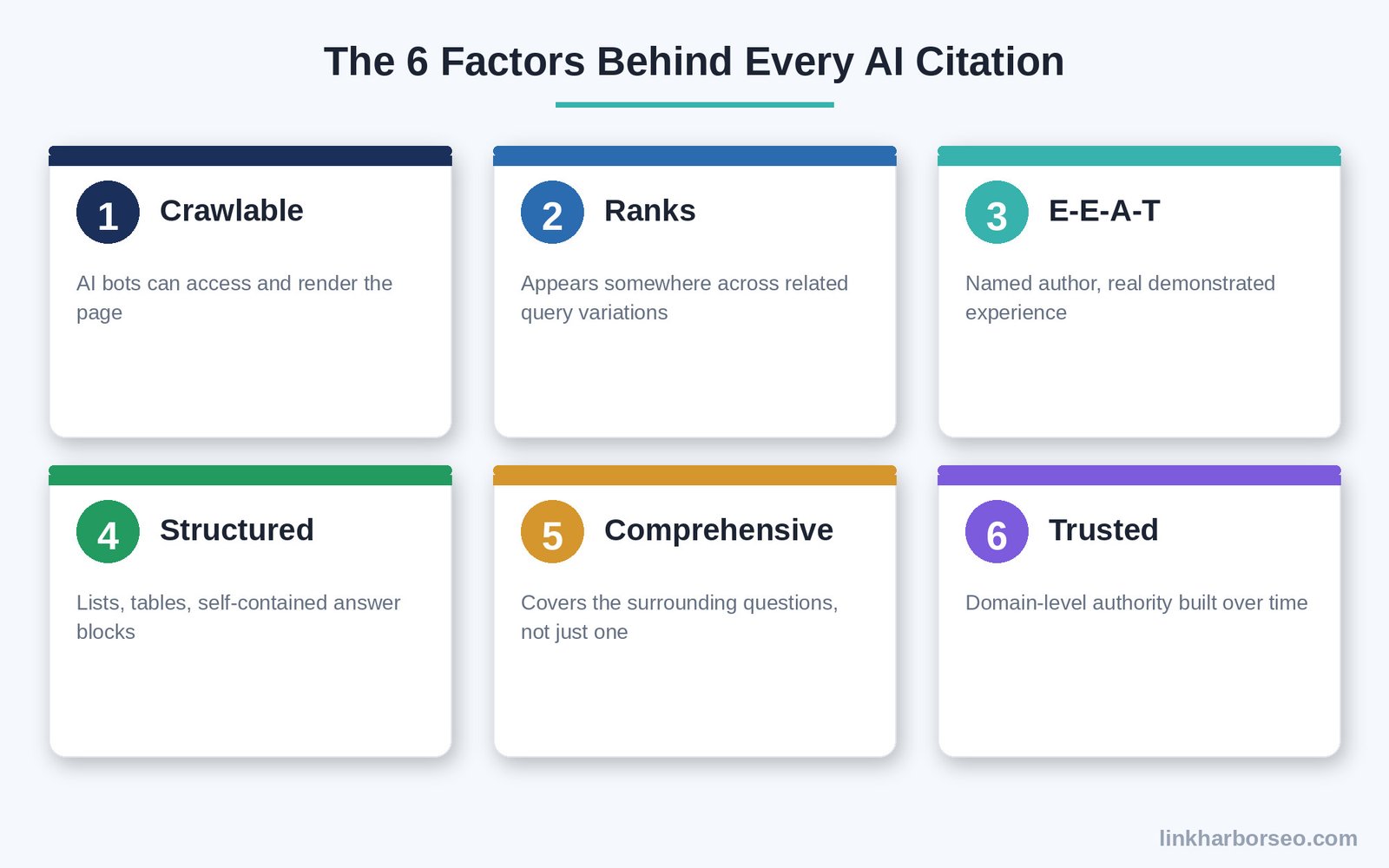
The Six Things AI Overviews Actually Check
Citation depends on being indexed and crawlable, ranking reasonably well across related queries, having clear E-E-A-T signals, structuring content so answers are extractable, and covering a topic comprehensively rather than thinly.
None of this is exotic. It’s mostly SEO fundamentals, just weighted differently than they used to be. Google’s own Search Central documentation on AI features says this almost word for word: there are no special extra requirements to appear in AI Overviews, and the same core SEO practices that always mattered still apply.
Crawlability first. If Googlebot or Google-Extended can’t access your page, none of the rest matters. Check your robots.txt. A surprising number of sites accidentally block AI crawlers while trying to block something else.
Ranking still matters, just not as a gatekeeper. Pages ranking in roughly positions 4 through 20 get cited constantly. You don’t need position 1. You need to be in the conversation Google’s AI is already having with itself across your topic.
E-E-A-T signals. A named author with real credentials, an about-the-author section, and content that demonstrates actual hands-on experience with the topic. Google’s own guidance has said for years it rewards content a person with only secondhand knowledge couldn’t have written. AI Overviews lean on that same signal harder than classic rankings ever did.
Structural clarity. Lists, tables, clear headings, and short self-contained answer blocks. AI systems extract passages, not pages. A passage that makes sense on its own, without needing the paragraph before it for context, is far easier to lift and cite.
Comprehensive coverage. A page that answers the main question and the three questions a reader would naturally ask next beats five separate thin pages every time. This is the same “topic depth over keyword volume” shift that’s reshaping SEO generally in 2026.
Trust at the domain level, not just the page. A single great article on a brand new, unproven site has a harder time than the same article on a site that’s already demonstrated expertise across the topic. This is part of why building a real cluster of related content compounds. It’s not just internal linking. It’s trust accumulating at the site level.
Does This Work the Same Way on ChatGPT and Perplexity?
Mostly, but not identically, and the differences matter if you’re trying to show up everywhere.
Google’s AI Overviews pull heavily from Google’s own index and ranking signals, which means classic SEO work still feeds it directly. ChatGPT and Perplexity behave a little differently. Perplexity runs something closer to a live search-and-summarize process, so freshness and clear structure tend to matter even more than they do for Google. ChatGPT leans more on a mix of training data and, when browsing is active, real-time retrieval, so consistency of information about a topic across the wider web carries extra weight.
The practical takeaway is simpler than it sounds. The same fixes help across all three: a clear direct answer, real specifics instead of vague claims, and a structure an AI system can lift cleanly. Nobody needs a separate strategy for each platform. They need one strong, well-structured page and enough patience to let each system discover it on its own schedule. This whole discipline, optimizing content to be selected and cited by AI systems rather than just ranked, has picked up a name in the industry: GEO, short for generative engine optimization.
How to Actually Structure a Page for Citation
A hundred-page citation study from CXL found something worth building your whole content process around: if your answer isn’t in the first third of the page, there’s a better than even chance it never gets cited at all.
That single finding should change how you write. Not the research, not the setup, not three paragraphs of context before the point. The direct answer, high, in a block that could stand completely alone if someone lifted it out of your page and dropped it somewhere else.
Here’s the structure that keeps showing up in analyses of pages that get cited consistently:
- A direct, bolded answer within the first 100-150 words of any major section, written so it makes sense with zero surrounding context
- Genuine tables where a comparison exists, not tables built just to have one
- FAQ sections using the exact phrasing real people search, each answer self-contained
- Specific numbers instead of vague claims. “Most placements cost $150 to $500” beats “pricing varies” every time an AI system is deciding what to quote
- Schema markup, particularly FAQPage schema, which gives AI systems a structured, unambiguous version of your content to work from
If any of that sounds familiar, it should. It’s close to how we’ve settled into structuring content on this site over time: direct-answer capsules under every heading, comparison tables where they earn their place, FAQ schema on every article. That standard wasn’t originally built with AI Overviews specifically in mind. It turns out to line up closely with what these systems are built to extract.
Do Backlinks Still Matter for AI Citations?
Yes, though indirectly. Backlinks and brand mentions build the domain-level trust and topical authority that make AI systems more willing to cite a page in the first place, even when the direct citation trigger is content structure, not the links themselves.
This trips people up because AI Overviews don’t cite “because of a backlink” the way classic PageRank once worked. But the case for backlinks building authority gets stronger here, not weaker. Authority is exactly what separates two similarly structured pages, one gets cited, one doesn’t. A domain that’s earned real editorial links, the kind covered in our breakdown of what actually builds authority, walks into that trust evaluation with a head start.
Unlinked brand mentions matter here too, arguably more than they used to. AI systems are increasingly trained on and grounded against the broader web, not just the link graph. A brand that gets mentioned across relevant sites, cited or not, builds a footprint these systems recognize. It’s part of why earning links and mentions the slow, editorial way keeps paying off in places automated shortcuts can’t reach.
What This Means If You’re Not Ranking #1 Yet
Here’s the part that should actually feel encouraging if you’re running a newer site.
The old rule was brutal for small sites: rank in the top 3 or don’t bother, because nobody clicks past that. AI Overview citation breaks that rule in a specific, useful way. Since citations regularly come from position 4 through 20, and sometimes further, a well-structured page on a smaller site has a real shot at citation long before it could ever compete for the top organic spot on that same keyword.
That’s a genuinely different opportunity than five years ago. You’re no longer just fighting for the top 3 blue links against sites with a decade of backlinks. You’re competing for extraction, and extraction rewards clarity and specificity more than it rewards raw domain age.
None of this makes backlinks or rankings pointless. It just opens a second door that used to be locked for anyone without an established domain.
The Trade-Off Nobody Talks About
Getting cited isn’t free money, and it’s worth being honest about that before you restructure your whole content strategy around it.
AI Overviews cut organic click-through-rate substantially on the queries where they appear, since a chunk of searchers get their answer without clicking anything. Several independent studies point the same direction on what happens next: pages that get cited inside the overview tend to capture a noticeably larger share of whatever clicks remain than pages sitting further down the page that aren’t cited at all. The overview eats some traffic across the board. Citation claws back a disproportionate share of what’s left.
So the strategy isn’t “stop caring about rankings.” It’s “stop assuming rankings are the whole game.” A page can rank fine and still lose the click to whichever competitor got the citation instead.
A Simple Audit for Your Own Content
Before writing anything new, run this check against your best existing pages.
Open your top three articles. For each one, find the direct answer to its main question. Time how long it takes to locate it while scrolling. If it takes more than a few seconds, or requires reading two paragraphs of setup first, that page is structured for a human willing to be patient. It is not structured for an AI system extracting a passage.
Check whether each major section has a table or list anywhere it plausibly could. Most explainer and comparison content can support at least one. Check whether your FAQ section, if you have one, uses schema markup or just looks like an FAQ visually. Those are treated very differently.
Fix the worst offender first. Don’t rebuild everything at once. One well-restructured pillar page, with real experience baked into it and a name attached to it, will earn more citations than ten mediocre pages published in a rush to chase this trend.
One more check worth doing while you’re at it: search your own target keyword and actually read the AI Overview that appears, if one does. Note which pages it cites. Open those pages. Nine times out of ten you’ll see the same pattern, a direct answer sitting within the first two hundred words, a table or list nearby, and a specific number or named source somewhere in the first section. Once you’ve seen that pattern on five different citations, it stops looking like a coincidence and starts looking like a checklist.
Where to Start This Month
If you take one thing from this guide on how to get cited in Google AI Overviews, make it this: pick your single highest-traffic page. Add a direct-answer block to the top of every major section if it’s missing one. Add FAQ schema if you don’t already have it. Check that a named author with a real bio is attached. Then leave it alone for a month and watch whether Search Console shows any change in how that page performs.
This isn’t a channel you win overnight, and anyone telling you otherwise is selling something. It compounds the same way editorial backlinks do: slowly, then in ways that are hard to reverse once you’ve built it.
The sites that treat this as a real second channel, not a side experiment, are the ones building citation counts that compound the same way a strong backlink profile does. The ones waiting for more certainty before starting are handing that visibility to whoever moves first.
Frequently Asked Questions
How do I get my website cited in Google AI Overviews?
Structure your content with direct answers near the top of each section, use tables and lists where they genuinely fit, add FAQ schema, and make sure a real named author with relevant experience is attached to the page. Being indexed and ranking reasonably well, even outside the top 10, is also required.
Do I need to rank number 1 to appear in an AI Overview?
No. Research from Ahrefs found only 38% of AI Overview citations come from pages ranking in the traditional top 10. Citations regularly come from positions 4 through 20, and sometimes further, based on how well a page answers the surrounding cluster of related questions.
What is query fan-out in AI Overviews?
Query fan-out is the process where Google’s AI runs several related searches based on your original query, then evaluates which pages answer that whole cluster of questions consistently. A page can get cited for a search it doesn’t directly rank for if it performs well across the related variations.
Do backlinks still matter for AI Overview citations?
Yes, indirectly. Backlinks and brand mentions build the domain-level trust and topical authority that make AI systems more willing to cite a page. The direct citation trigger is usually content structure, but authority is often what separates two similarly structured pages when only one gets cited.
How is AI Overview optimization different from regular SEO?
Regular SEO optimizes primarily for ranking position on one query. AI Overview optimization also requires content to be extractable in self-contained passages, comprehensive across a cluster of related questions, and backed by clear author expertise, since AI systems pull specific passages rather than entire pages.
Does getting cited in AI Overviews actually bring traffic?
Cited pages see meaningfully more clicks per impression than similar pages that aren’t cited on the same queries, according to research from Seer Interactive. AI Overviews reduce overall click-through-rate on the queries where they appear, but citation captures a disproportionate share of whatever clicks remain.
What is GEO (Generative Engine Optimization)?
GEO refers to optimizing content specifically to be selected and cited by AI systems like Google AI Overviews, ChatGPT, and Perplexity, rather than just to rank in traditional search results. It overlaps heavily with strong SEO fundamentals but places more weight on structure, extractability, and demonstrated expertise.
